Arabica
The arabica varieties worth knowing
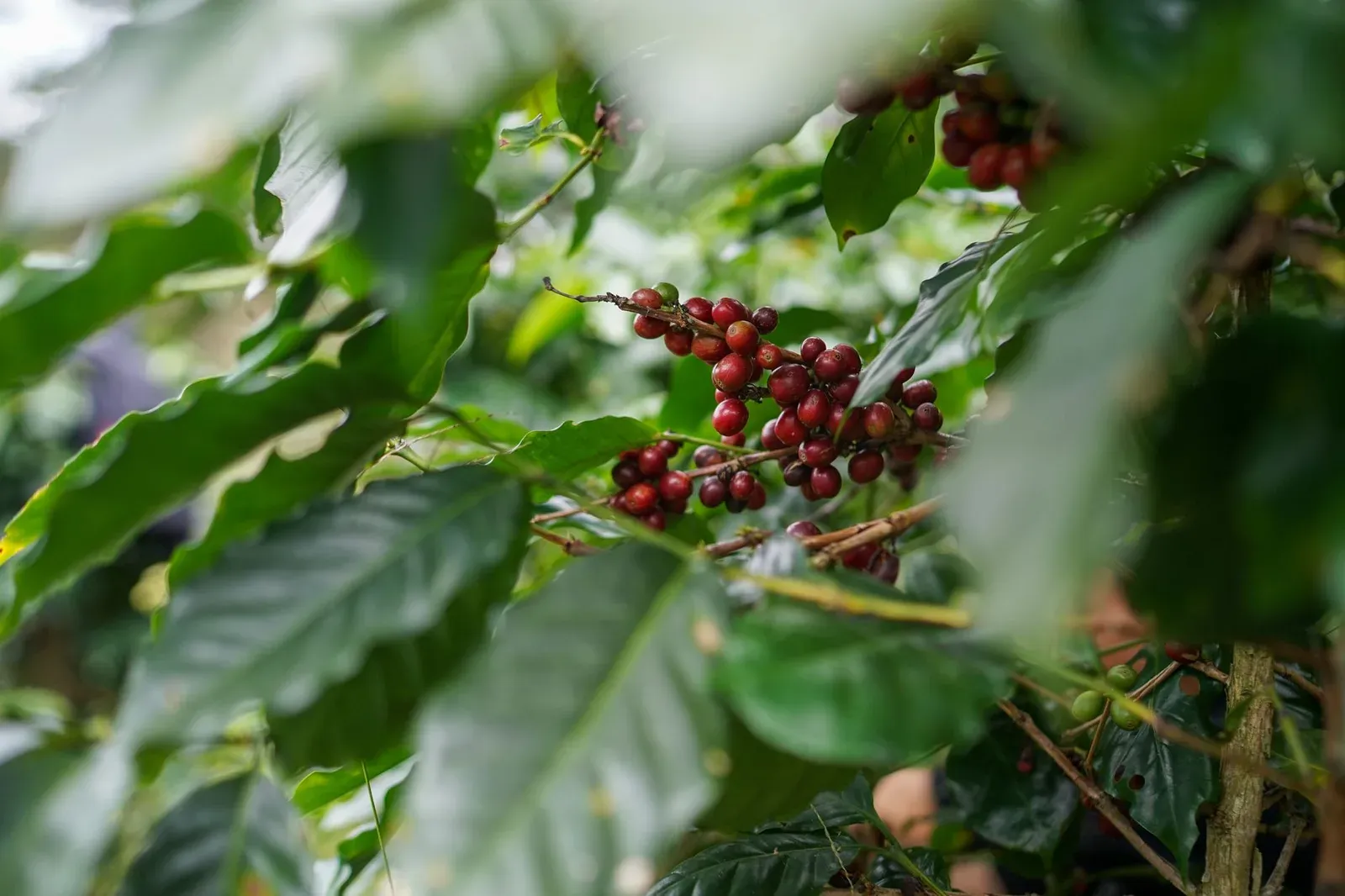
Arabica is a narrow species
Coffea arabica came out of a small population in southwestern Ethiopia, and almost everything cultivated outside Ethiopia descends from a handful of seeds that left it in the seventeenth and eighteenth centuries. One line went through Yemen to Java and then to Amsterdam and on to the Americas, and we call it Typica. Another went through Yemen to Bourbon, now Réunion, and we call it Bourbon.
That is the whole base. Two lines, a few plants each. The genetic diversity of the world’s cultivated arabica is roughly that of a large extended family, which is why one fungus can threaten an entire continent’s crop and why breeding programmes keep going back to Ethiopia for material.
Every name below is either a mutation of those two lines, a cross between them, or a deliberate hybrid with the other species.
The two originals
Typica is tall, sparse and slow. Yields are low, around 600 to 900 kilograms of green per hectare in most of the places it survives, and it is susceptible to almost every disease coffee has. It is still planted because the cup is clean and sweet, and because some very old farms never replanted.
Bourbon yields about 20 to 30 per cent more than Typica and ripens faster. Cherries come in red, yellow and orange depending on the strain. Yellow Bourbon in Brazil is a common bag on a shelf and usually reads as soft, nutty and round rather than bright.
Both are worth knowing mostly as ancestors. Almost every name that follows is one of them, changed.
The dwarf mutations
Coffee is picked by hand on a slope. A shorter plant is picked faster, planted denser and sprayed more easily, so a mutation that shortens the internodes is worth money.
Caturra is a single-gene dwarf mutation of Bourbon, found in Minas Gerais in the 1930s. It yields well, it ripens early, and it is the backbone of Colombia and Costa Rica. Grown high, it is bright and clean. Grown low, it is flat and forgettable, which is the fairest thing anyone can say about it.
Villa Sarchi is the same idea applied in Costa Rica, and Pacas is the same idea applied to Bourbon in El Salvador in 1949. Three countries, three farmers, one mutation found three times.
Catuai is Caturra crossed with Mundo Novo, and Mundo Novo is itself a natural Bourbon by Typica cross found in Brazil. Catuai holds its cherries against wind and rain, which is why it covers so much of Brazil and Central America. It is a farmer’s variety rather than a cupper’s.
The Kenyan pair
SL28 and SL34 were selected at Scott Laboratories in Kenya in the 1930s, SL28 from a drought-resistant Tanzanian line and SL34 from a French Mission Bourbon. Both are deep-rooted, both handle dry seasons, neither resists rust.
SL28 is the reason a Kenyan coffee tastes the way it does. Blackcurrant, tomato, a sharp malic acidity that can read as aggressive in a light roast and as brilliant in a good one. If you have ever wondered why Kenya is a category of its own on a menu, the answer is a seventy-year-old selection that nobody has improved on.
The ones that cost money
Gesha, collected in Ethiopia in the 1930s, sat unnoticed in Costa Rican collections for decades before the Peterson family in Boquete, Panama, entered it in the 2004 Best of Panama. It took the competition apart. Jasmine, bergamot, white peach, a body so light it surprises people the first time.
It also yields badly, grows tall and brittle, and needs altitude above roughly 1,600 metres to produce what made it famous. Plant Gesha low and you get an expensive, thin Typica. This is the clearest case in coffee that a variety is a potential, not a promise.
Pacamara is Pacas crossed with Maragogype, a Typica mutation whose beans are enormous. Pacamara inherits the size and adds a cup that swings between spectacular and herbaceous on the same farm in the same year. Roasters either love it or refuse to buy it.
Sidra and Wush Wush are the current names being asked for at auction. Both are Ethiopian-derived, both are grown in tiny volumes in Colombia and Ecuador, and both carry the same warning as Gesha: the name is doing some of the work the farm has to do.
The hybrids that carry robusta
Leaf rust reached Brazil in 1970 and Central America in 1976, and the epidemic of 2012 to 2013 cut Central American production by a fifth. Breeding a resistant arabica means borrowing from the species that already resists.
The Timor Hybrid is a natural arabica by robusta cross found on Timor in the 1920s. Cross it back with Caturra and you get Catimor; cross it with Villa Sarchi and you get Sarchimor. Colombia’s Castillo and Costa Rica’s Obata are descendants.
Catimor earned a bad reputation in the 1980s, and it deserved it: the early generations were rustic, woody and quick to go flat. The current generations are not the same plants. Blind cuppings in Colombia have put Castillo and Caturra within a point of each other, and the studies keep finding that altitude and processing explain far more of the variance than the variety does.
If you refuse rust-resistant coffee on principle, you are asking farmers to carry a disease risk so that a bag can carry a nicer word.
F1 hybrids, which are different
Centroamericano, Starmaya, Mundo Maya: first-generation crosses between an Ethiopian landrace and a resistant line, propagated as clones or, for Starmaya, from seed via a male-sterile parent. They yield 20 to 50 per cent more than the parent varieties, they resist rust, and they cup well enough to place in competitions.
The catch is that F1 vigour does not survive to the second generation, so a farmer cannot keep seed. Replanting means buying plantlets again. That is an economic question rather than a flavour one, and it is the reason adoption is slower than the agronomy would suggest.
Ethiopian landraces are not varieties
A bag from Yirgacheffe or Guji almost always says heirloom, and that word is an admission rather than a description. Ethiopia has thousands of distinct wild and semi-wild populations, most of them never catalogued, many of them growing in the same plot. A smallholder with a hectare may be farming a dozen genotypes without a name between them.
The Jimma Agricultural Research Center has released around forty selected lines, and the good exporters now name them: 74110, 74112, 74158, Kurume, Dega, Wolisho. When you see one of those numbers, somebody has done the work of separating a population from the forest around it. When you see heirloom, the coffee may be superb, but the label is telling you that nobody knows.
A short table to read a bag with
| Variety | Parentage | What to expect |
|---|---|---|
| Typica | Original line | Clean, sweet, low yield, rare |
| Bourbon | Original line | Round, nutty to sweet, soft acidity |
| Caturra | Bourbon dwarf | Bright when high, flat when low |
| Catuai | Caturra × Mundo Novo | Dependable, rarely remarkable |
| SL28 | Kenyan selection | Blackcurrant, sharp malic acidity |
| Gesha | Ethiopian collection | Floral and tea-like, above 1,600 m |
| Pacamara | Pacas × Maragogype | Huge beans, a cup that gambles |
| Castillo | Catimor line | Rust resistant, better than its reputation |
| Centroamericano | F1 hybrid | High yield, competition-capable |
Two caveats sit under every row. Altitude moves a coffee further than variety does, and a processing choice moves it further still: a washed Caturra and a four-day anaerobic natural from the same tree are not recognisable as the same coffee.
What the name on the bag is worth
A variety tells you what the plant is capable of and roughly how the acidity will be shaped. It tells you nothing about whether the cherries were picked ripe, whether the fermentation was controlled, whether the parchment dried evenly, how long the green sat in a warehouse, or whether the roast found the sugars.
Read it as one line of five. Altitude, variety, process, harvest year, roast date. A bag that gives you all five is from a roaster who knows their supply chain. A bag that gives you only the variety is selling you the word.
Frequently asked
- Does a variety name guarantee a taste?
- No. It sets a range. A Gesha grown at 1,300 metres and over-fermented will lose to a well-farmed Caturra at 1,900. The variety is one variable out of five, and the other four are all in human hands.
- Why is Gesha so expensive?
- It yields poorly, it needs high altitude to express itself, it breaks easily in the wind, and one auction result in 2004 created a demand curve that the supply has never caught up with. The price is agronomy plus reputation, in that order.
Related reading
Fine robusta exists now
A protocol, a grading scale and a handful of serious producers turned the cheap species into something worth cupping. What changed, and what to buy.
Why arabica is the fragile one
Narrow genetics, a tight temperature band and a fungus that never left. What makes the species behind almost all good coffee so hard to grow.
Cupping at home
The protocol professionals use to taste coffee, stripped to what works on a kitchen table, and what it is actually good for.