Arabica
Arabica and robusta, honestly
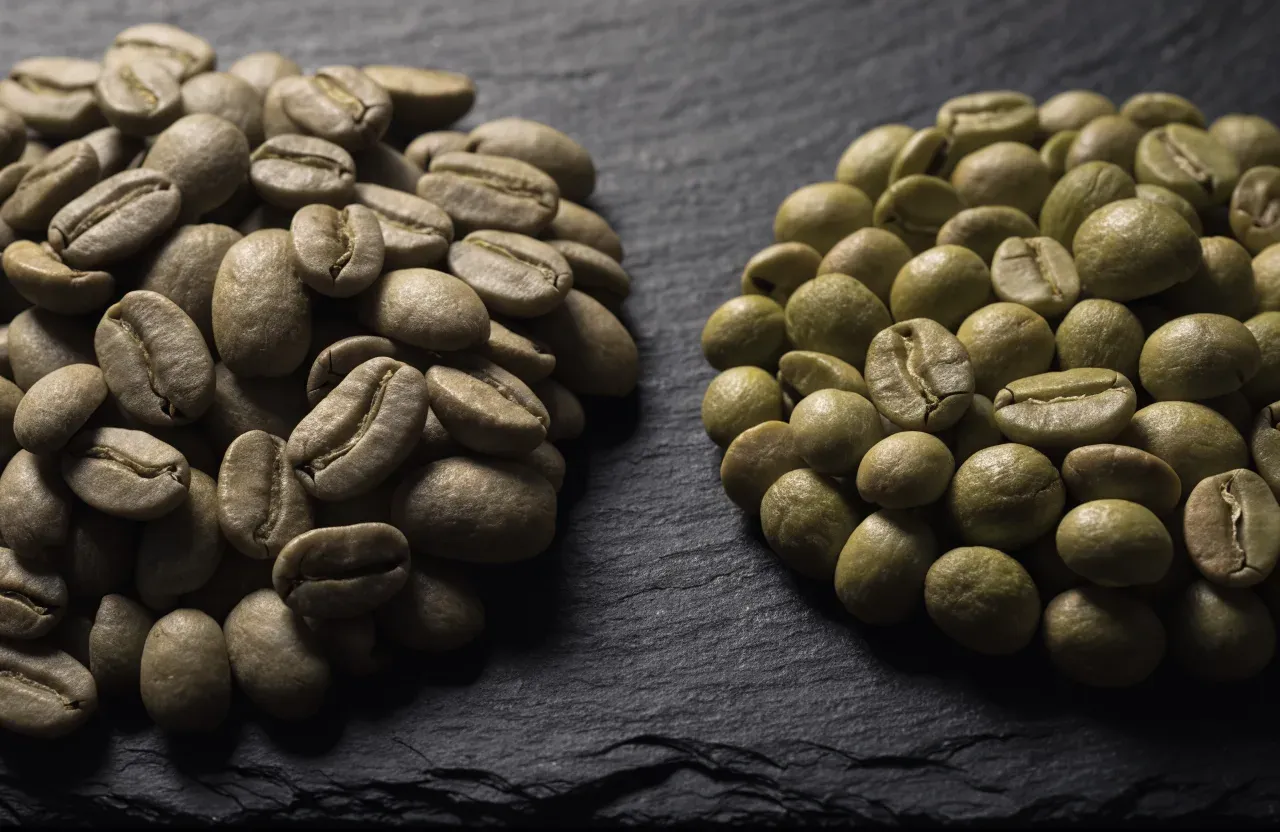
Two species, not two grades
Coffea arabica and Coffea canephora, which everyone calls robusta, are different plants rather than two qualities of the same one. Arabica is a natural hybrid, self-pollinating, and it wants cool nights, high ground and shade. Robusta is lowland, heat-tolerant, cross-pollinating, and far harder to kill. Between them they account for essentially all the coffee traded, arabica at somewhere around sixty per cent of world production and robusta at most of the rest.
You can tell the green beans apart by eye. Arabica is oval with a wavy centre crease; robusta is rounder and smaller, with a crease that runs straight. That is a useful party trick and tells you nothing about how the cup will taste, which is the recurring problem with this whole comparison.
What actually differs
The chemistry is where the argument becomes concrete, and it is short.
| Arabica | Robusta | |
|---|---|---|
| Caffeine, dry weight | roughly 1.2-1.5% | roughly 2.2-2.7% |
| Chlorogenic acids | lower | markedly higher |
| Sugars | higher | roughly half |
| Lipids | higher | lower |
| Typical altitude | 900-2200 m | sea level to 800 m |
| Disease resistance | poor, leaf rust is a constant threat | strong |
| Yield per hectare | lower | higher |
| Commodity price | higher | lower |
Sugars and lipids are what a roaster develops into sweetness, aroma and mouthfeel, so arabica simply has more raw material for the flavours people describe as complex. Chlorogenic acids degrade during roasting into compounds that read as bitter and astringent, so robusta starts with a heavier load of the thing you spend a roast trying to manage. Caffeine is itself bitter, though it contributes less to perceived bitterness than people assume.
The rest of the table is agronomy, and it is why robusta exists in the market at all. A plant that survives heat, resists leaf rust and yields more per hectare is a plant a farmer can rely on in a warming climate, which is a serious argument that has nothing to do with taste.
Why robusta got its reputation
Almost none of it is the species. Robusta became the raw material of cheap instant coffee and of supermarket blends sold on price, and coffee grown to a price is picked indiscriminately, dried on bare ground, and sorted loosely if at all. Unripe cherries, over-fermented lots and defective beans make coffee that tastes woody, rubbery and flat, and that is the flavour a generation learned to call robusta.
Meanwhile the entire specialty movement, with its emphasis on altitude, varietal, careful processing and traceability, organised itself around arabica. The comparison hardened into a rule: arabica good, robusta bad. It is a reasonable shortcut for a supermarket shelf and a poor description of what the two plants can do, which matters if you want to understand what the word specialty is actually claiming. We unpack that in what specialty coffee actually means.
Fine robusta complicates the story
Over the last two decades a small group of producers, mostly in India, Uganda and Vietnam, have applied specialty-grade practice to canephora: selective picking of ripe cherry, washed and honey processing, careful drying, altitude where the terrain allows it. A grading protocol for fine robusta exists, run separately from the arabica one, with its own cupping form because the sensory vocabulary does not transfer.
Good fine robusta does not taste like arabica, and the people who make it are not trying to. It is lower in acidity, heavier in body, and its best flavours run towards cereal, dark chocolate, nuts, tobacco and a distinctive salted note. It is genuinely good coffee. It is also rare, expensive, and it does not overturn the general rule: at any given price, the arabica lot is still usually the more interesting cup. What fine robusta proves is that the species was never the problem, and the processing was.
Where a percentage genuinely helps
In espresso, and specifically in espresso with milk. Three reasons, and they are all structural rather than aromatic.
Robusta’s lower lipid content and different protein profile produce a crema that is thicker and lasts longer, which is why a traditional Italian blend pours with that dense tiger-striped head. It adds body, a physical weight in the mouth that holds up when you cut the shot with 120 ml of textured milk. And it contributes a firm bitterness that survives that dilution, so the coffee still reads as coffee in a cappuccino rather than vanishing into sweetness. If your milk drinks taste hollow, the base is often the reason, which is the argument in why your latte tastes thin.
Ten to thirty per cent is the usual range. Above that the bitterness stops being a backbone and becomes the flavour. Below about five per cent it does nothing you could reliably pick out. And the quality of the robusta matters more than the percentage: five per cent of a bad lot is detectable, and twenty per cent of a good one is a blend you would happily buy. Which is where the blend question starts properly, and we take it up in single origin or blend.
Frequently asked
- Is arabica always better than robusta?
- On average, and for the coffee most people encounter, yes. Arabica has more sugar and more aromatic complexity, and almost all of the world's carefully grown lots are arabica. But the comparison people are really making is between well-grown arabica and badly grown robusta, which is not a species comparison at all.
- Does robusta have more caffeine?
- Substantially more, on the order of twice as much by weight, which is a defence the plant evolved against insects. That is also why it tastes more bitter and why it is the traditional choice where a strong, harsh style of coffee is the local norm.
- Why do Italian espresso blends contain robusta?
- For body, for a thicker and longer-lasting crema, and for a bitterness that still reads through milk and sugar. A shot of pure light-roasted arabica can disappear in a cappuccino. Ten to thirty per cent robusta gives the drink a spine, which is a stylistic choice rather than a cost-cutting one, although it is often both.
Related reading
Cupping at home
The protocol professionals use to taste coffee, stripped to what works on a kitchen table, and what it is actually good for.
How much caffeine is in your cup
A double espresso holds less caffeine than a mug of filter, and roast level barely matters. The numbers, and where the intuitions go wrong.
How to read a bag of coffee
Roast date, process, altitude, varietal and the tasting notes: what each line on a bag is actually claiming, and which ones are worth paying for.