Arabica
Why arabica is the fragile one
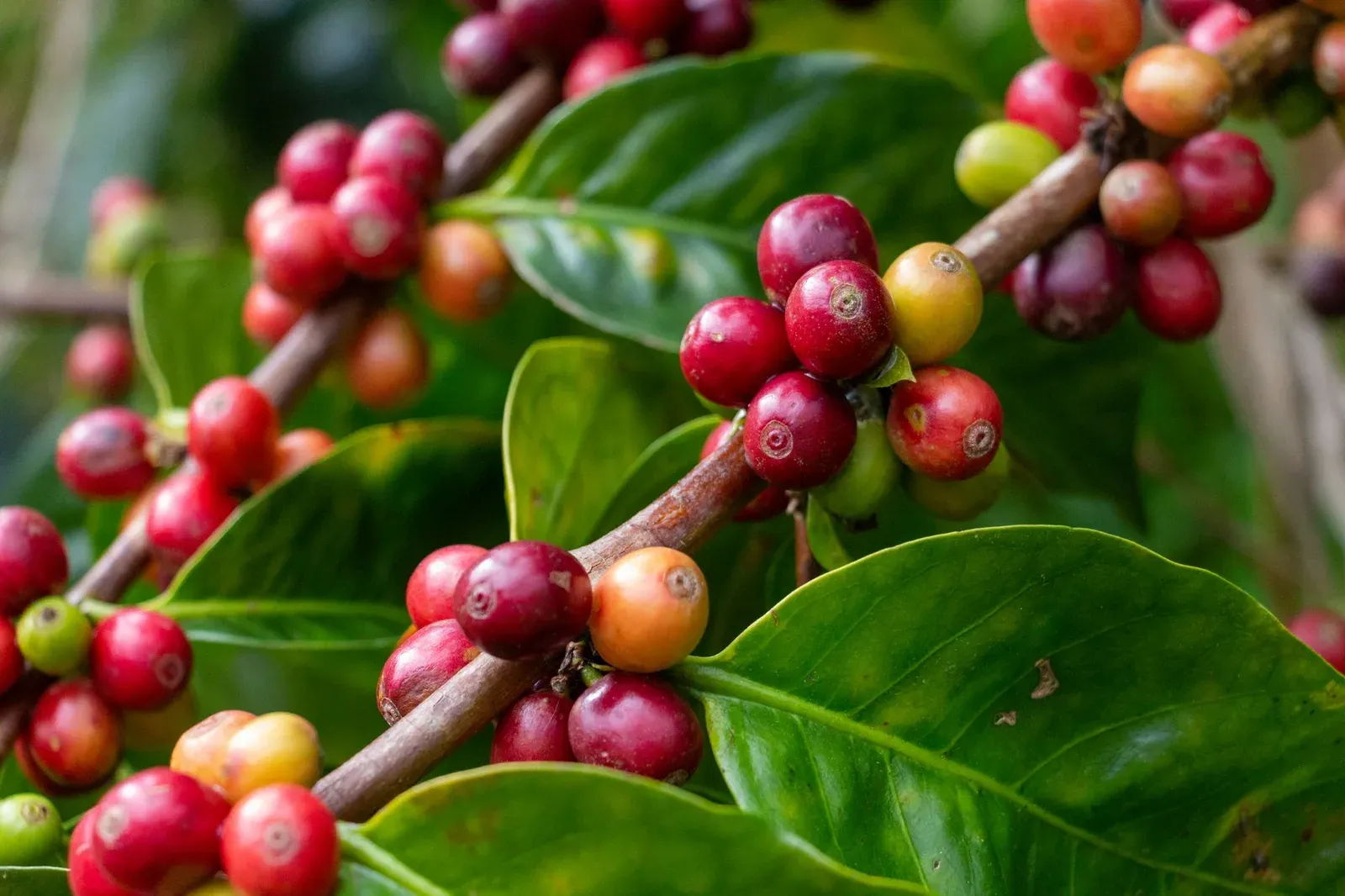
A plant with a very short list of demands
Arabica is not delicate in the sense of needing pampering. It is delicate in the sense that its acceptable range is narrow and it does not negotiate.
- Temperature: roughly 18 to 22 °C as a yearly mean. Above 24 °C the plant respires away more than it photosynthesises and the cherries ripen too fast for sugars to accumulate. Below about 4 °C the leaves die.
- Rain: 1,200 to 2,000 mm a year, with a dry spell to trigger flowering. Too even a rainfall and the tree flowers in scattered waves, which means a picker has to pass the same row four times.
- Shade and slope: originally a forest understorey plant, so full sun works only where it is engineered with irrigation and fertiliser.
On the equator, 18 to 22 °C means somewhere between 1,200 and 2,200 metres. Robusta grows happily at 200 metres in the heat and takes twice the yield per hectare while it does. Everything hard about arabica comes back to that comparison.
Altitude is the whole economy
The band that suits the plant is on a mountain, and a mountain is where a machine cannot go. Brazil harvests flat Cerrado farms with a straddle machine; Colombia, Guatemala and Ethiopia harvest by hand, cherry by cherry, on slopes of 30 degrees or more.
Hand-picking is what makes selective harvesting possible, which is a real quality advantage. It is also 50 to 70 per cent of the farm gate cost of a specialty coffee, and it depends on people being willing to do it at the price offered.
Altitude gives you the cup and takes away the margin. That trade is the single most important fact about arabica as a business.
Narrow genetics, wide consequences
Arabica is an allotetraploid, a natural cross between two other species that happened once, in the wild, a very long time ago. It self-pollinates, which means a field of Caturra is close to a field of clones.
The practical consequence is simple: when something beats one plant, it beats all of them. There is no genetic variation in the field to slow it down, and no broad reservoir of resistance in the cultivated pool to breed from. That is why resistance has to be imported from robusta, and why every rust-resistant variety in Latin America traces back to one hybrid found on one island.
The rust
Hemileia vastatrix destroyed Ceylon’s coffee industry in the 1870s and turned the country into a tea producer. It reached Brazil in 1970, Central America in 1976, and it has never left.
The 2012 to 2013 epidemic cut Central American production by about 20 per cent, pushed roughly 350,000 people out of work and cost an estimated 500 million dollars. It was not an unusual fungus year. It was a normal fungus meeting warmer nights, which let it survive at altitudes that used to be safe.
That last point is the one that matters going forward. Rust is not moving faster. The altitude at which coffee is safe from it is moving up.
The borer, and the rest of the queue
The coffee berry borer is a beetle that lays its eggs inside the cherry, where no spray reaches. It costs an estimated 500 million dollars a year on its own and it has followed the same warming path uphill.
Behind it: coffee leaf miner, nematodes in replanted soil, anthracnose in wet harvests, and frost in Brazil roughly once a decade, which is enough to move the world price on its own.
The biennial habit
A coffee tree that produces heavily one year produces poorly the next. The heavy crop drains reserves the tree spends the following season rebuilding.
Farmers manage it with staggered pruning across the plot rather than curing it, because it is not a disease. It means that a farm’s income arrives unevenly, and that a good year is partly a debt against the next one. Anyone reading coffee production statistics without knowing this will misread every second year.
Where the map is going
The usual projection is that about half the land currently suitable for arabica will be unsuitable by 2050, and that the suitable land will not vanish so much as move: up the same mountains, and further from the equator.
Both of those moves have limits a spreadsheet does not show. A mountain runs out of mountain, and the ground above a current coffee belt is often national park, cloud forest or bare rock. Moving away from the equator means moving into countries with no picking workforce, no wet mill, no exporter and no co-operative, which takes a generation to build rather than a season.
The responses that are actually being deployed are unglamorous: shade trees back in the plot, since a canopy holds two to four degrees off the leaf temperature; rootstock grafting onto robusta roots for nematode-heavy soils; and the F1 hybrids, which exist because the sequence of a normal breeding programme, about 25 to 30 years from cross to release, is slower than the problem.
What it means in the cup, and on the shelf
Every constraint above is a reason your bag costs what it costs. A washed Colombian at 1,800 metres represents hand-picking on a slope, a fungicide programme, a two-year lag between planting and the first real harvest, and a tree that will be stumped and regrown in fifteen to twenty years.
It also explains why the industry keeps investing in robusta quality and in F1 hybrids. Not because anyone prefers them, but because the band arabica lives in is getting narrower, and the plant has never once agreed to widen it.
Related reading
The arabica varieties worth knowing
Typica, Bourbon, Caturra, Gesha, SL28 and the rust-resistant hybrids. What a variety name on a bag tells you, and what it cannot.
Arabica and robusta, honestly
Two species, one long-running argument. What actually differs between them, why robusta earned its reputation, and where a percentage of it improves a blend.
From cherry to green bean
What happens between the tree and the sack: picking, washed, natural and honey processing, and what drying and grading do to the cup.