Cleaning
Backflushing, step by step
What it does, and what it does not
Backflushing pushes water backwards through the group head, using a blind basket that has no hole in it. Pressure builds, the machine’s three-way valve opens, and the water is forced back up past the shower screen and out through the valve, taking what it finds with it.
What it removes is coffee oil and fine grounds from the parts of the brew path you never see: the underside of the screen, the group’s internal channels, the valve itself. That gunk is the reason a machine that made excellent espresso two years ago now makes something faintly rancid that no dialling in fixes.
What it does not do is descale. Scale is mineral, it comes from water rather than coffee, it accumulates in the boiler rather than the group, and it needs an acid rather than a detergent. The two jobs are unrelated and people conflate them constantly, usually with the result that neither gets done properly.
First, check your machine can
This matters more than any other step, because doing it on the wrong machine achieves nothing and stresses the pump.
Backflushing needs a three-way solenoid valve. You can check by ear: pull a shot, stop it, and listen for a brief hiss from the drip tray about a second later. That is the valve dumping pressure off the puck, which is also why the puck comes out dry.
Most pump machines with a solenoid have it. Most entry-level machines with a pressurised basket and a soggy puck do not. Lever machines generally do not either. If yours does not, the equivalent routine is to remove the shower screen and dispersion block by hand, soak them in detergent, and wipe the group. Slower, same outcome.
The daily version, with water only
Sixty seconds, no chemicals, at the end of every session.
- Fit the blind basket in the portafilter and lock it into the group.
- Run the pump for five seconds, then stop for five. Repeat five times.
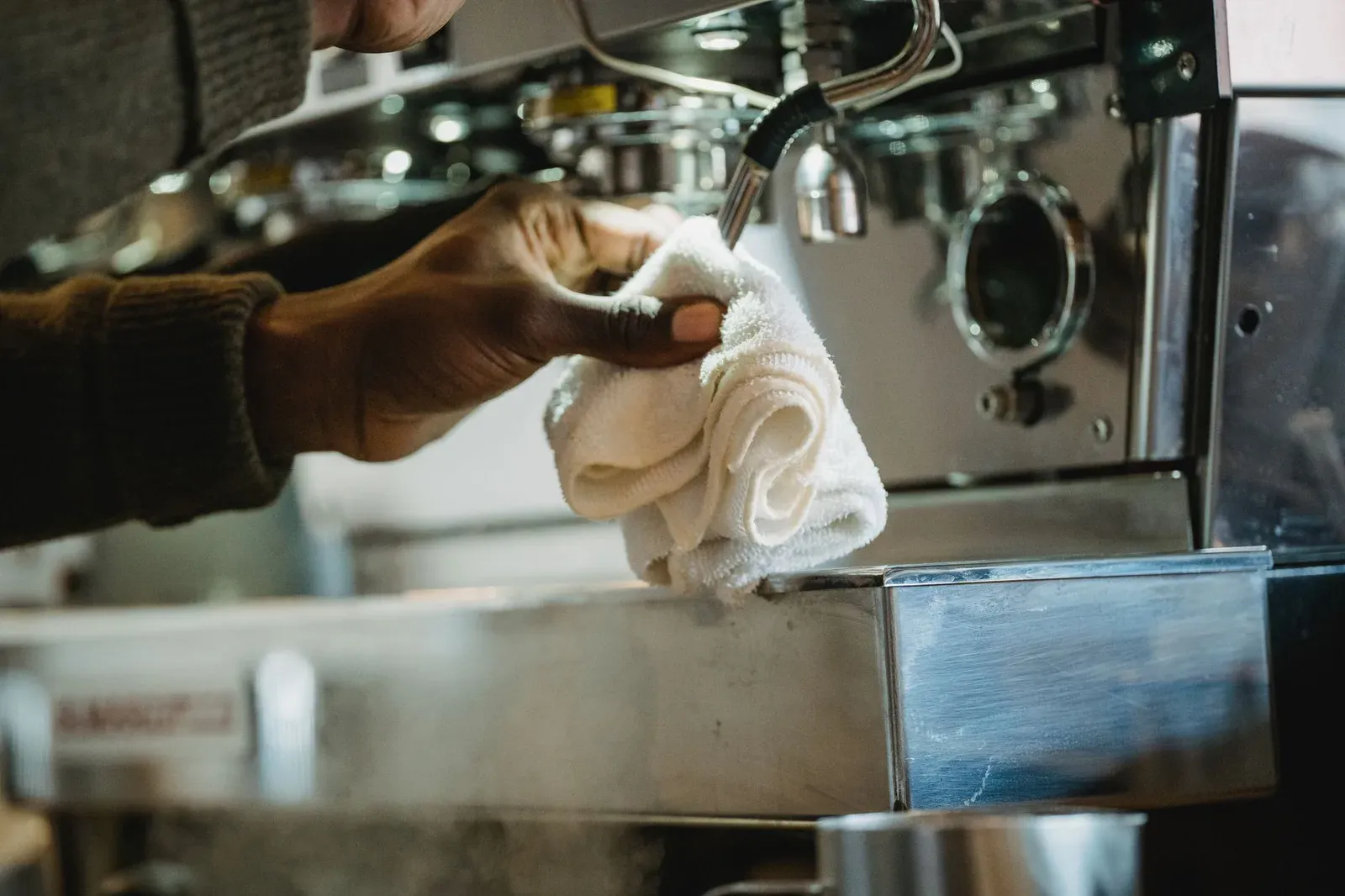
- Remove the portafilter and wipe the shower screen and the gasket with a cloth.
- Flush the group for two seconds to clear what the wipe loosened.
The stop-start matters. A continuous thirty second run just holds pressure against the valve; short bursts create the surges that actually dislodge material. This is the version to do every day, and on a home machine it is most of the benefit.
The weekly version, with detergent
Once a week, or after any session where you have pulled a lot of shots.
Use a detergent made for espresso machines, which will be a sodium percarbonate powder sold as a group head cleaner. The dose is small, about half a gram, roughly a level scoop from whatever the tub came with. More is not better and makes the rinse considerably harder.
- Put the detergent in the blind basket and lock it in.
- Run five seconds on, ten seconds off, five times. Longer rests here, because the chemistry needs contact time more than the water needs pressure.
- Remove the portafilter and look at what comes out. On a machine that has not had this done in a while it will be genuinely brown.
- Rinse the portafilter and blind basket under the tap.
- Refit the blind basket and repeat the five-by-five cycle with nothing in it.
- Do that rinse cycle twice more. Three rinse cycles is not excessive.
- Pull a shot of water through the naked group and discard it.
- Pull one real shot and discard that too.
Step six is the one people cut short, and it is the one that produces the complaint that espresso tasted of soap for a week. Percarbonate residue is persistent and it hides in the group’s channels rather than sitting on the screen where you can see it.
| Interval | Action | Time |
|---|---|---|
| Every session | Water-only backflush, wipe the screen | 1 min |
| Weekly | Detergent backflush plus three rinses | 5 min |
| Monthly | Remove the screen, soak it, clean the gasket seat | 20 min |
| Yearly | Replace the gasket and the shower screen | See the yearly jobs |
The gasket is what you are protecting
Worth stating plainly, because it reframes the whole routine as maintenance rather than hygiene.
The group gasket is rubber, it sits directly against hot metal and hot coffee, and it hardens over time. A hardened gasket stops sealing, the portafilter starts needing more force to lock, and eventually it drips down the side during a shot. That is a cheap part to replace, but the process of getting a fused gasket out of a group is genuinely unpleasant and occasionally destructive.
Coffee oil accelerates the hardening, and coffee oil is exactly what backflushing removes. A machine backflushed weekly typically gets four or five years out of a gasket. One that never is often needs one in eighteen months, and by then the shower screen and dispersion block usually want replacing as well.
Five minutes a week, against a part that has to be levered out with a screwdriver. It is one of the better trades in the whole hobby.
Frequently asked
- How do I know if my machine can be backflushed?
- Pull a shot, and listen for a short hiss from the drip tray a second after you stop. That is the three-way valve releasing pressure, and a machine that does it can be backflushed. If the puck is soupy when you knock it out and nothing hisses, it cannot, and forcing the issue with a blind basket puts the pressure back through the pump instead.
- Can I use dishwasher tablets or vinegar instead?
- No to both. Dishwasher detergent is formulated for a machine that rinses under far more water than an espresso group ever will, and it foams in ways that are hard to clear. Vinegar is an acid and belongs in a descaling conversation, not this one: it does nothing useful to coffee oil and will attack brass and seals if left sitting.
Related reading
Bean to cup: what breaks, and when
The four failures that account for most dead bean to cup machines, roughly when each one arrives, and which of them you can prevent.
Bringing a 1970s lever back to life
A fifty-year-old lever machine is mostly brass, a spring and four seals. Here is the order to work in, and the two faults that mean walk away.
Buying a used espresso machine
Second hand is the cheapest route to a serious machine, and the fastest route to a boiler you cannot replace. What to check, what to walk away from.