Coffee around the world
How the world actually drinks coffee
Espresso is not the world’s coffee, and Ethiopia shows why
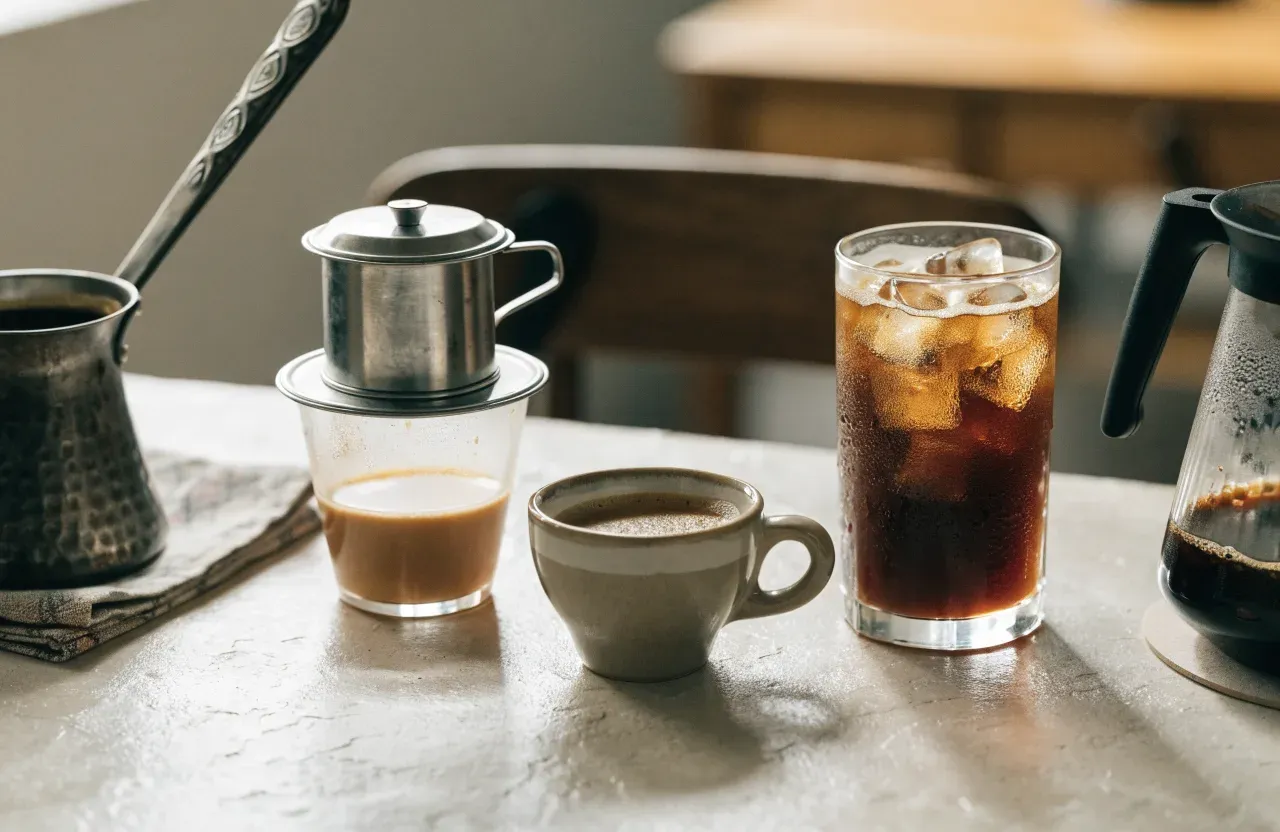
Read enough coffee writing in English and you could conclude the planet divides into espresso drinkers and filter drinkers. It does not. Several of the oldest and largest coffee cultures on earth filter nothing, sweeten during brewing rather than after, and serve in quantities that would look like a mistake in a London cafe. The common thread across the seven below is that the vessel explains the drink.
In the country the plant comes from, coffee is most often made at home, from green beans, in front of the people who will drink it. Green coffee is washed and roasted in a flat pan over coals while the room fills with the smell, and the roasted beans are carried round for everyone to take in. They are pounded in a wooden mortar, the mukecha, then boiled in a round-bellied clay pot with a narrow neck, the jebena, and poured from a height into small handleless cups so that the grounds stay behind in the pot.
Three rounds are served from the same grounds, traditionally named abol, tona and baraka, the last carrying a sense of blessing. Incense burns, popcorn is handed round, and the whole thing takes the better part of an hour, which is the point of it. Jebena buna is a way of holding people in a room, and it is the ancestor of every coffeehouse described in a history of coffee in five moments.
The cezve: Turkey, Greece, the Balkans and the Levant
From Yemen the drink moved north, and the method that travelled with it is the oldest one still in daily use. Coffee is ground to a powder finer than espresso, measured into a small long-handled pot with cold water and, crucially, any sugar, because it is sweetened during brewing and not after. The pot is brought slowly to the point where a foam rises, which is lifted off and shared between the cups, and then usually returned to the heat once or twice more.
Nothing is filtered. The grounds settle, the last centimetre is not drunk, and a glass of water comes alongside. Sweetness is ordered as a grade rather than added at the table, from unsweetened through medium to sweet. The pot is a cezve in Turkish, a briki in Greek, and the drink itself carries a different national adjective in every country that makes it, which is a live political matter and not a detail to be smoothed over. Greece, meanwhile, spends most of the summer drinking the shaken iced frappé it invented in Thessaloniki in the 1950s, and the espresso freddo that has largely overtaken it.
Italy: the counter, and ninety seconds
The Italian caffè is a small volume of dark-roasted coffee drunk standing at a bar counter, often in less time than it took to order. Two prices are normal: one at the counter and a higher one for table service, which is why visitors sometimes think they have been overcharged for sitting down. Milk drinks belong to the morning, an idea Italians hold more loosely than the internet claims but which is real enough. In Naples the caffè sospeso, a coffee paid for in advance for whoever comes in next needing one, is a genuine local custom rather than a marketing story.
| Place | Vessel | What arrives |
|---|---|---|
| Ethiopia | Clay jebena | Small unfiltered cups, three rounds from one pot |
| Turkey and Greece | Cezve or briki | Thick sweetened coffee with foam, grounds settled, water alongside |
| Italy | Espresso machine | About 25 ml, dark roast, drunk standing |
| Nordic countries | Batch or pour-over filter | A large light-roast filter cup, refilled |
| Vietnam | Phin | Strong robusta dripped over condensed milk, usually iced |
| Cuba | Stovetop or espresso | A thimble of coffee whipped to a sugar foam, often shared |
| Australia | Espresso machine | Flat white, long black, a sit-down cafe meal |
The Nordic countries: filter, light roast, and most of it
Finland drinks more coffee per person than anywhere else, with Norway, Iceland, Denmark and Sweden close behind, and almost all of it is filter. Roasts are light by European standards, which suits the method and gives a clean, acidic, tea-like cup that a dark roast would bury. The drink is domestic and constant: pots at work, pots at home, and in Sweden the institution of fika, a proper pause with something sweet rather than a paper cup carried to a desk. Scandinavian roasters were also central to the shift described in cafe culture and the three waves.
Vietnam, Cuba and Australia
Vietnam grows robusta at enormous scale, a legacy of French colonial planting, and drinks it accordingly. A small metal phin filter sits on the glass and drips a very strong, low-acid, chocolatey brew onto sweetened condensed milk, which is stirred up and poured over ice as cà phê sữa đá. Hanoi adds cà phê trứng, egg yolk whipped with condensed milk into a warm custard on top of the coffee, invented in the 1940s when fresh milk was scarce.
Cuban cafecito is espresso or stovetop coffee, with sugar whipped into the first few drops to make a pale foam called espuma, then served in thimble cups. A colada is the same coffee in a larger cup with a stack of small ones, bought for a workplace and shared out, which makes it a social object rather than a drink size.
Australia and New Zealand built their cafe culture on post-war Italian and Greek migration, and it grew into something distinct: espresso-based, milk-forward, seated, and attached to a serious breakfast menu. The flat white came out of that scene in the 1980s, with Sydney and Auckland both claiming it and neither able to prove it. If the difference from a latte is the part you want settled, it is taken apart in flat white against latte.
Frequently asked
- Why is Vietnamese coffee made with condensed milk?
- Fresh milk was scarce and hard to keep in a hot climate with limited refrigeration when coffee drinking spread under French colonial rule, and sweetened condensed milk kept indefinitely. It also suits the coffee: a strong, low-acid, chocolatey robusta brewed in a phin stands up to sugar and dairy in a way a delicate washed arabica would not.
- What is the difference between Turkish and Greek coffee?
- In preparation, very little. Both are coffee ground to a powder, brought to the foam in a small long-handled pot and served unfiltered with the grounds settling in the cup. The names are political rather than technical, and the pot is called a cezve, a briki or an ibrik depending on where you are standing.
- Did the flat white come from Australia or New Zealand?
- Both claim it, with competing accounts from Sydney and Auckland in the 1980s, and no decisive documentary evidence has settled it. What is clear is that the drink and the cafe culture around it grew together in both countries in the same decade.
Related reading
The Ethiopian coffee ceremony, from green bean to third cup
Green beans roasted in a pan, pounded by hand, boiled in a clay jebena and poured three times. How buna is made, and why it takes an hour.
Cupping at home
The protocol professionals use to taste coffee, stripped to what works on a kitchen table, and what it is actually good for.
How much caffeine is in your cup
A double espresso holds less caffeine than a mug of filter, and roast level barely matters. The numbers, and where the intuitions go wrong.