Coffee around the world
The Ethiopian coffee ceremony, from green bean to third cup
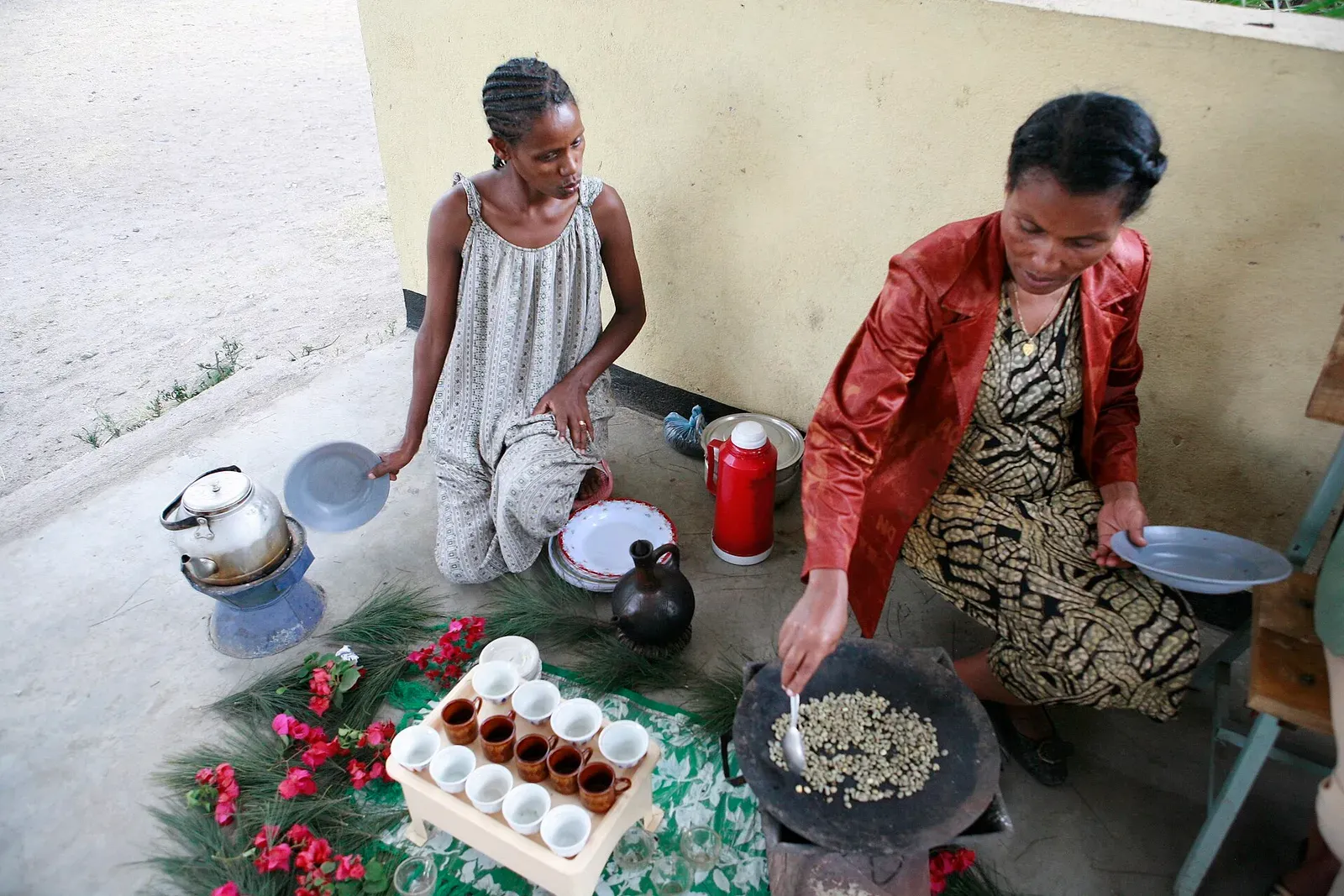
The question every visitor asks is how long the coffee will be, and the honest answer is that the question is the wrong way round. The coffee takes an hour, sometimes more, because the hour is the point. Nobody at a coffee ceremony is waiting for a drink; they are there for the time it takes to make one.
Ethiopia is where arabica comes from, and it is one of the few producing countries that drinks a large share of its own harvest. Most of that coffee is made at home, by hand, in a form that has barely changed in a century. The word for coffee in Amharic is buna, and a coffee ceremony is often just called that: come for buna.
The setting comes before the coffee
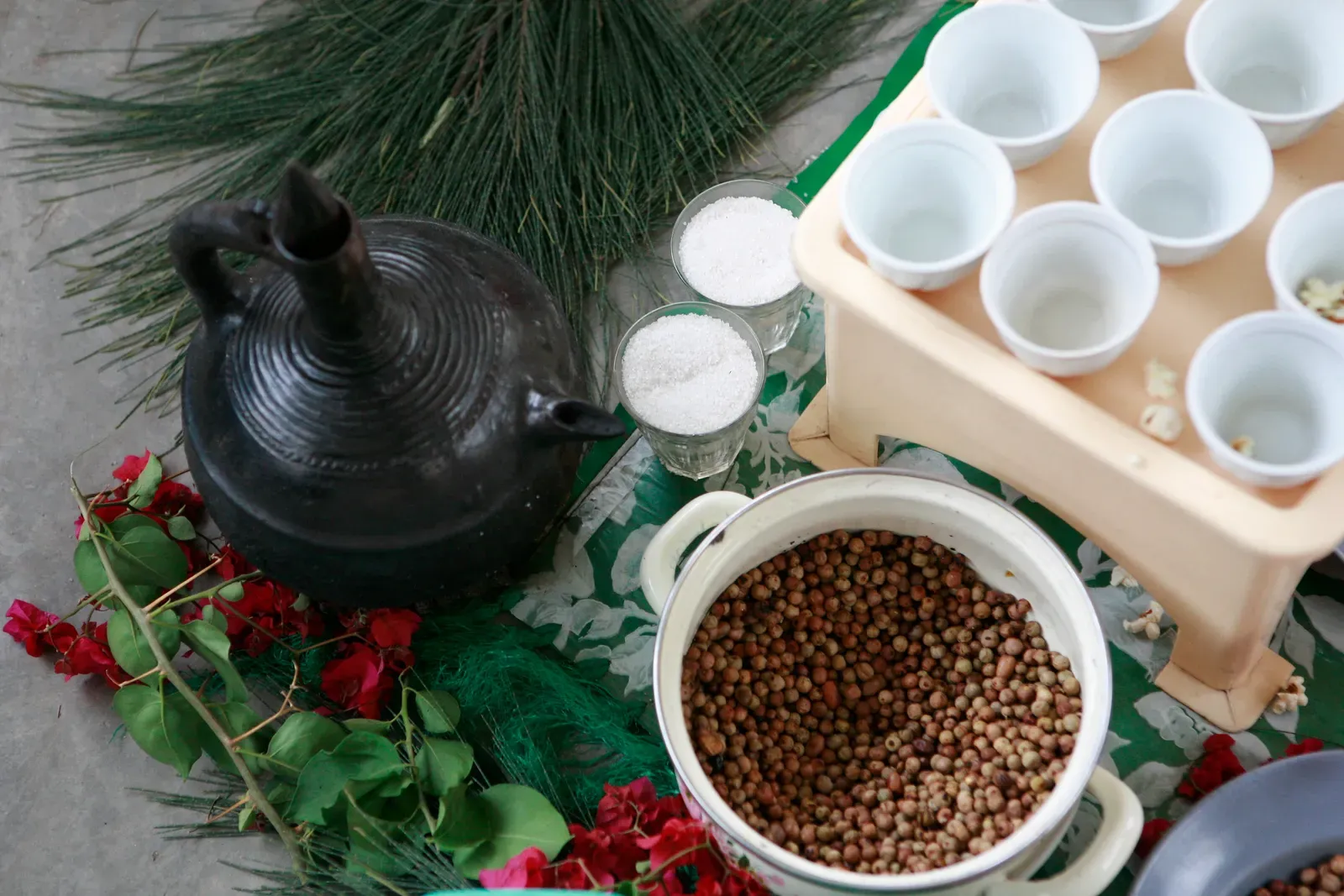
Before any coffee appears, the floor is strewn with freshly cut grass, sometimes with flowers. A small tray on short legs, the rekebot, holds a row of small handleless cups. Frankincense smoulders on a few coals in a clay burner. There may be popcorn or roasted barley to eat while you wait, and there will be waiting.
None of this is decoration for visitors. The ceremony is how a household receives people, settles news and marks the day, and in many homes it happens two or three times a day.
Roasting in front of the guests
It begins with green coffee. The beans are washed, then roasted in a flat pan over charcoal or a small stove, stirred constantly until they crack and turn a deep, glossy brown, usually further than a Nordic roaster would take them but well short of the oily black of an old Italian espresso blend. When the smoke rises, the pan is carried round so each guest can wave the smoke towards their face. Saying how good it smells is part of the ritual, and it is also true.
The roasted beans are then pounded in a heavy wooden mortar, the mukecha, with a metal or wooden pestle. The grind comes out uneven, from powder to small fragments, which matters less than it would for a pour over, because nothing here is filtered.
The jebena does the brewing
The grounds go into the jebena, a clay pot with a round belly, a long neck and a spout, already half full of water. It is brought to the boil on the coals, taken off, and set to rest at an angle so the grounds sink into the belly. Some households push a small twist of fibre into the spout as a strainer; many do not bother.
What you are drinking, technically, is a boiled, unfiltered coffee closer to a cezve than to anything brewed in Europe. The ratio is strong, the cups are small, and the pour is done from a height in one continuous stream along the row, so that each cup gets the same strength and no cup gets the sludge.
Three rounds from the same pot
The first round is called abol. It is the strongest and the one guests are most expected to stay for. Water is added to the same grounds for the second round, tona, and again for the third, baraka, which means blessing. Leaving after the first cup is not an insult, but staying for all three says something.
Sugar is common now, served on the side. In parts of the country the coffee comes with salt, and in some rural areas with a small knob of spiced butter. A sprig of rue is sometimes laid across the cup. None of these is the “correct” way; they are regional, and each is correct where it is done.
What it tells a coffee drinker
Two things. The first is how much of the pleasure of that coffee comes from the moment rather than the bean. It is a heavy, rustic, slightly smoky cup that no specialty cupping table would score highly, and people who have drunk it in someone’s home tend to remember it longer than any cup they scored.
The second is that the ceremony keeps every step that industrial coffee hides. Roasting, grinding and brewing are done by one person, in front of you, in the time it takes to have a conversation. If you want to taste what the same country does when the beans are washed, sorted and roasted light, the Ethiopia origin profile is the other half of the story, and the coffee map shows where the growing regions sit.
Related reading
The café menu, decoded
Ristretto, lungo, cortado, batch brew, single or double: what a specialty café menu is actually offering, and how to order the cup you want.
Cafe culture, and what the three waves actually mean
First wave, second wave, third wave: where the phrase came from, what each one changed about the drink and the room.
How the world actually drinks coffee
Ethiopian buna, the cezve, the Italian counter, Nordic filter, the Vietnamese phin, the Cuban cafecito and the Australian flat white.