Capsules
Coffee capsules: the cost per cup and the waste question
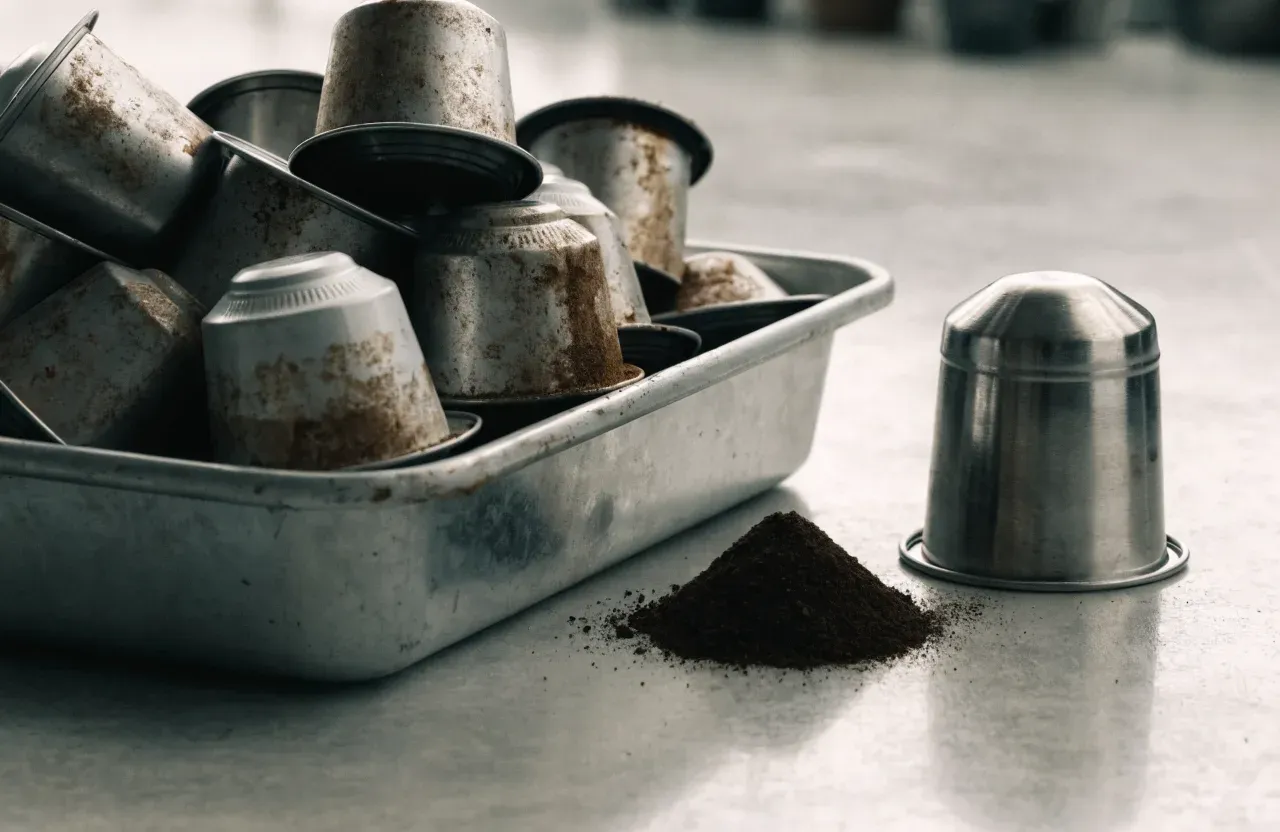
The number nobody puts on the box
The price of a capsule is designed to be easy to agree to. Thirty-five pence, forty pence, fifty for the fancier ranges. Set against a coffee shop it looks like a saving, and against a kettle it looks like a rounding error. The reason it works is that the unit is tiny, and the unit is never converted into the one we use for every other coffee purchase.
So convert it. A standard espresso capsule holds about 5 grams of ground coffee. Some are 5.5, a few of the intense ranges reach 6, and the lungo and filter formats go higher. Take 5 grams as the working figure and the arithmetic is one division: a kilogram is 200 capsules.
At 30p a capsule, that is £60 per kilogram. At 35p, £70. At 50p for a limited edition, £100 per kilogram, for coffee that was ground and packed months ago. A bag of freshly roasted single origin from a good roaster sits somewhere between £20 and £35 per kilogram, and supermarket beans well below that. The capsule is not competing with a café. It is competing with loose coffee, and on the metric that every other coffee purchase uses it is three to five times the price.
None of which makes it a bad purchase. You are buying a dose measured for you, a machine that needs no dialling in, no grinder, no scale and no cleaning beyond emptying a bin. That convenience is real and it is worth something. It is just worth knowing what it costs, which is roughly £40 per kilogram of coffee, paid in five gram instalments. If that figure changes your mind, the first setup guide covers what the same monthly spend buys in equipment instead.
Aluminium, plastic and the compostable ones
The material argument is usually presented as a ranking. It is closer to three different trade-offs, none of which resolves cleanly.
| Material | The case for it | The catch |
|---|---|---|
| Aluminium | Infinitely recyclable, excellent oxygen barrier, protects the coffee best | Energy intensive to produce, too small for kerbside sorting, needs a dedicated scheme |
| Plastic | Lighter, cheaper, sometimes kerbside recyclable as a single polymer | Multi-layer versions cannot be separated, barrier is weaker so the coffee stales sooner |
| Compostable | Breaks down rather than accumulating, no collection round needed | Almost always requires industrial composting, not a garden heap, and many councils reject them in food waste |
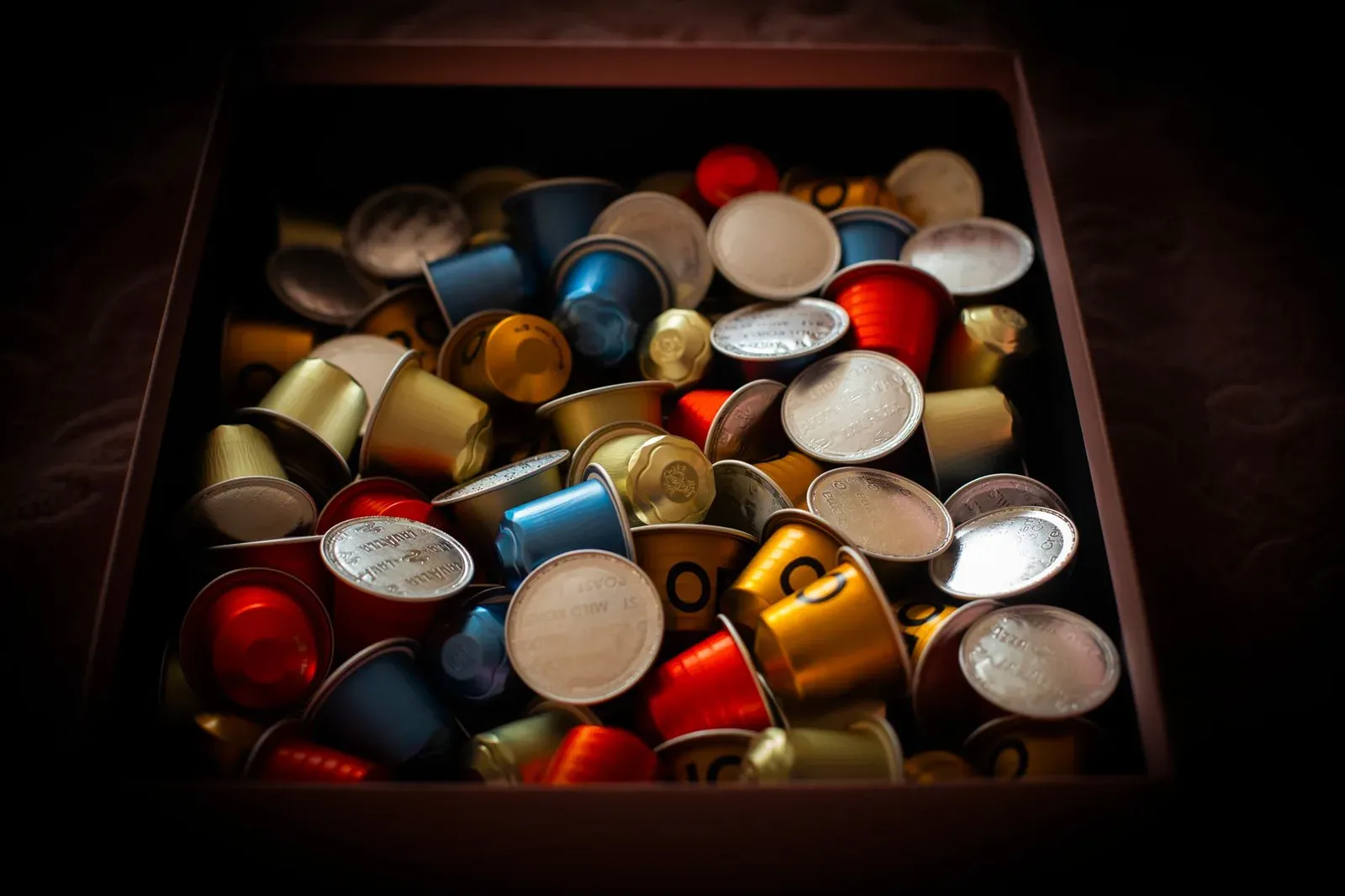
What the schemes actually require
Aluminium is the honest one on paper. The metal can be recycled endlessly with no loss of quality, and the barrier it provides is why capsule coffee tastes fresher than a supermarket bag of the same age. The catch is entirely about collection. A used capsule is a few grams of metal full of wet grounds, and municipal sorting lines are built around minimum sizes that it falls well below. It will not be recovered from a kerbside bin. It is only recycled if it goes into the manufacturer’s own scheme, which means a specific bag, a specific drop-off point or a specific postal label, and the published return rates for those schemes have never been close to the volumes sold.
Plastic capsules vary more than any other category, because “plastic” covers both a single moulded polymer that a sorting line can identify and a laminate of three materials that no process can separate. The former is genuinely recyclable where the local facility accepts that polymer. The latter is not, whatever the symbol on the box implies.
Compostable capsules are where the labelling is most misleading. Almost all of them are certified for industrial composting, which means sustained temperatures around 55 to 60 °C for weeks. A garden compost heap does not reach that, and the capsule will still be recognisably a capsule a year later. Whether your food waste collection sends material to a facility that accepts them is a local question with a local answer, and in many areas that answer is no.
Refillable capsules, and the pressure problem
A refillable stainless steel capsule costs a few pounds, lasts years, and drops the cost per cup to whatever your beans cost divided by the dose. On the arithmetic above, filling a capsule with £25 per kilogram coffee turns a 35p cup into a 13p one and produces no packaging at all beyond the original bag.
The engineering is the awkward part. An original capsule is a sealed pressure vessel. The machine pierces it, water is forced in, pressure builds because the foil lid is holding, and the lid then ruptures against a spiked plate in a pattern the manufacturer designed. That controlled rupture is doing real work: it is where much of the crema comes from. A reusable capsule has to substitute either a mesh, which offers far less resistance, or a replaceable foil disc, which gets you closer at the cost of the convenience you bought the thing for.
In practice that means a mesh refillable produces a thinner, paler crema and a flatter shot unless you compensate. Compensating means grinding finer than the machine’s original capsules were filled at, and it means grinding consistently, which is a grinder question rather than a capsule one. Our grind size explainer covers what “finer” actually means here. Expect to tamp lightly, expect to fill level rather than heaped, and expect the first half dozen attempts to be worse than the capsules you are replacing before they get better.
It is also worth saying that machines are engineered around a pressure profile and a capsule geometry, and using a third-party refillable is outside that design. Some machines cope indefinitely. Some develop leaks around the piercing plate. Manufacturers generally decline warranty claims that involve one, which is a commercial position rather than a technical verdict, but it is a real cost to weigh against the saving.
Frequently asked
- How much coffee is actually in a capsule?
- Most espresso capsules hold between 5 and 6 grams, and the larger lungo or filter styles hold 7 to 12 grams. The figure is usually printed on the box in small type, or derivable from the net weight divided by the capsule count.
- Can I put used capsules in my household recycling?
- Usually not. Aluminium capsules are small enough to fall through the sorting machinery at most facilities, and they still contain wet grounds. Nearly every aluminium scheme works by post or by a drop-off point instead, and the capsules have to go into the scheme's own bag.
- Do refillable capsules work properly?
- They work, with a caveat. The sealed foil lid of an original capsule ruptures under pressure in a designed way, and a reusable lid cannot copy that exactly. Expect a thinner crema and expect to grind finer than you would for the same machine on originals.
Related reading
Cupping at home
The protocol professionals use to taste coffee, stripped to what works on a kitchen table, and what it is actually good for.
How much caffeine is in your cup
A double espresso holds less caffeine than a mug of filter, and roast level barely matters. The numbers, and where the intuitions go wrong.
How to read a bag of coffee
Roast date, process, altitude, varietal and the tasting notes: what each line on a bag is actually claiming, and which ones are worth paying for.