Grind
Grind size, explained properly
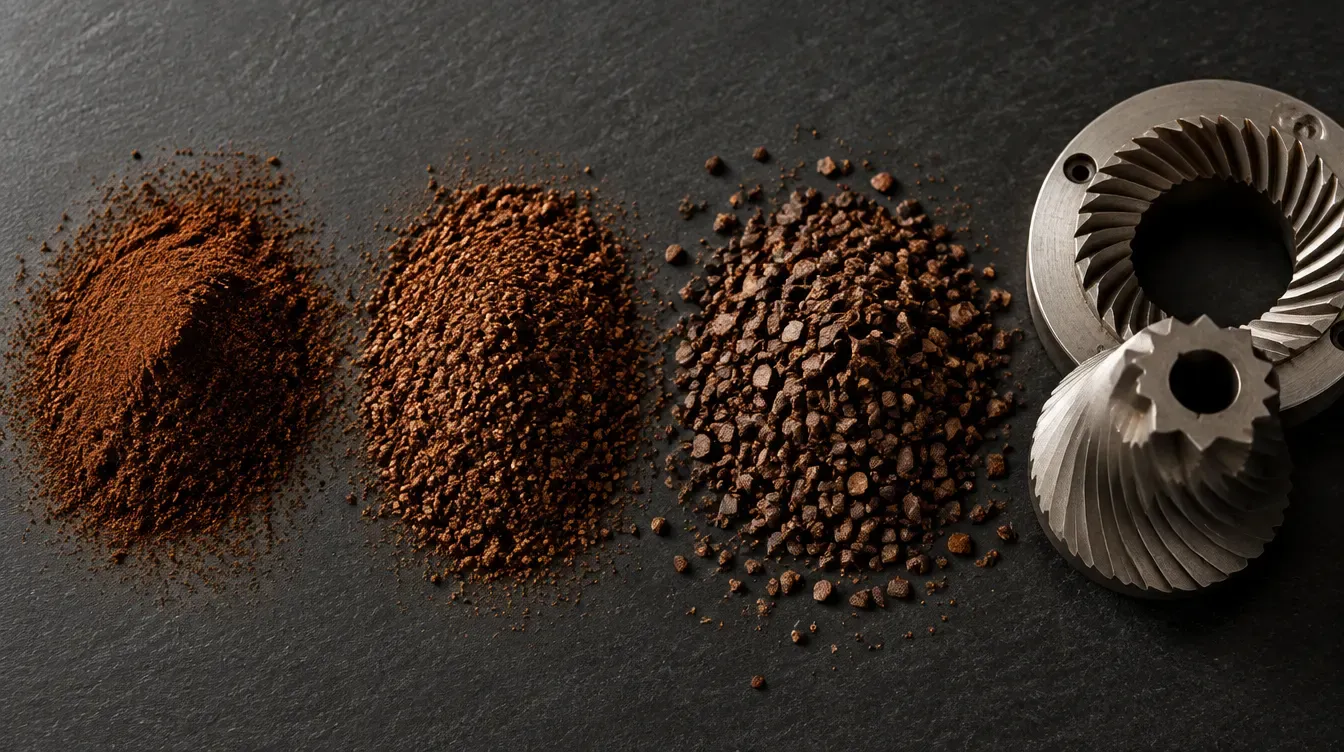
There is no such thing as one grind size
Every grinder produces a distribution, not a size. What changes between settings is where the peak of that distribution sits. What changes between grinders is how wide the distribution is around that peak.
That sentence is the whole subject, and almost every confusion about grinding comes from ignoring it. People talk about grind as though a setting produced particles of one diameter, the way a sieve would. It does not. Run eighteen grams through any grinder on earth and you get a spread: a hump of particles around the size you asked for, a tail of very small ones below it, and a few stragglers above.
Move the setting finer and the whole hump slides left. The tails come with it. What you cannot do, with the adjustment collar alone, is make the hump narrower.
Fines and boulders, and why both matter
The two tails have names, and they behave in opposite directions.
Fines are the particles far below the target, most of them fragments broken off the edges rather than cut cleanly. They have enormous surface area for their mass, so water strips them almost instantly. In a filter brew they contribute sweetness early and bitterness if the contact time runs long. In espresso they do something else as well: they migrate down through the bed and pack against the basket holes, which is why a shot can start fast and choke halfway through.
Boulders are the opposite problem. A particle twice the target diameter has eight times the volume and only four times the surface area, so water reaches its interior far too slowly. Whatever is inside it never arrives in the cup. It is dead weight in the basket, and you paid for it.
Here is the part that makes dialling in feel unpredictable. A cup can be over-extracted and under-extracted at once, because the fines gave up too much while the boulders gave up too little. The average reads as correct on a refractometer and the drink tastes harsh and hollow together. No single adjustment fixes that, because it is not a setting problem.
Why two grinders on the same number disagree
The number on the collar is not a unit. It is a position, calibrated by the manufacturer against their own burrs, and it means nothing outside that model.
More than that, the width of the distribution is a property of the grinder rather than the setting. It comes from burr geometry, from how true the burrs run to each other, from motor speed, and from how long a particle stays in the grinding chamber before it escapes. A better grinder is one that produces fewer fines and fewer boulders for the same peak, which is a narrower hump.
So two grinders set to “12” produce different coffee twice over: the peak is in a different place, and the spread around it is a different shape. This is why recipes that quote a number are worthless across machines, and why a dial-in reference can only give you a starting region rather than an answer.
Burr shape is the biggest single lever on that spread. Conical and flat burrs produce characteristically different distributions, which is the real content of an argument that usually gets conducted in terms of taste alone.
What this means at the machine
Four practical consequences, in the order they will save you time.
Change grind alone, and in meaningful steps. Grind moves extraction more than dose, temperature and time combined. Changing it alongside something else means you learn nothing from the result. When dialling in a new bag, move grind until the shot time is right, then stop and taste before touching anything.
Expect a dead zone on a stepped grinder. Between two clicks there is a gap, and on a stepped grinder aimed at filter, one click can be the whole espresso range. That is not a fault. It is the resolution the machine has, and it is the main reason espresso wants a grinder built for espresso.
Season the burrs after any change. The chamber holds grounds from the previous setting. Purge five to ten grams after an adjustment or your next dose is a blend of two settings, which reads as inconsistency in your technique.
Suspect the grinder before the recipe when the fault is bitter and thin at once. That combination is the distribution signature described above. If it persists across bags and across recipes, the grind is producing both tails, and that is either a burr that needs cleaning or replacing or a grinder working outside the range it was built for.
A rough map, with the caveat attached
Every chart of grind sizes is a lie of convenience, because the numbers describe the peak and say nothing about the spread. With that stated plainly, the peaks sit roughly here:
| Method | Peak particle size | Feels like |
|---|---|---|
| Espresso | 200–400 µm | Powdered sugar, clumps when squeezed |
| Moka | 300–500 µm | Fine sand |
| V60, Chemex | 600–800 µm | Table salt |
| Cold brew, french press | 1000–1200 µm | Coarse sea salt |
Use it to get in the region, then let the cup decide. A grinder that suits hand grinding at the coarse end may be hopeless at the fine end of that table, and the reason is never the number on the collar. It is the shape of the hump.
Related reading
Conical or flat burrs
The burr shape argument, with the marketing removed: what each geometry does to the grind distribution, and when it matters in the cup.
Dialling in a new bag
A repeatable routine for the first four shots from a new coffee: what to fix, what to change, and how to know when you are done.
Filter papers, cloth and metal
Bleached, natural, cloth and metal filters change body, clarity and even the oils in a filter coffee. What each one lets through, and what it holds back.