Buying guides
Your first coffee setup, from scratch
What to buy, in what order, if you are starting with nothing. Four tiers, from a $60 kit to a full espresso bar.
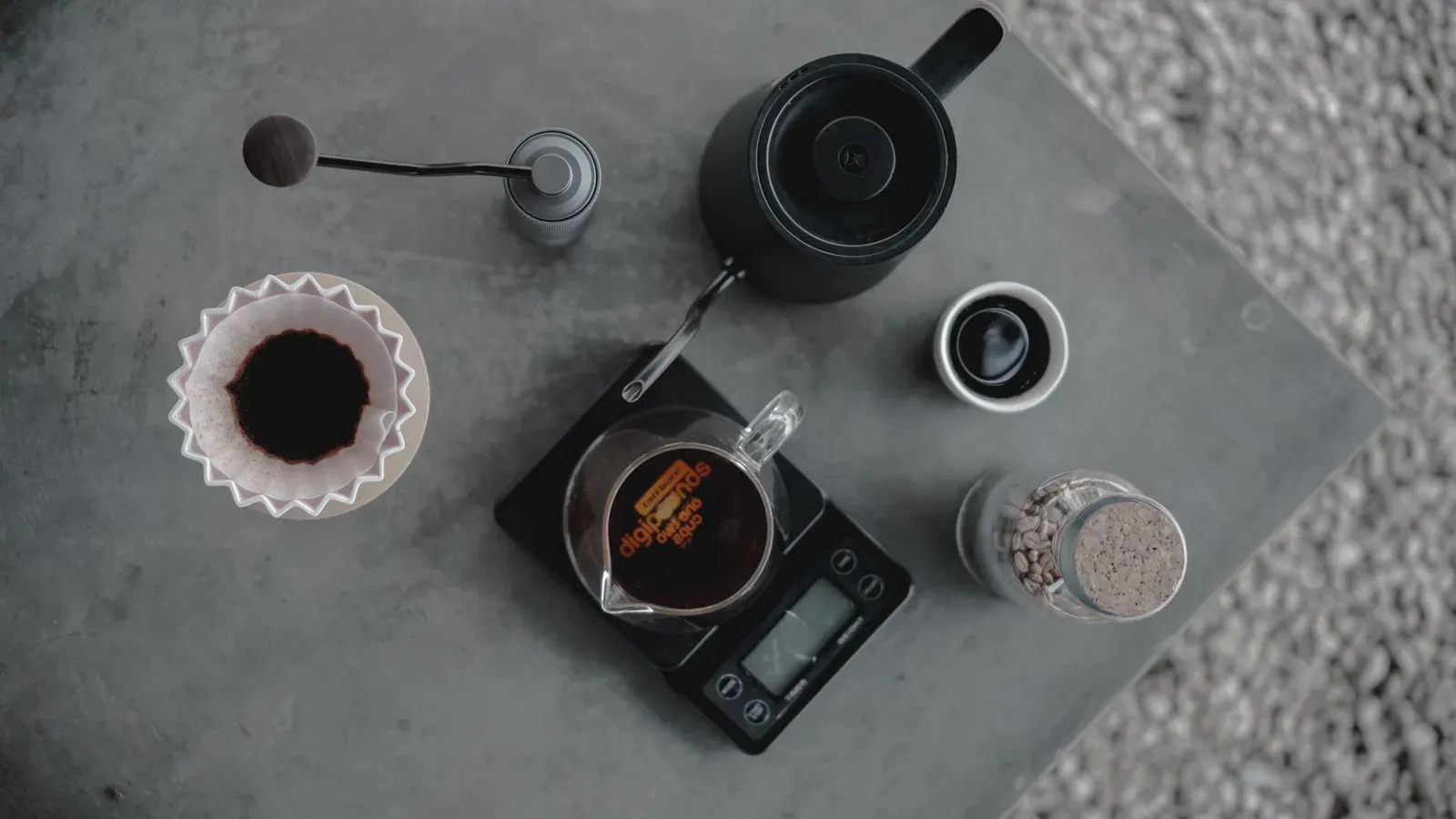
Tier one: sixty dollars
A hand grinder, an AeroPress and a set of scales. That is a complete, genuinely good coffee setup, and it will beat a $400 bean-to-cup machine on flavour while fitting in a drawer.
The scales are not optional and they are the part people skip. Coffee is a ratio, and a ratio needs two weights. A kitchen scale that reads to one gram will do; one that reads to a tenth and has a timer is better and costs about fifteen dollars. Without it you are guessing, and guessing is why the same method tastes different on Tuesday.
The grinder is the other non-negotiable, and at this tier it is a hand grinder rather than an electric one, because sixty dollars buys a genuinely good manual burr set and a bad electric blade unit. A blade grinder is not a cheap grinder. It is a different and worse machine that chops rather than cuts, and the particle distribution it produces cannot be brewed around.
Two minutes of cranking per cup is the cost. Hand grinders are competitive with electrics three times their price up to about this dose size, which is why the tier works at all.
Tier two: two hundred dollars
Keep the grinder, add a kettle with a spout you can aim and a brewer that rewards technique.
A gooseneck kettle changes pour-over more than any other single purchase, because it converts an uncontrolled glug into a stream you place where you want it. A variable-temperature model costs more and earns it, since light roasts want water near 96 °C and dark roasts want it nearer 88 °C.
For the brewer, the choice at this tier is between a V60 and a french press, and it is a choice about what you want to do rather than about quality. The V60 is a percolation method: you control the pour, the cup is clean and bright, and a bad pour is a bad cup. The french press is immersion: coarse grind, four minutes, plunge, and the result is heavy-bodied and nearly impossible to ruin.
If you make coffee for two or three people at once, the press wins on logistics and it is not close.
Tier three: five hundred dollars
This is where espresso becomes possible, and where the order of purchase matters most.
Put the larger share of the budget into the grinder. Espresso needs a grind range that filter grinders do not reach, adjusted in steps fine enough to change a shot by two or three seconds, and that requirement is what the money buys. The machine can be the cheapest pump model with a non-pressurised basket.
That allocation is unpopular and it is the single most tested claim on this site. The grinder or machine comparison put the two allocations against each other blind, and all four tasters picked the same side.
Expect the learning curve to be real. Espresso has the tightest tolerances in coffee, and the first month is spent dialling in rather than enjoying yourself. If that sounds like a chore rather than a hobby, tier two makes better coffee for less money and less effort, and there is no shame in stopping there.
Tier four: the full bar
A dual boiler or heat-exchanger machine, a stepless espresso grinder, a distribution tool, a bottomless portafilter, a milk jug and a knock box.
What the money buys at this tier is not better coffee on your best day. It is better coffee on your worst one. Temperature holds between shots, steam is available while you pull, and the grinder sits exactly where you want rather than at the nearest step. The ceiling barely moves; the floor comes up a long way.
It is also the tier where a second grinder starts to make sense, because a grinder set for espresso is not set for filter and readjusting twice a day gets old.
What to buy in what order, whatever the budget
The tiers assume you are starting from nothing. If you already own some of it, the order is what matters, and it is the same every time.
| Priority | Why |
|---|---|
| 1. Scales | Everything else is a ratio you cannot measure without them |
| 2. Grinder | The only defect no other component can correct |
| 3. Fresh whole bean coffee | See below |
| 4. Water | Free to fix, changes every cup |
| 5. Brewer or machine | Matters, and matters last |
Coffee sits third rather than first only because a grinder without good beans is still useful and good beans without a grinder are wasted within a week. Whole bean against pre-ground is the whole argument, and storing it properly costs nothing.
Water is fourth and it is free. Most tap water is either too hard or too alkaline, and testing it with a two-euro strip tells you whether a filter jug would do more for your coffee than your next purchase.
If the grinder is the piece you are choosing right now, the grinder guide covers the range this page only points at.