Grind settings
Grind settings by brew method
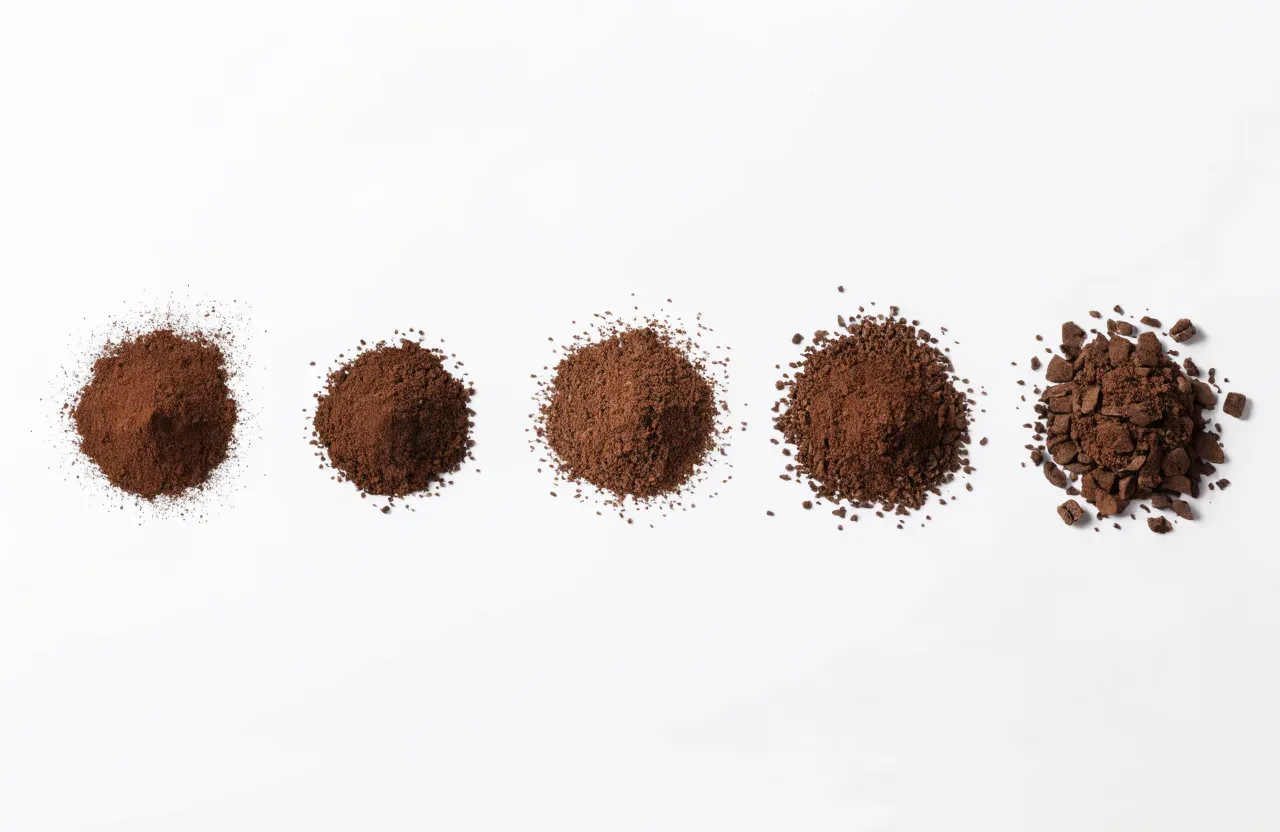
One rule explains every setting on the list
Grind size is not a preference. It is what you change so that the water finishes extracting at the same moment the brew finishes, and the only two things that decide the right size are how long the water is in contact with the coffee, and whether it is being pushed.
Grinding finer does two things at once. It makes each particle smaller, so water reaches the centre faster, and it hugely increases the total surface area the water can work on. It also packs the bed tighter, which slows the water down. So finer means faster extraction per second and, in most brewers, more seconds as well. Both push in the same direction.
That gives you the rule the whole table below follows. Short contact needs fine coffee, long contact needs coarse coffee. Pressure shortens contact dramatically, which is why espresso sits at the extreme end: nine bar pushes water through the bed in under half a minute, so the coffee has to be ground to a size where half a minute is enough.
The map, from espresso to cold brew
| Method | Grind | Looks and feels like | Contact time |
|---|---|---|---|
| Espresso | Extra fine | Icing sugar, clumps when squeezed | 25–32 seconds |
| Moka pot | Fine | Fine sand, just short of espresso | 4–6 minutes |
| Aeropress | Medium fine to fine | Table salt, finer for short recipes | 1–3 minutes |
| V60 and pour over | Medium fine | Table salt | 2:30–3:30 |
| Chemex | Medium coarse | Coarse sand, thicker filter needs it | 4–5 minutes |
| Siphon | Medium | Sand, a touch finer than for a Chemex | 1–1.5 minutes of steeping |
| Filter machine | Medium | Sand | 4–6 minutes |
| French press | Coarse | Breadcrumbs | 4–8 minutes |
| Cold brew | Very coarse | Cracked pepper | 12–18 hours |
Read the right-hand column against the middle one and the logic is obvious. Everything in that table is the same relationship applied at different time scales.
Two entries deserve a note. Aeropress spans a wide range because the recipes do: an inverted brew steeping for two minutes wants something close to filter grind, while a short thirty second press is nearer moka. And Chemex sits coarser than V60 despite similar times because its filter paper is much thicker, so a fine grind chokes it and the brew stalls.
Finding a setting on an unmarked grinder
Plenty of grinders, particularly good hand grinders, have a stepless adjustment with no useful markings. Finding your way on one is a two-minute job done once.
Empty the grinder, then close the adjustment until the burrs just touch. You will hear them chirp if you turn the handle. That is zero, and it is the only reference point the grinder has. Now back it off and count as you go, in whatever unit the grinder gives you: clicks, numbers on a ring, or full turns.
From zero, espresso usually lives somewhere in the first eight to twenty clicks, pour over in the middle of the range, and French press near the far end. Those numbers vary enormously between models, so treat them as a starting region rather than a target. Brew, taste, adjust, and write down what worked next to the name of the coffee. A note that reads “Kenyan, V60, 22 clicks, 3:05” is worth more than any manufacturer chart, because it is about your grinder and your water.
Never adjust an espresso grinder from zero with beans still in the burrs. On some designs, closing them under load damages the alignment.
Adjust by taste, and only ever one step
The number is a means to an end. What you are actually chasing is a cup where the sweetness has arrived and the bitterness has not, and there are two symptoms that tell you which way to move.
Sour, sharp, thin, salty, finishing quickly and leaving nothing behind: the water left too early. Grind finer. This is the most common fault by a wide margin, and it is the subject of why your espresso tastes sour, which applies just as well to a weak pour over.
Bitter, harsh, drying, hollow, with a lingering ashy finish: the water took too much. Grind coarser.
The discipline is to change one thing at a time. Move the grind one or two steps, keep the dose, the ratio and the water the same, and brew again. If you also change the dose you have learned nothing, because either change could explain the result and you cannot tell which did. This is slower for one brew and far faster over a week.
A few things will move the setting out from under you. A new bag needs dialling in again, and a darker roast usually needs a step coarser than a light one at the same brewer. Very fresh coffee, within a few days of roasting, releases enough carbon dioxide to disturb the flow and often settles down by the end of the first week. Humidity changes how grounds clump. And the water itself changes what is extracted at all, which is why water is the ingredient nobody tests is worth reading before you blame the grinder for a cup you cannot fix.
Frequently asked
- Why does the same grinder setting not work on two different coffees?
- Density, roast level and freshness all change how a bean breaks up and how readily it gives up its solubles. A light, dense, high-grown coffee usually needs a step or two finer than a dark roast on the same brewer, and very fresh coffee degasses enough to alter flow for the first week after roasting.
- How big a change is one click?
- It depends entirely on the grinder. On an espresso grinder with fine adjustment, one click may change a shot by two or three seconds, which is a meaningful move. On a filter grinder one click is often barely noticeable, so it is normal to move two or three at a time when brewing pour over.
- Should I dial in by time or by taste?
- Use time as a signal and taste as the verdict. A shot running long or a pour over draining fast tells you which direction to move, but the target is not a number on a timer. Two coffees can both taste right at times thirty seconds apart.
Related reading
Conical or flat burrs
The burr shape argument, with the marketing removed: what each geometry does to the grind distribution, and when it matters in the cup.
Dialling in a new bag
A repeatable routine for the first four shots from a new coffee: what to fix, what to change, and how to know when you are done.
Hand grinders: when they beat an electric
A hand grinder buys you far better burrs for the money and almost no retention. Here is where that wins, and where an electric is worth every penny.