Manual grinders
Hand grinders: when they beat an electric
Where the money goes
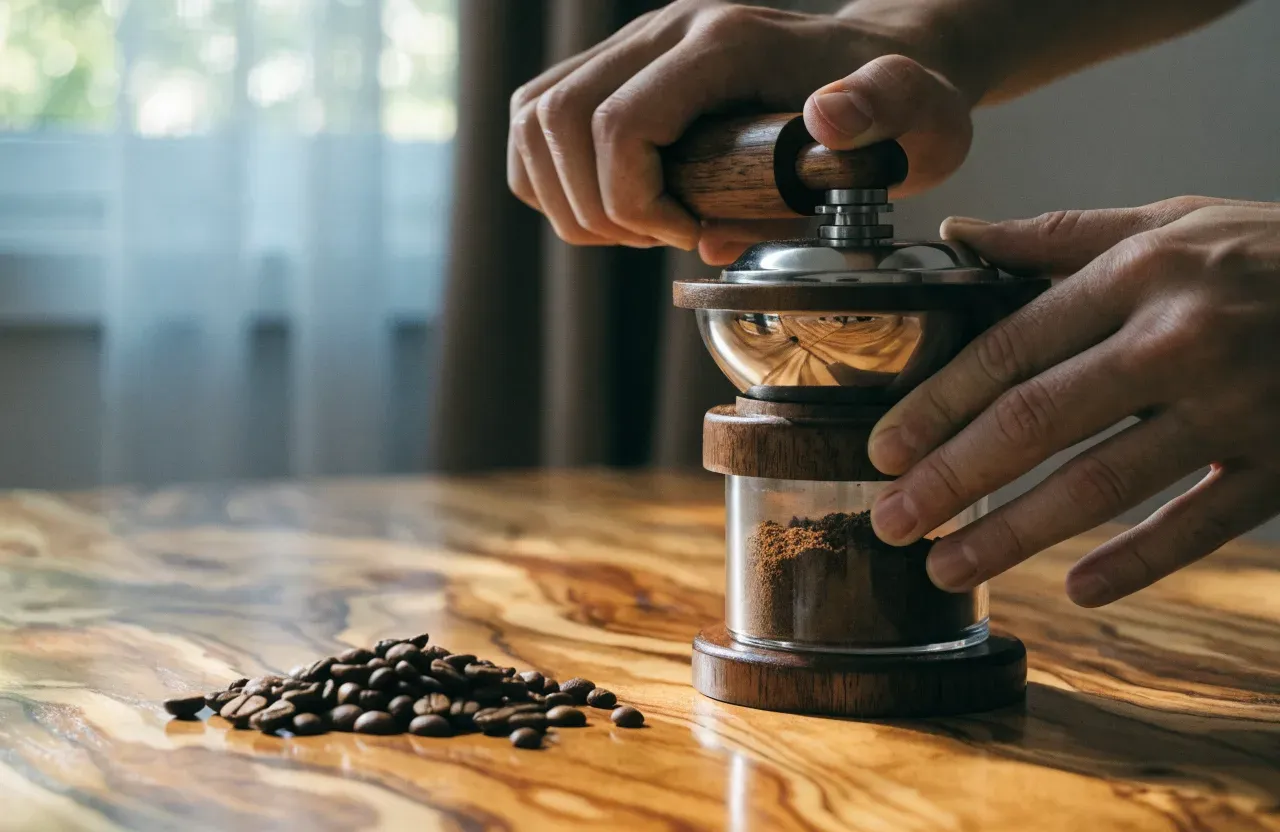
A hand grinder beats an electric at the same price for one unglamorous reason. An electric grinder has to buy a motor, a gearbox, a housing stiff enough to hold the two under load, a switch and a plug, and all of that comes out of the same budget as the burrs. A hand grinder buys an axle, two bearings, a handle and the burrs. At a hundred pounds, the electric is spending perhaps a quarter of the cost on the part that actually cuts the coffee. The hand grinder is spending most of it there.
That shows up as particle distribution, which is the thing that matters. Better burrs produce fewer fines and fewer boulders around your target size, and a narrower distribution means the water extracts more of the grounds at the same rate. In the cup that reads as clarity and sweetness rather than as a muddy middle. If the underlying idea is unfamiliar, grind size explained is the place to start, because none of the rest of this matters if the target size is wrong.
The practical consequence is that a 120 pound hand grinder often produces a better filter cup than a 250 pound electric, and hand grinders at the top end compete with electric machines costing several times as much. That is not brand loyalty. It is arithmetic about where the components went.
Retention, and why one cup at a time is different
Retention is the coffee that stays inside the grinder after you have finished grinding. Electric grinders hold grounds in the chute, around the burr carrier and in whatever gap the design leaves, and the figure is commonly one to three grams, sometimes considerably more on a machine designed to grind into a hopper.
A hand grinder is a short vertical path from the burrs into a catch cup, so retention tends to be a fraction of a gram. Two things follow. First, what you weigh in is what you get out, so your recipe stays honest without purging. Second, you are not drinking yesterday’s coffee mixed into today’s. Stale grounds are noticeably flat, and if you switch between a light Ethiopian and a dark blend the carryover is obvious in the first cup.
None of that matters much in a cafe grinding the same coffee all day. It matters a great deal if you brew one cup at a time and buy a different bag every fortnight, which is most people reading this.
Travel, noise and the parts that do not break
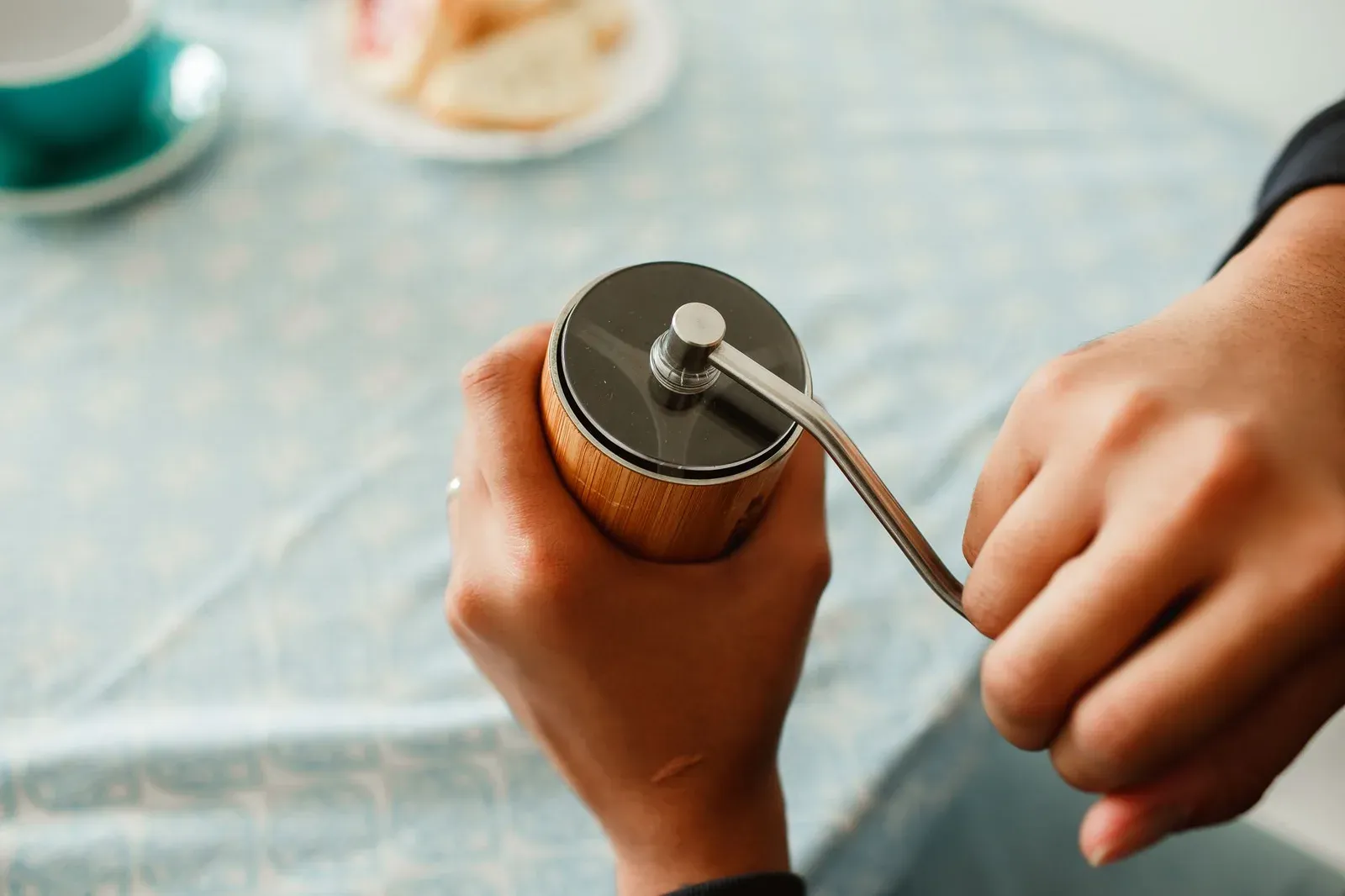
A hand grinder fits in a rucksack, works in a hotel room, on a campsite and on a train, and needs no adapter. That alone is why many people who own a good electric grinder still own a hand grinder.
It is also quiet. Not silent, but a soft crunching rather than the shriek of a motor, which is worth something at six in the morning in a flat with thin walls or a sleeping household.
And there is very little to fail. No motor to burn out, no electronics, no timer that drifts. Burrs eventually dull after several hundred kilograms of coffee, bearings can be replaced, and most reputable manufacturers sell both. A hand grinder is the piece of coffee equipment most likely to outlive everything else on the counter.
The effort is real, and it depends entirely on grind size
Here is the part the enthusiasm usually skips. Grinding coarse is easy and grinding fine is not, because the force needed rises sharply as the burrs close.
| Use | Dose | Time by hand | Effort |
|---|---|---|---|
| Cold brew, French press | 30 g | 30–45 seconds | Very light, the handle almost spins |
| V60, filter | 18 g | 20–30 seconds | Light, one hand is enough |
| Aeropress, moka | 16 g | 25–35 seconds | Moderate, you notice it |
| Espresso | 18 g | 30–60 seconds | Firm, two hands, a real effort |
For filter brewing the work is trivial and the grinder is a pleasure. For espresso it is a small daily workout, and the honest question is not whether you can do it but whether you will still want to on a wet Tuesday in February. Plenty of people make two espressos a day by hand for years. Plenty of others buy a hand grinder for espresso and quietly stop using the machine.
Where an electric simply wins
Volume is the obvious one. Three flat whites for guests means three doses ground fine, back to back, and by the third your forearm is arguing. An electric grinder does not care how many drinks you are making.
Repeatability is the subtler one. A hand grinder’s output is affected by how fast you turn it and how steadily, and a stepless adjustment with no markings means that finding a setting again after a change involves counting clicks or remembering a position. Electric grinders with a calibrated dial, and especially those that grind by weight, make returning to a known recipe trivial. If you are dialling in a new bag every week that is a genuine time saving. The grinders guide covers where that line sits by budget.
Milk drinks make the case most clearly. Steaming milk is a timed operation, and the workflow of a cappuccino wants the grind to happen while your attention is on the wand rather than on your wrist. Anyone making several milk drinks in a row is better served by a motor.
The useful conclusion is not that one type is better. It is that the answer falls out of how you brew. One or two filter cups a day, changing coffees often, travelling sometimes: buy the best hand grinder you can and spend nothing on a motor. Espresso every morning, milk drinks, guests at the weekend: buy the electric, and keep a hand grinder in the bag for holidays.
Frequently asked
- How long does grinding by hand actually take?
- For filter, about twenty to thirty seconds for 15 to 20 g, and it is light work. For espresso the burrs are much closer together, so the same dose takes thirty to sixty seconds and needs real force. That difference is the single biggest factor in whether you will still be using the grinder in a year.
- Can a hand grinder really do espresso?
- The good ones can, but the requirement is not just fineness. The axle has to be supported at both ends so the burrs cannot wobble under load, and the adjustment has to be fine enough to move in small steps. Grinders without both tend to be described as espresso capable and are not pleasant to dial in.
- Do steel and ceramic burrs taste different?
- In practice the geometry of the burr matters far more than the material. Steel cuts a little faster and dulls over years of use, ceramic keeps its edge longer but is more brittle. Whether one produces a cleaner cup than the other at the same design is contested, and you will notice the shape of the burr long before you notice what it is made of.
Related reading
Conical or flat burrs
The burr shape argument, with the marketing removed: what each geometry does to the grind distribution, and when it matters in the cup.
Dialling in a new bag
A repeatable routine for the first four shots from a new coffee: what to fix, what to change, and how to know when you are done.
Grind settings by brew method
From espresso to cold brew, what size each method needs and why. How to find a setting on an unmarked grinder, and how to adjust by taste instead of by number.