Grind
Dialling in a new bag
Fix everything except the grind
Dialling in fails when two things move at once. Before the first shot, fix these and leave them alone:
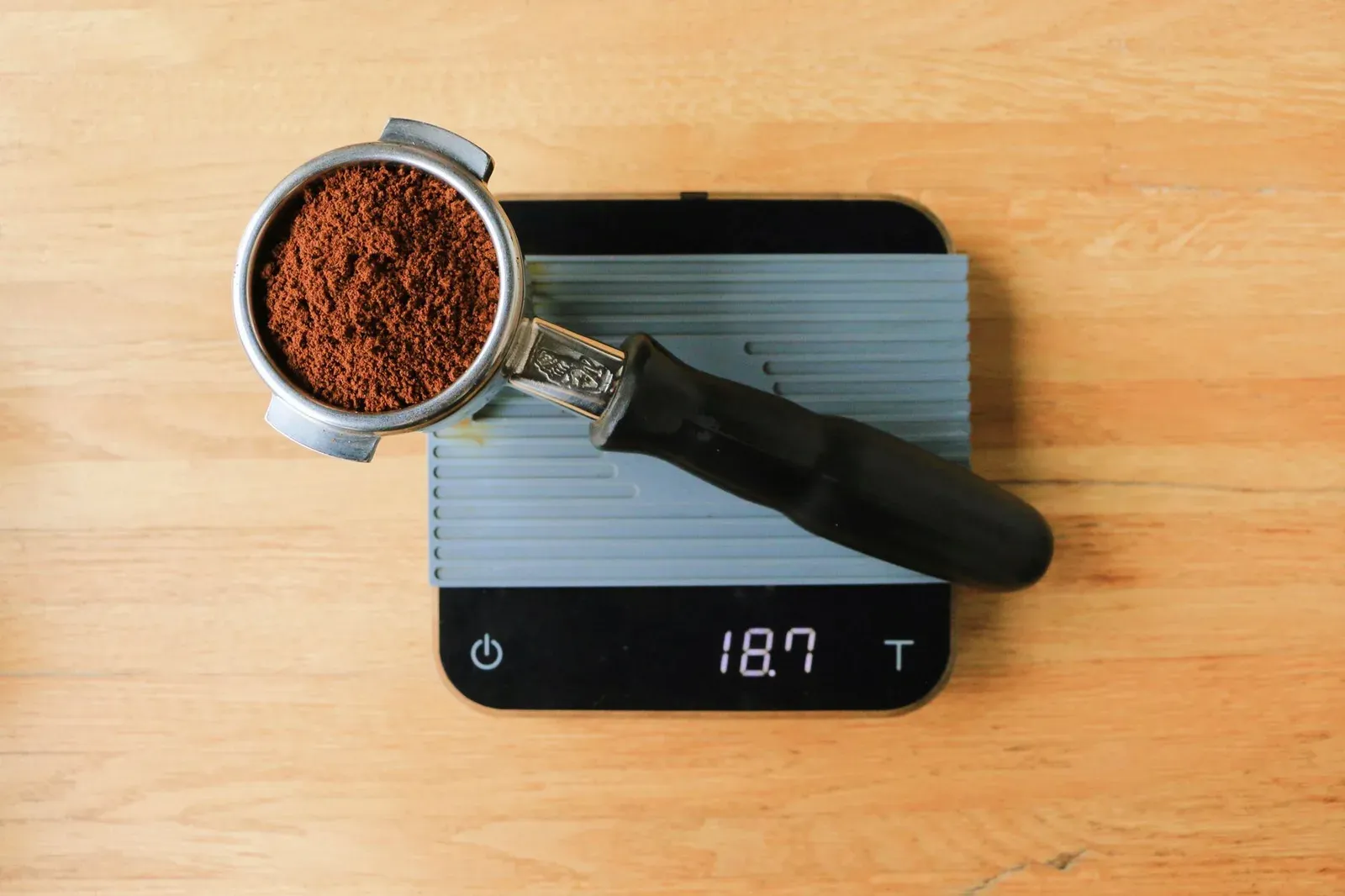
- Dose: whatever your basket is made for, weighed. An 18 g basket gets 18 g, every time, to the tenth of a gram.
- Ratio: start at 1:2. An 18 g dose gives 36 g in the cup, weighed, not guessed by eye.
- Water temperature: whatever your machine does. Do not touch it yet.
- Puck prep: the same routine every shot, or you are measuring your technique rather than the coffee.
Now the only thing you change is the grind, and the only thing you read is the time.
The target
18 g in, 36 g out, in 25 to 30 seconds from the moment the pump starts.
That window is a starting point, not a law. It exists because it lands most medium roasted coffees in a reasonable extraction range, which makes it a sensible place to begin before you deliberately leave it.
The loop
- Pull a shot to the target weight and note the time.
- Faster than 25 seconds: grind finer.
- Slower than 30 seconds: grind coarser.
- Make the first correction big enough to see. Half of what you think, and you will spend six shots creeping towards an answer.
- Purge a couple of grams after each adjustment, or you are brewing the old setting.
Once the time lands in the window, taste it. The clock got you into the range; your palate decides the rest.
Reading the cup
| Tastes | Meaning | Do |
|---|---|---|
| Sour, sharp, thin, salty | Under extracted | Grind finer, or raise temperature |
| Bitter, drying, ashy | Over extracted | Grind coarser, or lower temperature |
| Sour and bitter at once | Channelling | Fix the puck prep, not the grinder |
| Correct but hollow | Ratio | Try 1:2.2 or 1:2.5 |
That third row is the one people miss. Sour and bitter together is not a grind problem, and grinding either way will make one of the two worse.
Roast level changes the starting point
A light roast is denser and less soluble, so it usually wants a finer grind, a longer ratio towards 1:2.5, and a higher temperature. A dark roast is porous and extracts easily, so it wants a coarser grind, a shorter ratio, and a lower temperature before it turns bitter.
When to stop
Stop when two consecutive shots taste the same and you like them. Write down the grinder setting, the dose, the yield and the time on the bag itself.
Then expect it to drift. A bag roasted four days ago is still releasing carbon dioxide, which resists the water and makes the shot run fast, so you will grind finer across the first week and then hold steady. That drift is the coffee changing, not your technique failing. Resting coffee after roasting explains where that gas goes and how long to wait for it.
Frequently asked
- How much coffee does dialling in waste?
- Three to five shots on a new bag, which is about 60 to 90 g. You can halve that by making the first two adjustments large and deliberate rather than nudging the grinder.
- Do I need to change the dose too?
- Not while you are learning. Fix the dose at whatever your basket is rated for, change the grind until the shot time lands, and only then play with dose.
Related reading
Resting coffee: why a fresh roast is not ready yet
Roasted coffee is full of carbon dioxide for days. How long to rest beans for filter and for espresso, and what a bag that is too fresh does to the cup.
Pre-infusion and the bloom
Wetting the coffee before you brew it properly is the same idea on an espresso machine and on a pour over. What it fixes, and how long it should last.
Puck prep: WDT and distribution
What happens between the grinder and the group head decides the shot. Clumps, distribution tools, the WDT needle, and which steps are worth the time.