Specialty coffee
AA, SHB, strictly soft: grading decoded
Grading was invented for shipping, not for drinking
The systems below were built so that a buyer in Hamburg could order a container of coffee from a seller in Nairobi, sight unseen, and know what would arrive. They had to describe something measurable with a sieve, a scale and a pair of eyes.
Flavour is none of those things. So grading measures size, density, altitude, defect count and appearance, and it leaves flavour to a separate process that did not exist in most origins until the 1990s.
That gap explains almost every confusion on a coffee bag. AA is not a quality mark. Supremo is not a quality mark. They are logistics terms that marketing departments discovered sounded impressive.
Screen size: Kenya, Tanzania, and the AA family
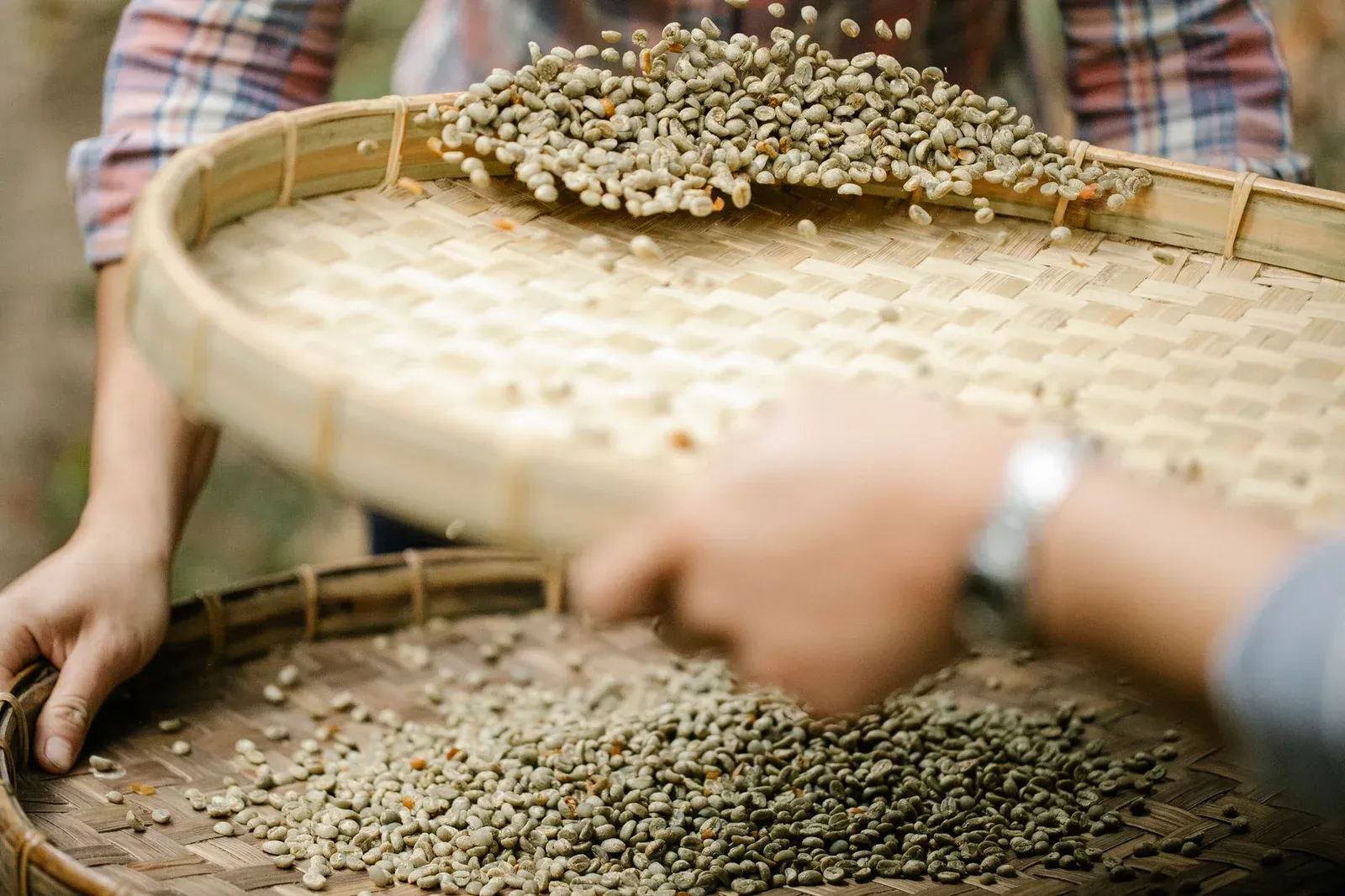
A screen is a metal plate with round holes, sized in sixty-fourths of an inch. A screen 18 has holes 18/64 of an inch across. Beans are poured over a stack of them and sorted by what they fall through.
| Grade | Screen | Note |
|---|---|---|
| E, elephant | 20+ | Malformed doubles, usually separated out |
| AA | 17 to 18 | The large grade, and the famous one |
| AB | 15 to 16 | The bulk of any harvest |
| PB, peaberry | Varies | One round bean instead of two flat halves |
| C | 14 to 15 | Smaller, lower value |
| TT, T | Light and small | Fragments and lights, local market |
Size correlates loosely with maturity and tree health, and a uniform screen roasts more evenly than a mixed one, which is a real advantage. But the correlation is weak, and Kenyan washing stations regularly produce AB lots that beat their own AA on the table. Peaberry, a natural mutation where only one seed develops in the cherry, is a special case: it is small, dense, roasts differently and is often sold at a premium.
Colombia uses the same logic with different words. Supremo is screen 17 and above, Excelso is 14 to 16, and the two are frequently the same coffee sorted into two bags.
Altitude and hardness: Central America
Density comes from slow maturation, slow maturation comes from cool nights, and cool nights come from altitude. So Central American systems grade by the altitude the coffee grew at, which is a proxy for how hard the bean is.
- Guatemala and Costa Rica: SHB, strictly hard bean, above roughly 1,350 metres. Then HB, hard bean, then semi-hard, then extra prime downwards.
- Honduras, El Salvador, Nicaragua: SHG, strictly high grown, above about 1,200 metres, then HG, then central standard.
- Mexico: altura, and SHG on export lots.
This is the most useful family of grades on a bag, because altitude genuinely predicts something: density, acidity, and how much sugar the bean had time to accumulate. It still says nothing about picking, fermentation or drying, which is where most defects are made.
Defect count and cup: Brazil
Brazil grades on two axes at once, which makes it the most complete system and the hardest to read.
The type is a defect count, on a 300-gram sample, using a weighted table where a black bean counts as one full defect and five broken beans count as one. Type 2 allows four defects, type 4 allows twenty-six, type 8 allows around 360. Almost no coffee is graded type 1, which is a theoretical zero-defect standard.
The cup is a taste classification, and this is where the phrases come from:
- Strictly soft: clean, sweet, no harshness. The best.
- Soft, then softish: still clean, less sweet.
- Hard: astringent, a rough edge.
- Rioy and Rio: a distinct iodine, medicinal or phenolic taint, from overfermented or ground-dried cherries. Unmistakable once you have met it.
A bag labelled Santos 2/3 strictly soft is telling you almost everything a traditional grade can tell you: very few defects, and a taster confirmed the cup was clean.
Ethiopia, Indonesia, India
Ethiopia grades 1 to 5 by defect count, with grade 1 and 2 being the export specialty grades. Since the ECX reforms and the direct trade rules that followed, what matters more on an Ethiopian bag is the washing station name and the region, which the grade does not carry.
Indonesia uses Grade 1 to 6, also by defect count, on a 300-gram sample. Grade 1 allows up to eleven defects, which is loose by specialty standards, and a Sumatran Grade 1 is a starting point rather than a promise.
India grades arabica as plantation A, AA or AAA and robusta as cherry or parchment, by size and appearance. The name worth knowing is Kaapi Royale, a top plantation A grade, and Monsooned Malabar, which is not a grade at all but a process: green coffee deliberately exposed to monsoon winds until it swells and loses acidity.
The two systems that are about the cup
SCA green grading. A 350-gram sample is sorted by hand and defects are counted on a standard table. To be called specialty, a lot must have zero primary defects, no more than five full defects in total, and at least one distinct attribute in the cup with no faults. This is a real standard, applied to a real sample, and it is auditable.
The score. A Q Grader roasts a sample to a fixed profile, brews it under fixed conditions, and scores aroma, flavour, aftertaste, acidity, body, balance, uniformity, clean cup, sweetness and an overall judgement out of 100. Eighty is the specialty threshold. Eighty-five is very good. Ninety is rare enough to be newsworthy.
A score is the only number on a bag that is directly about how the coffee tastes, and it comes with two caveats: it applies to one lot on one day, and the person who assigned it may have been paid by the person selling it.
Where the grade decides the price
The reason any of this is enforced is that grades are contractual. A shipment sold as Kenya AA and arriving as AB is a claim, not a disappointment, and the paperwork behind it runs through an exchange, an inspection body and often a government marketing board.
Kenya’s auction system prices lots by grade before anyone has tasted them. Brazil publishes differentials against the New York C price by type and cup, so type 4/5 soft trades at a known discount to type 2/3 strictly soft. A Colombian exporter who sorts a harvest into Supremo and Excelso is doing it because the two bags fetch different prices, not because the beans want to be apart.
This is also why grading persists in a world that has better tools. The cupping score describes the coffee far more usefully, but a score cannot be verified by a port inspector with a sieve, and international trade runs on what can be verified in a warehouse.
What a grade cannot tell you
- Whether it was picked ripe. Selective picking is the single biggest lever on cup quality, and no size or altitude grade sees it.
- How it was processed. Washed, natural, honey and every controlled fermentation variant sit outside grading entirely.
- When it was harvested. A grade is permanent; freshness is not. A top-grade green two years old is a stale coffee with an impressive name.
- How it was roasted. Which is the last hundred metres of a very long journey, and where most bags on a supermarket shelf lose whatever the grade promised.
How to actually use a grade
Read it as a filter, not as a verdict.
A grade rules out the bottom of the market cheaply. SHB tells you the farm was high. Strictly soft tells you a taster found the cup clean. Grade 1 tells you the defect count was low. None of them tells you the coffee is good, and none of them is a substitute for the four things that do: a named origin, a harvest year, a process, and a roast date.
When a bag leads with its grade and gives you none of those four, the grade is doing the work of a label rather than the work of a specification. That is worth noticing, because a roaster who knows their supply chain always has something more specific to say.
Frequently asked
- Is AA better than AB?
- Not inherently. AA beans are larger, which historically correlated with mature cherries from healthy trees, and large beans roast evenly together. But plenty of AB lots outscore AA lots from the same washing station, and peaberry, which is the smallest grade of all, is often the most prized.
- What is the difference between a grade and a score?
- A grade is a physical classification of green coffee: size, density, altitude or defect count, assigned by the exporting country's own system. A score is a sensory evaluation of the brewed cup on a 100-point scale, assigned by a trained taster. A lot can be top grade and score 79.
Related reading
Cupping at home
The protocol professionals use to taste coffee, stripped to what works on a kitchen table, and what it is actually good for.
How to read a bag of coffee
Roast date, process, altitude, varietal and the tasting notes: what each line on a bag is actually claiming, and which ones are worth paying for.
Cafe culture, and what the three waves actually mean
First wave, second wave, third wave: where the phrase came from, what each one changed about the drink and the room.