Professional machines
Do you need a professional machine at home?
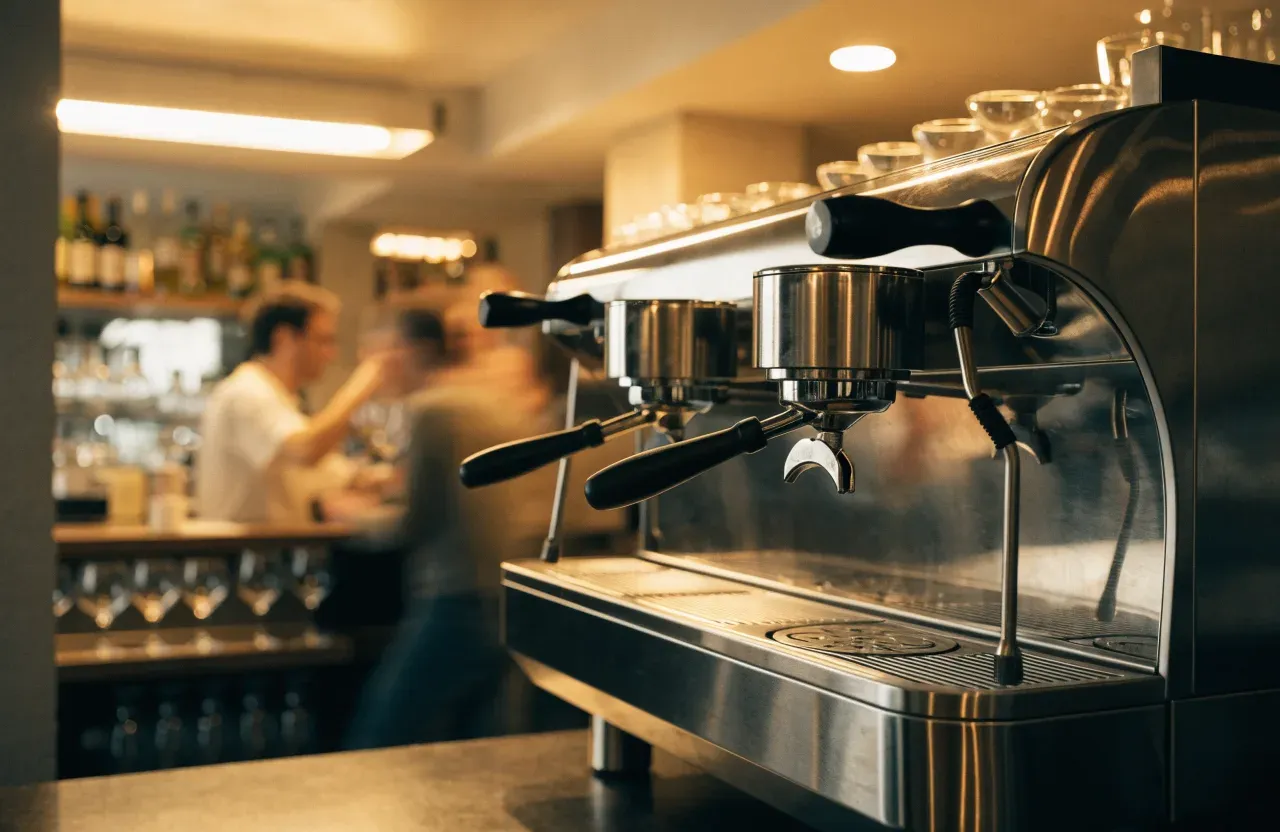
The honest answer is no, and here is why
A professional machine is not a home machine that has been made better. It is a machine built to solve a specific problem: pulling shots and steaming milk continuously, for hours, by several people, without the quality drifting. Every expensive decision inside it exists to serve that problem. A large saturated group and a big boiler are there so the fortieth shot matches the first. A separate steam boiler is there so someone can texture milk while someone else pulls. Plumbed water is there because nobody has time to fill a tank during a rush.
Your kitchen has none of those problems. You make one to four drinks, you make them yourself, and between them the machine sits idle. Buying commercial hardware for a domestic duty cycle means paying for capability that is switched on all day and used for ninety seconds of it.
That is not a snobbish objection about money. It is that the engineering is pointed somewhere else, and pointing it at your kitchen has costs that show up later.
What it costs once it is in the room
| Consideration | Commercial machine | Serious home machine |
|---|---|---|
| Warm-up | 20-40 minutes, or left on all day | 10-25 minutes, or switched on by timer |
| Power | Often 2.5-4 kW, sometimes a dedicated circuit | Normal 13 A socket |
| Water | Usually plumbed, softener sized to the supply | Tank, filter cartridge optional |
| Waste | Drip tray drains to a waste pipe | Tray you empty |
| Footprint | 60-80 cm wide, heavy, effectively permanent | 25-35 cm wide, movable |
| Service | Engineer visits, gaskets, boiler checks | Descale and a group seal once a year |
The warm-up time is the one that changes behaviour. A large boiler at operating temperature is a machine you leave on, because a thirty-minute wait for one coffee is not a thing anyone does twice. So it runs all day and draws power all day to serve two drinks, which is the domestic version of keeping a restaurant oven lit for toast.
Water is the quiet one. A commercial boiler is a large volume of water held hot, and if it is fed from a hard mains supply without treatment it scales up in a way that is expensive rather than annoying. Getting that right means knowing what comes out of your tap, which almost nobody does, and which we argue is the most underrated variable in the whole hobby in water is the ingredient nobody tests.
What people actually want, and where to get it
When someone says they want a professional machine, they usually mean one of three specific things, and none of them requires a commercial chassis.
They want temperature stability, because they have used a cheap machine that pulled a different shot every time. That is a PID or a well-designed heat exchanger, and it is available on home machines at a fraction of the price and the footprint.
They want steam that does not give up, because their current machine takes forty seconds to texture 150 ml and arrives there wet. That is boiler capacity and wand design, and a decent dual boiler or a well-specified heat exchanger solves it for a single household comfortably.
They want the machine to feel serious, which is a real desire and not a silly one. A heavy home machine with a 58 mm portafilter, a proper wand and a lever or paddle satisfies it without a drain in the floor.
What none of them require is the duty cycle. And the variable that would improve their coffee most is still upstream: the grinder, and after it, consistency of technique. If the espresso is inconsistent today, the machine is rarely the reason, as why your espresso tastes sour sets out. The same money spent on a grinder and on the kind of compact machine covered in compact espresso machines for a small kitchen will produce better coffee in a home, not worse.
When it genuinely makes sense
Three cases, and they are narrower than the forums suggest.
You are actually serving a queue. A large family who all drink milk coffee at the same time, a home office with staff, a supper club, a small guesthouse. Once the requirement is six drinks in ten minutes, the duty cycle argument reverses and a home machine becomes the wrong tool.
You are training on the machine you will use professionally. Muscle memory on a commercial group, a commercial wand and commercial timings is worth something real, and practising on domestic hardware does not transfer cleanly.
You want the machine as an object and you have gone in with your eyes open about the plumbing, the power and the service. That is a legitimate reason to buy anything, provided nobody has told you it will improve the coffee. It will improve the fortieth coffee. The first one is already available to you for much less, and the espresso machine guide is where that shortlist starts.
Frequently asked
- Will a commercial machine make better espresso than a home machine?
- Not by itself. It will make the twentieth shot as well as the first, which is a different quality. For the first shot of the morning, a well-made home machine with a stable brew temperature and a good grinder produces espresso that is not distinguishable in the cup.
- Can I plumb a commercial machine into a normal kitchen?
- Sometimes, but it is real plumbing work rather than an accessory. You need a mains feed with an isolating valve, a softener or filter sized to your water, a drain for the waste tray, and in many cases a dedicated electrical circuit. That is a fitted installation, and it is not reversible when you move.
- What about a used commercial machine to save money?
- The purchase price is the smallest number involved. A used machine of unknown history needs gaskets, likely a boiler inspection and a full descale before you trust it, and service parts and an engineer who knows the model are ongoing costs. It can be a good route if you enjoy maintaining machines, and a poor one if you want coffee.
Related reading
Real espresso in twenty centimetres
Small machines used to mean bad espresso. The compact category grew up, and the compromises moved somewhere more sensible.
Volumetric, paddle or button
How a bar machine decides when to stop a shot, why volumetric dosing drifts, and what a paddle gives back to the person holding it.
A commercial machine at home
Power, plumbing, drainage and heat: what a bar machine actually demands of a kitchen, and when the answer is to buy a smaller machine instead.