Buying guides
The best espresso machines
Every machine here has pulled shots on our bench. Picks by budget, with the compromises each one asks you to accept stated plainly.
Featured
1 buying guides
Best under $250
De'Longhi
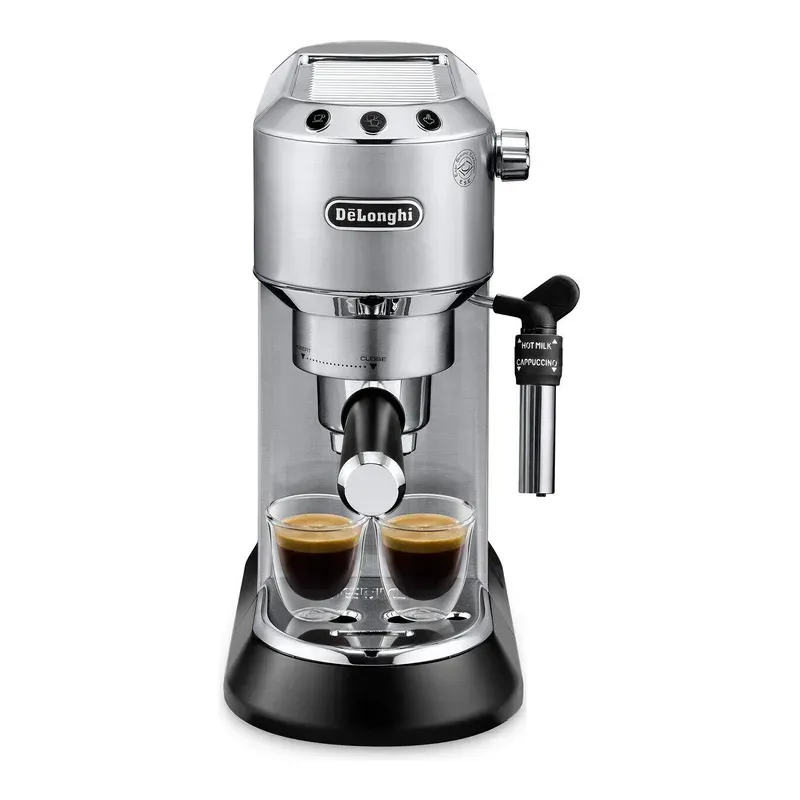
De'Longhi Dedica EC685
A 51 mm pressurised basket is the limit here, but swap in a non-pressurised one and it becomes a genuinely capable first machine.
- Type
- Single boiler, thermoblock
- Portafilter
- 51 mm, pressurised
- Width
- 15 cm
- Tank
- 1.1 L
How we test
Every machine on this list has been run for at least two weeks on the bench, pulling shots from the same two coffees, a medium-roast Brazilian blend and a washed Ethiopian, so that differences come from the machine rather than the beans.
Two weeks matters because the faults that decide whether you keep a machine do not appear on day one. Temperature drift between consecutive shots, how long the group takes to come back after steaming, whether the portafilter still seats squarely after a hundred locks: none of that shows in a shop demonstration.
Buy the grinder first
This is the least popular advice in coffee and the most reliable. A $200 machine paired with a $200 grinder outperforms a $400 machine paired with pre-ground coffee, every time, and it is not close.
The reason is structural rather than a matter of degree. The machine’s job is to push water through a bed at a controlled pressure and temperature. The grinder’s job is to make the bed. A machine cannot correct a bed that is wrong, because the defect is in the thing the water has to pass through. We put the two allocations against each other blind in the grinder or machine comparison and all four tasters picked the same side.
Take that seriously before reading any further, because it changes what budget you are actually shopping in.
Ignore the bar number
A machine advertising fifteen or twenty bars is quoting what the pump can produce against a closed valve. Espresso extracts at nine, and every machine worth buying has an over-pressure valve that dumps the rest.
So the number on the box is not a performance figure. If anything it correlates negatively with quality, because the machines that shout loudest about it are the ones sold on specification rather than on how they brew. What you want to know instead is whether the machine holds its brew temperature, and almost nobody prints that.
What each budget actually buys
| Budget | What you get | What it asks you to accept |
|---|---|---|
| $150–250 | Thermoblock, pressurised basket, small steam wand | Temperature wanders; swap the basket immediately |
| $250–600 | Single boiler, non-pressurised basket, real wand | No steaming while brewing; temperature surfing |
| $600–1200 | Heat exchanger or PID single boiler | Size, weight, warm-up time |
| $1200+ | Dual boiler, stable temperature, steam on demand | Price, and a ceiling you may never reach |
The first row is where our pick sits, and the note attached to it is the whole story: a pressurised basket is a workaround for bad coffee, designed to manufacture crema from pre-ground. Swap in a non-pressurised basket and the same machine becomes a real espresso machine that simply demands a real grind.
The jump worth understanding is from the second row to the third. What you buy there is not a better shot on your best day; it is the same shot on your worst one. Temperature holds, steam is available while you pull, and the machine stops being a variable you have to work around.
The compromises nobody lists
Three things that decide satisfaction and appear on no spec sheet.
Warm-up time. A thermoblock is ready in a minute, a single boiler in ten, and a dual boiler in twenty-five. If your coffee happens on the way out of the door, that is the specification that matters most, and it argues against the expensive machine rather than for it.
Water hardness. Scale kills more domestic machines than any other cause, and the interval is set by your water rather than by a calendar. On a hard supply, budget for a filter alongside the machine. Testing the water costs two euros and changes both the flavour and the lifespan.
Parts availability. A machine whose gaskets, screens and solenoid are orderable is a machine you keep for a decade. Baskets, gaskets and screens covers which ones wear and how often, and it is worth checking a model against that list before buying.
If you are starting from nothing
This guide assumes espresso is the decision you have already made. If it is not, it is worth saying plainly that espresso is the most demanding and least forgiving method in coffee, and that a hand grinder and an AeroPress make better coffee for sixty dollars than an entry-level machine does for four hundred.
The first setup guide lays out the tiers in order. If espresso is the goal anyway, what the method actually asks of you is worth reading before the purchase rather than after it, and expect the first month to be spent dialling in.
Frequently asked
- Do I need a separate grinder?
- Yes. Every machine in this guide performs worse with pre-ground coffee than a cheaper machine does with a good grinder. Budget for the grinder first.
- Is a higher bar rating better?
- No. Espresso extracts at nine bars. A machine advertising fifteen or twenty bars is quoting pump maximum, not brew pressure.