Compact machines
Compact espresso machines for a small kitchen
What actually takes the space
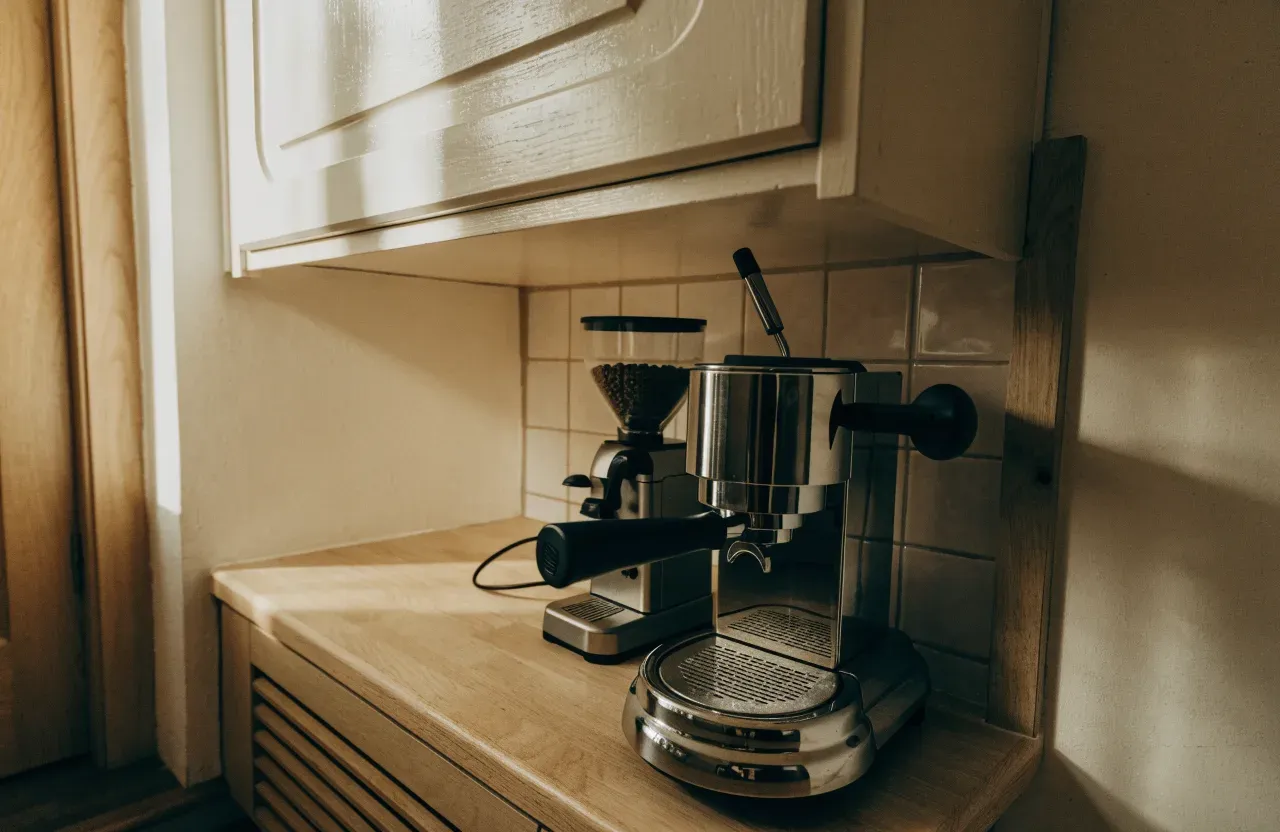
The width on the spec sheet is the least useful number the manufacturer prints. A machine is not a box you slide into a gap: it is a box with a handle that swings, a lid that lifts, a drip tray that pulls out and a cup that has to fit underneath while your hand is still holding it.
Four measurements decide whether a machine fits a small kitchen, and only one of them is on the box.
| What to measure | Why it bites | Rough allowance |
|---|---|---|
| Width plus handle swing | The portafilter arcs out to the right before it locks | Listed width plus 8-12 cm |
| Height plus tank lid | Most tanks fill from the top, under your wall unit | Listed height plus 12-18 cm |
| Depth plus cables and tank | The rear tank and the kettle lead both add depth | Listed depth plus 5-8 cm |
| Working height under the group | A travel mug is 15 cm tall, a cup is 8 cm | Measure the cups you own |
Height is the one that breaks purchases. Standard wall units sit around 45 to 50 cm above the worktop, and a machine 35 cm tall with a top-filling tank needs closer to 50. It will sit there perfectly well and you will never be able to fill it without dragging it forward twice a day, which is the kind of small friction that ends with the machine in a cupboard.
So before you read a single review, measure the slot: the clear width, the height to the cupboard, and the depth from wall to worktop edge. Then look for a machine with a front-removable or side-access tank, because that single feature buys back more space than any amount of narrow styling.
What a small machine gives up
Three things, and it is worth being precise about them because they are not equally important.
Thermal mass. A small boiler or a thermoblock holds less heat, so it is more affected by what you do to it. The shot pulls fine. The second shot, five minutes later, pulls at a slightly different temperature, and after steaming milk the machine needs time to come back down to brew temperature rather than being ready instantly. On a compact machine this is real, and it shows up as inconsistency that people usually blame on their grinder.
Steam power. This is the honest weak point. A small thermoblock can steam a 120 ml jug to a good cappuccino texture, and it will struggle with 400 ml for two lattes at once. It takes longer, the steam is wetter, and by the time you get there the milk has been in the jug too long. If you routinely make milk drinks for more than one person, this is the compromise you will notice first, not the espresso.
Tank capacity. A 1.4 litre tank is fine for solo espresso and disappears fast once milk drinks and rinses are involved. It is a habit change rather than a defect, and it only becomes a defect when the tank is behind the machine against a wall.
What it does not have to give up
Here is where the marketing gets confusing, because “compact” is used to mean two different things. There are machines that are small, and there are machines that are cheap and also happen to be small, and the second group gives up things the first group does not.
A small machine can and should still have a full-size 58 mm portafilter, or at least a serious 54 mm one, with a real basket rather than a pressurised insert. It can have a pump running at a sane pressure with an expansion valve, a thermostat or PID that holds brew temperature within a couple of degrees, and a steam wand you actually control rather than a panarello frother that only makes bubbles. None of those require volume. They require the manufacturer to have spent the money inside the case instead of on the case.
The cup itself is decided almost entirely by the grind, the dose and your consistency, which is why a compact machine paired with a good grinder beats a larger machine paired with a bad one every time. If the budget has to split, it splits toward the grinder. Our grinder guide under 300 covers that trade in detail, and why your espresso tastes sour explains why grind is the first thing to move when the shot is wrong.
Who a compact machine is genuinely right for
One or two people, one or two drinks at a time, in a kitchen where the machine has to share worktop with everything else. That describes most homes, which is why this category exists rather than being a consolation prize.
It is the wrong choice if you regularly make four milk drinks back to back, if you want to steam and pull at the same time, or if you have decided that the machine is the centrepiece of the kitchen and space is not the constraint. In that case the question is a different one, and we have answered it separately in do you need a professional machine at home.
For everyone else the practical shortlist is short: measure the slot, insist on a tank you can reach, insist on a real portafilter and a real steam wand, then spend what is left on the grinder. The espresso machine guide works through the specific trade-offs by price.
Frequently asked
- How much worktop space does a compact espresso machine actually need?
- Take the listed width and add about 10 cm on the handle side so the portafilter can swing out and lock in, plus roughly 15 cm of clearance above for the tank lid if the tank fills from the top. A machine listed at 20 cm wide and 33 cm tall realistically wants a slot of 30 cm by 48 cm, and that slot has to be reachable rather than merely empty.
- Do small espresso machines make worse coffee?
- Not inherently. Grind quality, dose and technique move the cup far more than machine size does. What a small machine gives up is recovery between shots and steam power for milk, so the espresso itself can be excellent while the third cappuccino in a row is not.
- Is a smaller water tank a real problem at home?
- For one or two people it rarely is, but it changes your habits. A 1.4 litre tank is roughly a week of solo espresso and about two days if you make milk drinks for two, so plan on refilling rather than forgetting it exists. A tank you can reach without moving the machine matters more than the number of litres.
Related reading
Real espresso in twenty centimetres
Small machines used to mean bad espresso. The compact category grew up, and the compromises moved somewhere more sensible.
A commercial machine at home
Power, plumbing, drainage and heat: what a bar machine actually demands of a kitchen, and when the answer is to buy a smaller machine instead.
Lever machines: spring against direct
A spring lever pulls a curve the machine decides. A direct lever pulls the curve your arm decides. That single difference sorts every lever machine sold.