Buying guides
The best coffee grinders under $300
Burr geometry, retention and step size decide what a grinder is good for. Here is which one to buy for espresso, for filter, and for both.
Featured
1 buying guides
Best all-rounder
Baratza
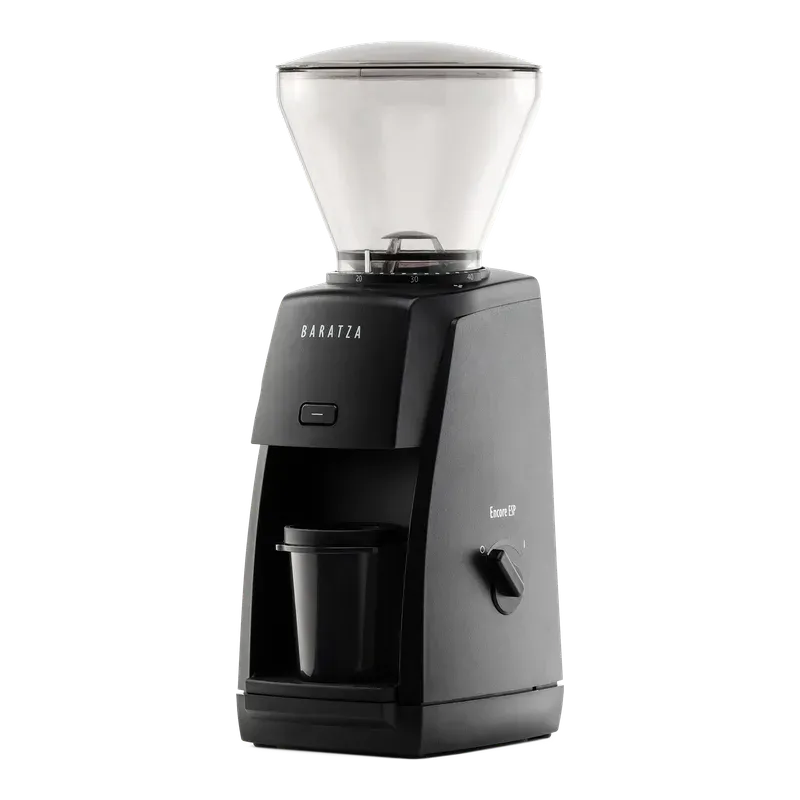
Baratza Encore ESP
Forty espresso steps is genuinely enough for a single-boiler machine, and every internal part is available separately.
- Burrs
- 40 mm conical, M2
- Steps
- 40 espresso / 20 filter
- Motor
- DC, gear reduction
- Retention
- Low, ~0.5 g
What separates a $100 grinder from a $300 one
Burr size and motor control, mostly. Bigger burrs cut more coffee per rotation, which means less heat and fewer fines. A gear-reduced DC motor holds its speed under load, which keeps the particle distribution stable from the first gram to the last.
Everything else on a spec sheet at this price is downstream of those two. Timers, hoppers, displays and grind-by-weight features change the ergonomics; they do not change what comes out. So the way to read this range is to ignore the features and ask four questions.
The four questions
How big are the burrs, and what shape? Forty millimetres is the working minimum for espresso and fifty-four to sixty-four is where the range gets genuinely good. Shape matters less than people argue about, and under $300 the answer is conical, because flat sets at this price are smaller and softer than the conicals they compete with and the theoretical uniformity advantage does not survive that compromise. Above $500 the argument reverses, which is why you see it made so confidently in both directions. The burr shapes piece has the full version.
Does the motor hold its speed? A universal motor spins fast and slows when the beans arrive. A gear-reduced DC motor turns slowly and holds. You can hear the difference: a DC grinder’s pitch stays flat through the dose, a universal motor’s drops and recovers. Pitch that drops means the last gram was ground coarser than the first.
How fine does it go, in usable steps? This is where filter grinders fail at espresso. Many have plenty of range but spread forty steps across all of it, so the entire espresso window falls between two clicks. A grinder aimed at espresso redistributes its steps rather than extending its range, which is a different thing from being “finer”.
What is the retention? Coffee that stays inside comes out with the next dose. Half a gram on eighteen is tolerable. Three grams means every shot is a blend of two bags, and no amount of technique fixes it. Short, steep chutes and single-dose designs retain least; tall hoppers with long paths retain most.
Reading the budget in three steps
| Budget | What you get | What you give up |
|---|---|---|
| Under $100 | A good hand grinder, or a poor electric | Speed, and any dose over about 25 g |
| $100–200 | Electric filter grinders, wide steps | The espresso range, usually entirely |
| $200–300 | Espresso-capable steps, DC motor, low retention | Stepless adjustment, burrs over 40 mm |
The jump that matters in this table is the second one, and it is not about quality. A $150 electric grinder is often a better filter grinder than a $250 espresso one, because its steps are spread across the range you are actually using. Buying up the range only helps if you are buying into espresso.
Below $100, the honest answer is that a hand grinder beats any electric you can buy. It is slower and it is better, and hand grinders explains where that stops being true, which is roughly at doses above 25 grams or more than about three drinks a day.
Our pick, and its ceiling
The pick above is the all-rounder because it answers all four questions acceptably and one of them very well: retention measured at 0.4 to 0.6 grams across twenty consecutive doses, which is low enough to single-dose without a bellows.
Its ceiling is stepped adjustment. There are bags where the right setting is plainly between two clicks, and you end up adjusting dose or ratio instead. That matters most with light roasts on a machine that holds temperature, and it disappears into the noise on a single boiler with a medium roast. The full review works through where the limit bites.
Before you spend the money
Two things worth settling first, because both can change the size of the purchase.
If you are buying a grinder and a machine at the same time, the split is the real decision and it is not even. The grinder or machine comparison put the two allocations head to head, and the result says put the weight on this side of the counter.
And if you already own a grinder that has started needing finer settings than it used to for the same coffee, you may not need a new one at all. That symptom is usually a burr chamber full of compacted fines, and cleaning and burr replacement costs a fraction of an upgrade. Rule that out before you read any further.
Frequently asked
- Conical or flat burrs?
- At this budget, conical. Flat burrs at under $300 use smaller, softer burr sets than the conicals they compete with, and the theoretical uniformity advantage disappears.