Manual machines
Manual lever machines, and who they are for
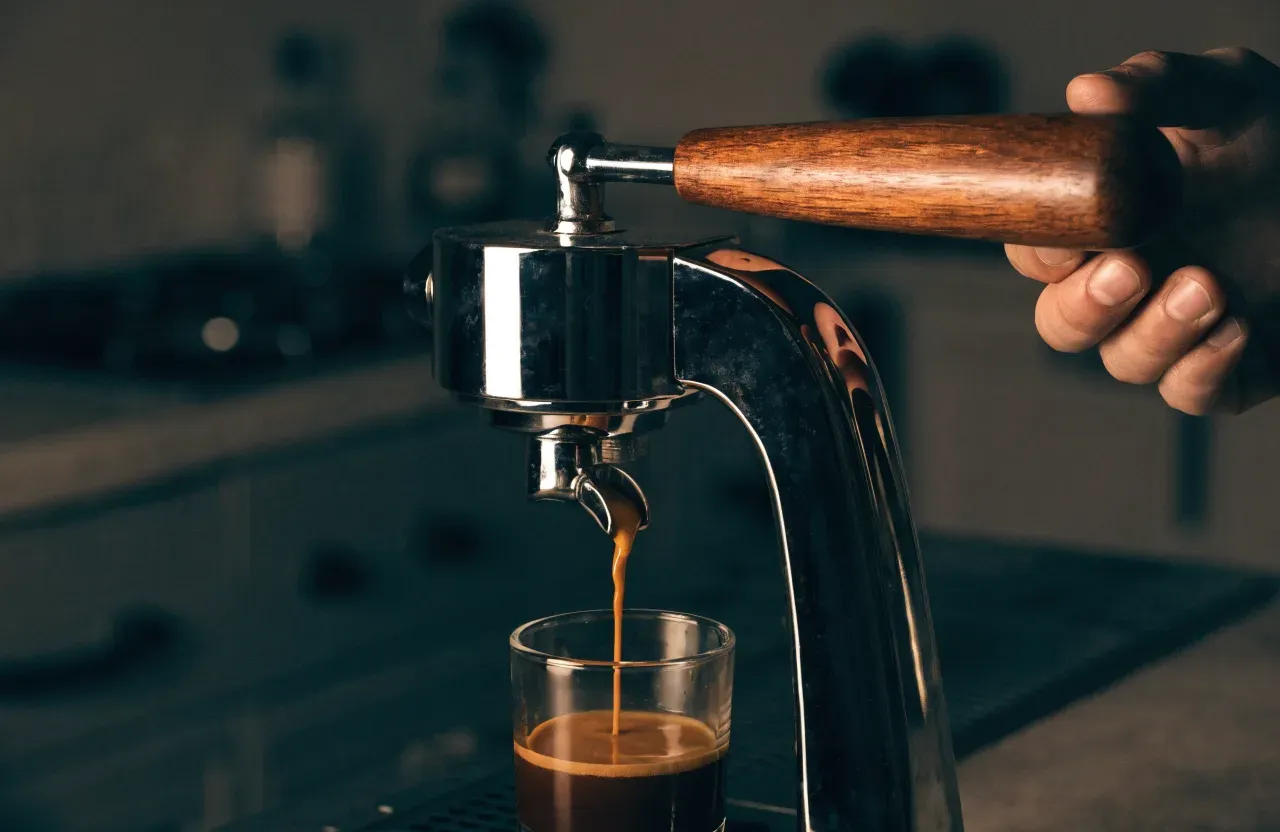
What a lever machine actually is
A lever machine has no pump. The pressure that pushes water through the coffee comes from a piston in the group head, and the lever is how that piston is driven. Water is drawn from a boiler into the cylinder above the puck, then forced down through it. That is the whole mechanism, and it has not needed to change since the late 1940s.
The reason people still buy them is that a pump holds one pressure while a piston does not. A pump set to nine bar delivers nine bar from the first second to the last. A lever delivers a curve: pressure rises as the piston engages, peaks, then falls away as the stroke completes and the coffee bed opens up. That declining profile is what lever shots are known for, and it is also what a lot of modern profiling machines are built to imitate electronically.
Spring lever against direct lever
These are two quite different machines that share a handle.
On a spring lever, pulling the lever down compresses a heavy spring and charges the cylinder with water. You let go, and the spring pushes the piston back up over roughly 20-30 seconds. The curve comes from the spring, so it is the same curve every time, usually starting around nine bar and decaying to six or lower. Your only inputs are the grind, the dose and when you release. It is the more forgiving of the two and the one most people should start with.
On a direct lever, sometimes called a manual lever, there is no spring. Your arm is the spring. You push down, and how hard you push at each moment is the pressure curve. That gives you total control, including things a spring cannot do, such as holding a very low pressure for ten seconds of pre-infusion and then ramping. It also means every shot depends on how you happen to push that morning.
The rule of thumb is that a spring lever is a machine with a personality and a direct lever is an instrument. Neither is a beginner’s machine, but a spring lever is far closer to one.
What profiling by hand gives you
The honest answer is smaller than the enthusiasm around it suggests, and it is specific.
The first real gain is pre-infusion. Wetting the puck at low pressure before the main stroke lets the bed settle and swell evenly, which reduces channelling and makes a light roast far easier to extract. This is the single biggest practical benefit, and on a direct lever you can hold it for as long as the coffee wants rather than for a preset interval.
The second is the tail. A declining finish extracts the last of the sweetness without dragging the bitter compounds that a flat nine bar keeps pulling. Shots tend to read as sweeter and more aromatic, with slightly less body than a pump shot at the same ratio.
The third is diagnostic. You can feel a bad puck. A lever that drops away under your hand is telling you the grind is too coarse or the distribution is poor, before you have tasted anything. That makes the link between grind size and extraction obvious in a way no gauge does.
What profiling does not do is rescue bad coffee, bad water or a bad grinder. If anything it is less tolerant of all three.
Temperature, and the small boiler problem
Most domestic lever machines carry a small boiler, often under a litre, and the group is heated by that boiler through conduction rather than by a dedicated circuit. Two consequences follow.
First, the group takes a long time to reach a stable temperature. Twenty to thirty minutes from switch-on is normal, and a machine used cold will pull a sour shot regardless of what you do with the lever. Many owners run a blank stroke to warm the piston and cylinder before the real one.
Second, temperature moves during a session. Pull three shots in ten minutes on a small boiler and the third is hotter, because the group has absorbed heat faster than the machine sheds it. Managing that is part of the craft: a cooling flush, a longer wait, or on some machines simply accepting a warmer third cup. This is also why water matters so much here. A small boiler scales quickly, and our piece on water as an ingredient applies with more force to a lever than to anything else in a kitchen.
| Spring lever | Direct lever | |
|---|---|---|
| Source of pressure | Charged spring | Your arm |
| Curve | Fixed, repeatable, declining | Whatever you shape |
| Pre-infusion | Short and preset | As long as you like |
| Effort per shot | One firm pull | Sustained push for 25-30 seconds |
| Consistency | Good once dialled in | Depends entirely on you |
| Learning time | Weeks | Longer, and never quite finished |
| Best suited to | Most home users wanting a lever | Light roasts and experimenters |
The maintenance reality
A lever is mechanically simple, and that is the whole appeal in the long run. No pump, usually no electronics beyond a thermostat, and parts that are still made. Machines from the 1980s are in daily use because everything on them can be replaced with hand tools.
The consumable is the group seals. They harden and shrink with heat, and when they go the symptom is a shot that starts well and loses pressure. Expect to replace them every year or two, which means a service kit, an hour, and a willingness to take a group apart. Descaling matters more than on a pump machine, because a scaled cylinder wall chews seals.
If none of that appeals, buy a good semi-automatic machine instead and spend the difference on the grinder. A lever asks for attention, and rewards it, but it is a poor choice for anyone hoping the machine will simply work.
Frequently asked
- Is a lever machine harder than a normal espresso machine?
- Harder to be consistent with, easier to understand. Everything happens where you can see and feel it, so you learn faster why a shot went wrong. What takes weeks is repeating a good one, because your arm is now one of the variables and arms are not calibrated.
- Do I still need a good grinder for a lever machine?
- More than ever. A lever is unusually sensitive to grind because there is no pump holding a set pressure against a bad puck, so a coarse or uneven grind simply runs through and the lever drops. Budget for the grinder first if you have to choose.
- How often do lever machines need servicing?
- The group piston seals are a wear item and typically want replacing every year or two depending on use, which is a straightforward job with a service kit. Beyond that they are mechanically simple, with no electronics and often no pump, which is exactly why thirty-year-old ones are still in daily service.
Related reading
Real espresso in twenty centimetres
Small machines used to mean bad espresso. The compact category grew up, and the compromises moved somewhere more sensible.
A commercial machine at home
Power, plumbing, drainage and heat: what a bar machine actually demands of a kitchen, and when the answer is to buy a smaller machine instead.
Bringing a 1970s lever back to life
A fifty-year-old lever machine is mostly brass, a spring and four seals. Here is the order to work in, and the two faults that mean walk away.