Automatic machines
Automatic or semi-automatic: which espresso machine to buy
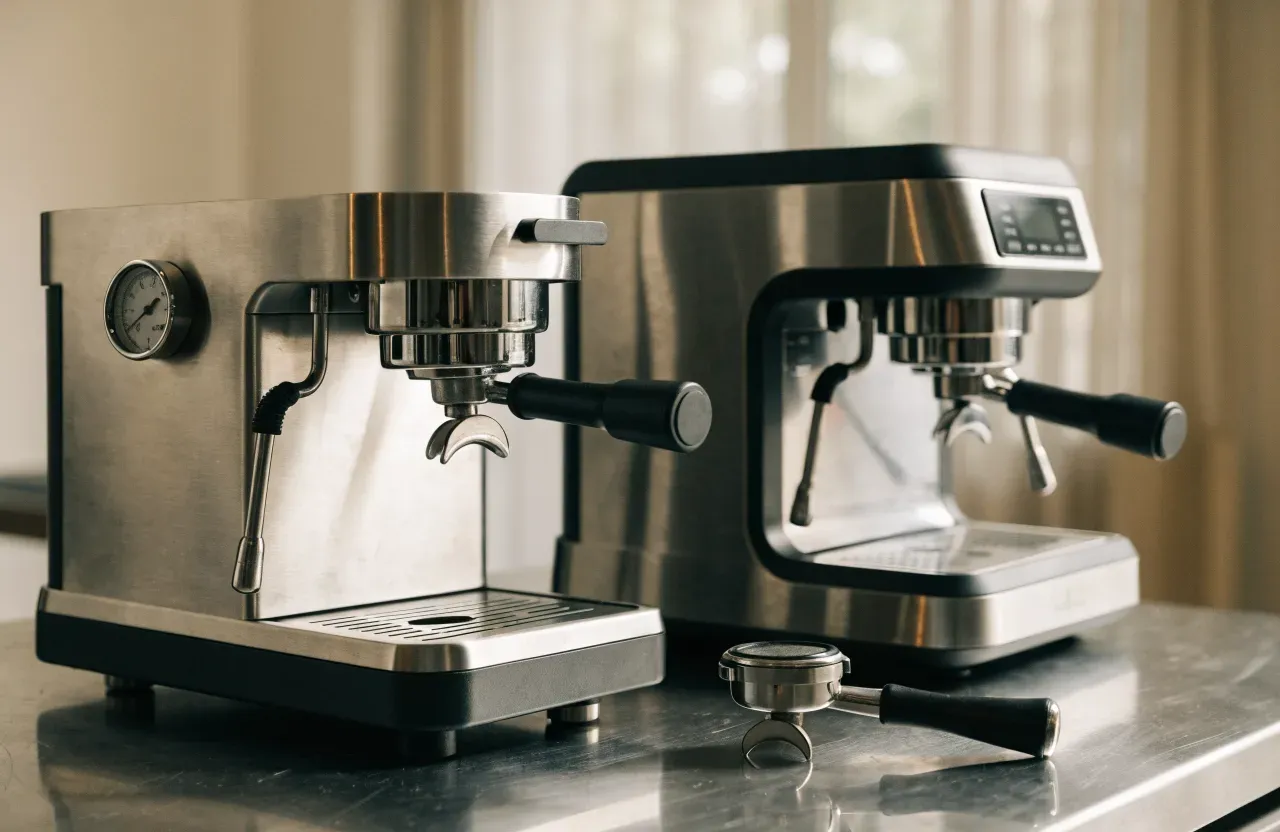
The words mean less than the shop implies
Strip out the marketing and the difference is one thing: who decides when the shot stops.
A semi-automatic machine has a pump and a switch. You lock in the portafilter, start the pump, watch, and stop it yourself. Everything else, grind, dose, tamp, ratio and timing, is yours.
An automatic machine, sometimes called volumetric, has a flow meter in the water line. You press a programmed button, the meter counts a set volume of water through the group, and the pump stops on its own. You still grind, dose and tamp exactly as before.
A super-automatic, which shops usually sell as bean to cup, does the grinding, dosing, tamping and brewing itself. That is a different category rather than a further step, and we cover it in bean to cup machines, explained.
So the automatic label buys you one thing: the machine ends the shot. Everything people associate with better machines, temperature stability, pressure control, pre-infusion, is sold separately and can appear on either type.
Which variable each one takes away
Semi-automatic takes nothing away, which is either the appeal or the problem. You are responsible for stopping at the right yield, which in practice means watching a timer or, much better, a scale. If you already weigh your shots to a 1:2 ratio, the automatic feature is solving a problem you have already solved more accurately.
Automatic takes away shot volume. This sounds minor and is genuinely useful in one situation: when more than one person uses the machine, or when you are steaming milk with your hands full while the shot runs. It becomes less useful the more precise you want to be, because a flow meter measures water into the group rather than liquid into the cup. Change the basket, change the grind, or change how much crema the coffee throws, and the finished weight moves while the programmed volume does not.
The features worth paying attention to are the ones that sit underneath both labels.
PID temperature control replaces a mechanical thermostat that swings several degrees with a controller that holds within roughly one. It is the single most valuable upgrade on most machines, because brew temperature is invisible: a cool group gives you a sour shot and no clue that temperature rather than grind is the cause.
Pre-infusion wets the puck at low pressure before the pump ramps up, so the bed swells evenly and is less likely to crack and channel. It can be a timed line pressure soak, a programmable ramp, or on a paddle machine simply how far you open the valve.
A paddle or lever valve on the group gives you manual control over flow at the start and end of the shot. It is a semi-automatic feature that does much of what a lever machine does, and it is worth more than volumetric buttons to anybody chasing light roasts.
| Semi-automatic | Automatic (volumetric) | |
|---|---|---|
| Who stops the shot | You | A flow meter |
| Variable removed | None | Shot volume, approximately |
| Grind, dose, tamp | Yours | Yours |
| Works with a scale | Perfectly | Fights it slightly |
| Hands free while brewing | No | Yes |
| Good for several users | Only if all are trained | Yes |
| Typical extras worth having | PID, paddle, pre-infusion | PID, pre-infusion |
How to choose by your mornings
Start from the morning, not the spec sheet.
If your morning has four minutes in it and you enjoy them, buy semi-automatic and put the saved money into the grinder. The grinder is the component that limits everything else, and a modest semi-automatic machine with a good grinder beats a feature-heavy machine with a poor one every time. Our grinder guide is the place to start on that side, and the espresso machine guide covers what to look for on the machine.
If your morning has two people in it, or a machine used by a household where not everybody wants to learn, volumetric buttons earn their place. Consistency across users is a real benefit and the loss of precision is small.
If your morning has ninety seconds in it and no interest at all, neither of these is the right purchase. A bean to cup machine or a capsule machine will serve you better than a portafilter that becomes a guilt object on the worktop.
The order to spend money in
Whichever type you choose, the priority is the same and it is worth stating plainly, because it is the opposite of how machines are marketed.
Grinder first. Then temperature stability, meaning PID or a machine with enough thermal mass to be predictable. Then the ability to influence the start of the shot, meaning pre-infusion or a paddle. Then, a long way behind, volumetric programming.
Nothing on that list is an argument against automatic machines. It is an argument that automatic against semi-automatic is a smaller decision than the shop floor makes it look, and that the money saved by not caring about it is better spent one component upstream.
Frequently asked
- What is the difference between automatic and super-automatic?
- An automatic machine still takes a portafilter you fill and tamp yourself; it just stops the shot at a measured volume. A super-automatic, usually sold as bean to cup, grinds, doses, tamps and brews on its own. They sound similar and are very different machines.
- Is PID worth paying for?
- More than almost anything else on the spec sheet. A PID holds brew temperature within about a degree instead of the several degrees a plain thermostat swings through, which removes a variable you cannot see and cannot correct for. It matters most with light roasts, which are the least forgiving of a cool group.
- Does volumetric dosing measure the coffee or the water?
- The water. A flow meter counts what passes into the group, not what lands in the cup, so a different basket, a choked puck or a change in crema will all shift the finished weight slightly. That is why a scale under the cup remains more accurate than any volumetric setting.
Related reading
Real espresso in twenty centimetres
Small machines used to mean bad espresso. The compact category grew up, and the compromises moved somewhere more sensible.
A commercial machine at home
Power, plumbing, drainage and heat: what a bar machine actually demands of a kitchen, and when the answer is to buy a smaller machine instead.
Lever machines: spring against direct
A spring lever pulls a curve the machine decides. A direct lever pulls the curve your arm decides. That single difference sorts every lever machine sold.