Tamping
Tamping: level matters, pressure barely does
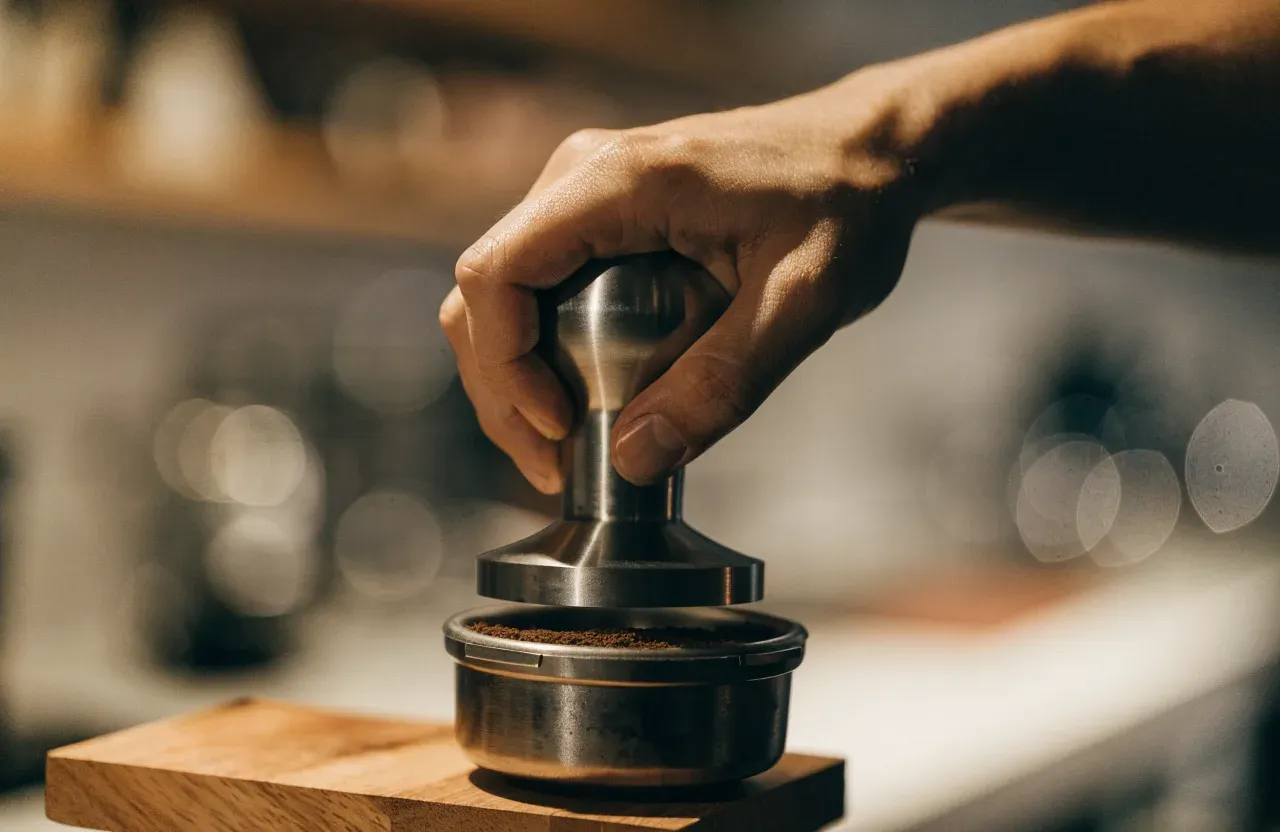
The 30 lb rule, and where it came from
Most people learn a number before they learn anything else about tamping: press with thirty pounds of force. The figure has a real origin in barista training, where a bathroom scale and a portafilter made a memorable classroom demonstration, and it survived because it is easy to repeat. What it is not is a target worth hitting.
The reason is that coffee grounds stop compressing. Press a level bed of coffee and it compacts quickly, and once the particles have found their positions against each other the bed is essentially at its final density. Whether you stopped at fifteen pounds or carried on to forty, the resistance the water meets is very nearly the same. Tests by baristas and by equipment makers have found small flavour differences at the extremes, and the interpretation of those differences is contested, but nobody has produced a case that an ordinary shot is transformed by pressing harder.
What a heavy tamp does reliably produce is variation. Thirty pounds is hard to repeat by feel, so people who chase it apply a different force each time, in an arm position that makes going in level harder.
Level is the thing that actually matters
Water takes the easiest route through the puck, every time, without exception. If one side of the bed is more compacted than the other, the water goes through the loose side, moves too fast through it, and barely touches the dense side. You get over-extraction and under-extraction in the same cup, which tastes simultaneously sharp and harsh and cannot be fixed by grind.
That is channelling, and an angled tamp is one of its most common causes. A tamper that goes in two degrees off leaves a wedge, and two degrees is smaller than it sounds when you are pressing at a worktop that is slightly too high for you.
So build the level in rather than aiming for it. Put the portafilter flat on the bench or in a tamping stand instead of holding it in the air. Stand so your forearm can come straight down over it, with your elbow above your wrist and your wrist straight. Press down, pause for a moment, and lift straight up without twisting. The polish, the little twist at the end that supposedly seals the surface, does nothing useful and can smear the top layer.
If you want to know whether your tamp is level, the cheapest test is a bottomless portafilter. A level bed gives streams that converge into one within a few seconds. A wedge sprays.
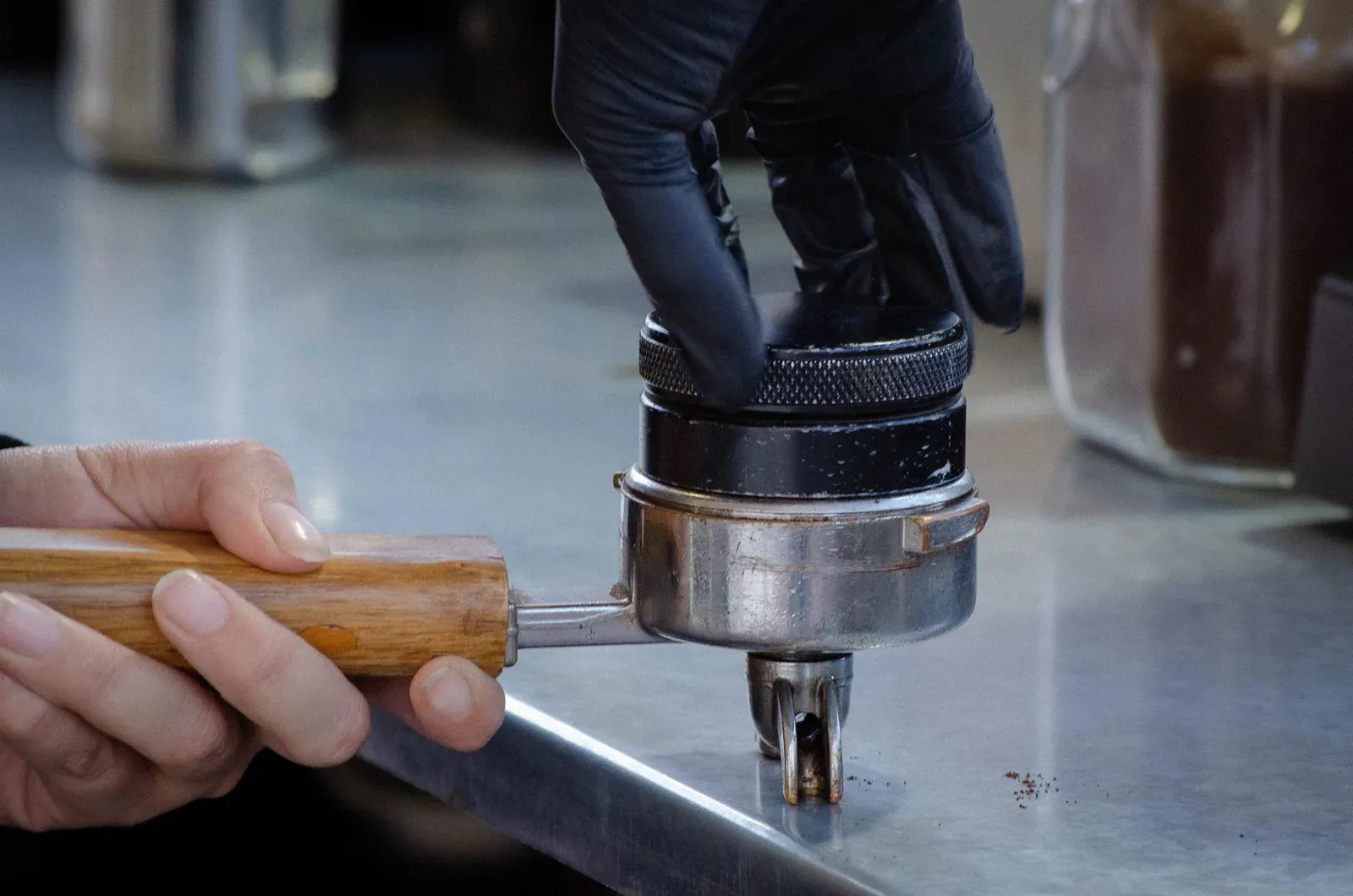
Distribution comes before the tamper
Here is the uncomfortable part: by the time the tamper arrives, most of the outcome has already been decided. A tamp compacts what is in front of it. It cannot move coffee sideways, and it cannot break up a clump that is sitting under the surface.
Grinders produce clumps. Static makes ground coffee stick to itself and to the chute, and what lands in the basket arrives in lumps with gaps between them. Press that flat and the surface looks perfect while the density underneath is uneven, which is exactly the condition that produces a channel through a beautifully tamped puck.
This is why the needle technique exists, usually abbreviated to WDT. Stirring the dry grounds with several fine needles breaks the clumps and redistributes the coffee through the full depth of the basket rather than just across its top. It takes about ten seconds, the tool costs almost nothing, and it does more for shot consistency than any tamper at any price. If you buy one thing after reading this, buy that.
Spinning distributors, the flat discs that screw down onto the surface, are a different and weaker tool. They level the top and can compact the outer ring, but they do not reach the clumps below. They are not useless, and they are not a replacement for stirring.
Fit, and the rim nobody thinks about
A tamper that is too small for the basket leaves an untamped ring around the edge. Water finds that ring immediately, and you get an edge channel on every single shot regardless of how carefully you pressed.
Baskets are not all the same width even at the same nominal size, so the honest advice is to measure yours rather than to trust the label.
| Tamper fit | What happens at the edge | Verdict |
|---|---|---|
| Noticeably undersized | A loose ring the water escapes through | Replace it |
| About 0.5 mm under the basket | Clears the wall, compacts the full bed | The usual target |
| Exactly basket width | Binds and can wedge or tilt | Awkward in practice |
| Self-levelling or palm style | Rests on the rim, sets its own depth | Removes the angle problem |
Base shape is a smaller question. A flat base is the straightforward choice and the easiest to judge level. A convex base is argued to help the edge, and the claim is contested.
The spring tamper, and your wrist
Calibrated tampers, which collapse at a set force and click, are often sold as precision instruments. That is the wrong reason to buy one, since the force they are measuring is the part that barely matters.
The right reason is your wrist. Pressing hard, repeatedly, with a joint that is not quite straight, is how baristas develop tendon problems, and it happens to home users pulling several shots a day too. A spring tamper stops at a fixed point, which removes the incentive to lean on it and takes the peak force out of every push. The self-levelling versions that rest on the basket rim solve the angle problem at the same time, which is the one that genuinely affects the shot.
That combination is worth paying for. The click is not.
If you are still getting uneven shots after all of this, the bed may not be the culprit at all, and working through the symptoms in order in espresso troubleshooting will find it faster than another new tamper.
Frequently asked
- How hard should I tamp?
- Hard enough to compact the bed and no harder, which for most people is somewhere around the weight of a firm push rather than a measured figure. Once the grounds stop moving under the tamper, further force is going into your wrist rather than into the coffee. Consistency matters more than the number.
- Do I need a distribution tool as well as a tamper?
- You need something that evens the bed, and a needle tool costs very little and does the job better than most spinning distributors. A distributor levels the surface; a needle tool breaks up clumps through the depth of the puck, which is where uneven density actually lives.
- Should I tap the portafilter to settle the grounds?
- Tapping the side after tamping is a habit worth dropping, since it can crack the puck and open a route for water. Tapping the base gently before tamping, to settle grounds into the corners, is harmless. If you need either to get a level bed, the problem is upstream in how the coffee left the grinder.
Related reading
Dialling in a new bag
A repeatable routine for the first four shots from a new coffee: what to fix, what to change, and how to know when you are done.
Pre-infusion and the bloom
Wetting the coffee before you brew it properly is the same idea on an espresso machine and on a pour over. What it fixes, and how long it should last.
Puck prep: WDT and distribution
What happens between the grinder and the group head decides the shot. Clumps, distribution tools, the WDT needle, and which steps are worth the time.