Flat white
The ristretto base, explained
What a ristretto is, in numbers
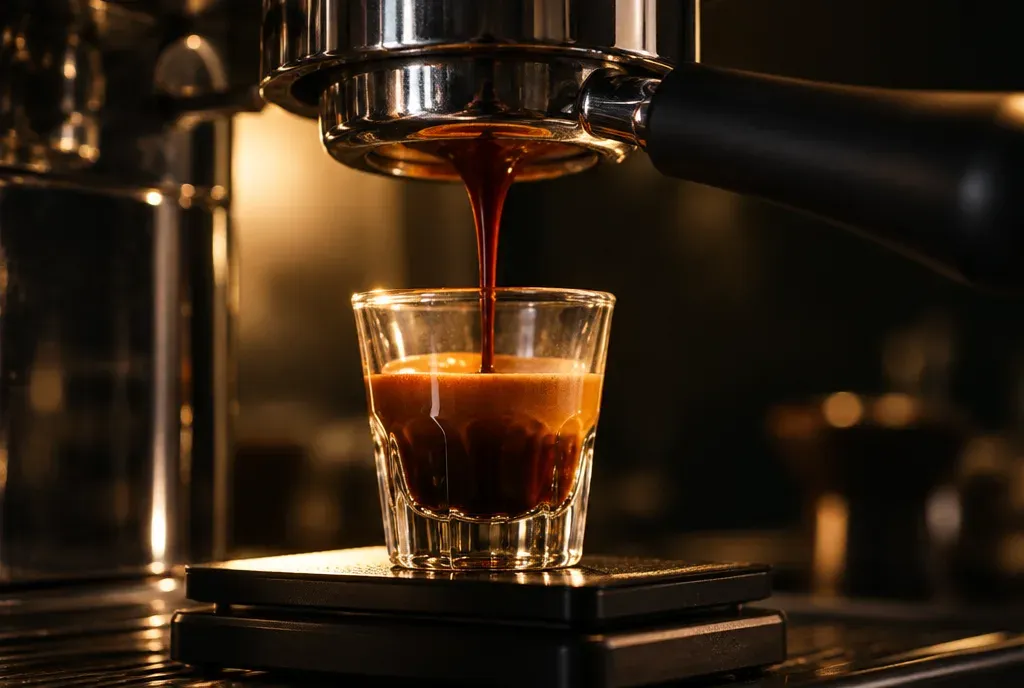
A ristretto is an espresso stopped early. The usual build is 20 g of dry coffee in the basket and about 32 g of liquid in the cup, a ratio of roughly 1:1.6. Set that against a standard espresso, which is 18 g in and 36 g out, or 1:2, and against a lungo, which runs on to 1:3 or beyond.
Two things are worth separating there. The ratio changed, and the time did not. A well made ristretto still takes 25 to 30 seconds. What has changed is how much water passed through the bed in that time, which means the grind must be finer to slow the flow down. A ristretto is not “the same shot, cut short”. It is its own recipe with its own grind setting, and treating it as a shortcut is the source of almost every disappointing one.
The name helps. Ristretto is Italian for restricted, and what is restricted is the water, not the coffee. The dose is the same or larger than in a normal shot.
What comes out early, and what stays in the basket
Extraction is not uniform over the life of a shot. Acids and the lighter aromatic compounds are the most soluble and leave first. Sugars and the browning compounds from roasting follow. Bitter compounds, dry-tasting polyphenols and the thin, papery notes at the end come out last, and they come out slowly.
Stopping at 32 g means you have taken the acids and most of the sugars and left a good part of the bitter tail in the puck. What lands in the cup is the dense, syrupy front of the shot: heavy body, obvious sweetness, low bitterness, and a short finish because the compounds that make a shot long are the ones you skipped.
That short finish is why a ristretto can read as unfinished on its own, and why it is so good under milk. Milk does not need length from the coffee. It needs body and sweetness to survive 110 ml of it, and those are exactly the things the first two thirds of a shot carry. A flat white built on a ristretto tastes concentrated rather than merely strong, and it is the same principle behind a piccolo and behind most cafes’ default shot for their smaller milk drinks.
The grind has to move, or the shot runs fast and sour
Here is the failure mode, and it is extremely common. Someone dials in a good espresso at 18 g in, 36 g out, 28 seconds. They then pull the same shot and stop the scales at 32 g, which happens at around 22 seconds, and the drink tastes sharp and hollow.
Nothing mysterious happened. They served the first 22 seconds of a shot that was ground for 28, so the water spent less time in contact with the bed than the recipe was ever designed for. That is under-extraction, and under-extraction tastes sour. It is the same diagnosis as a sour espresso and the same fix: grind finer, one step at a time, until 32 g takes 25 to 30 seconds again. Expect to move one or two steps on most grinders, and expect to move further on a light roast.
You will feel the difference in the basket too. A ristretto grind gives more resistance, so the pour starts later and runs slower and darker. If the shot gushes or blonds early, you are still too coarse whatever the scales say.
When a ristretto base is the wrong call
A ristretto is a tool for a specific job, not an upgrade. Skip it when:
The coffee is a filter roast or a light roast. Light roasts are physically harder to extract, so a recipe that deliberately shortens the extraction starts from behind and stays there. You get acidity without the sweetness that would balance it. Give a light roast more water, more time and more heat rather than less.
The drink is already long. A 240 ml latte needs a shot with enough substance to reach the last mouthful. Cutting it to 32 g under 200 ml of milk gives a weak, milky drink. Pull a full double, or a triple, and let the ratio do the work.
The coffee is already sweet and heavy. A dark, chocolatey blend at 1:2 may already be giving you everything a ristretto would. Shortening it then mostly adds weight and takes away clarity, and the shot starts to taste flat.
The honest test is to make both, side by side, with the same coffee and the grind properly adjusted for each. One will obviously belong under milk and the other in a cup on its own, and which is which changes with the coffee.
Frequently asked
- What ratio is a ristretto?
- Around 1:1.6. The common build is 20 g of coffee stopped at about 32 g in the cup, against a normal espresso at 1:2, which is 18 g in to 36 g out. Anything from 1:1.5 to 1:1.75 is fair game; the number that matters is that you stopped early, on a grind fine enough to keep the time up.
- Do I have to change the grind for a ristretto?
- Yes, and this is the step most people skip. Stopping an espresso grind early gives you 32 g of the first part of a fast shot, which is under-extracted and sour. Go one or two steps finer so 32 g still takes 25 to 30 seconds, and you get the concentrated, sweet shot the drink is built on.
- Is a ristretto stronger than an espresso?
- More concentrated, not more extracted. There is less water carrying the same dose, so every millilitre is denser and the drink tastes heavier and sweeter. Total extraction is actually lower, because the last third of the shot never happened.
Related reading
Volumetric, paddle or button
How a bar machine decides when to stop a shot, why volumetric dosing drifts, and what a paddle gives back to the person holding it.
Resting coffee: why a fresh roast is not ready yet
Roasted coffee is full of carbon dioxide for days. How long to rest beans for filter and for espresso, and what a bag that is too fresh does to the cup.
Dialling in a new bag
A repeatable routine for the first four shots from a new coffee: what to fix, what to change, and how to know when you are done.