Capsules
What is actually inside a capsule
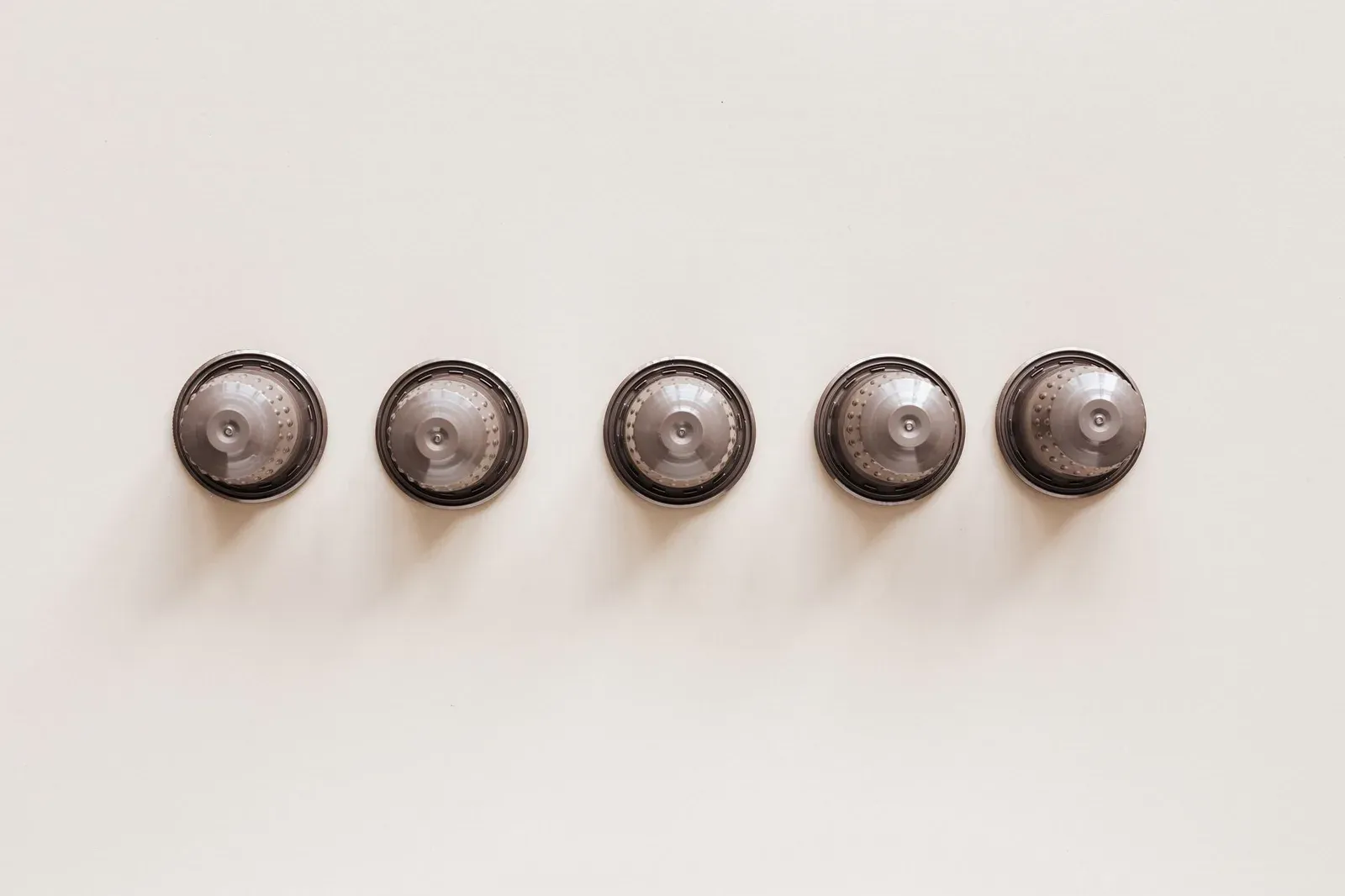
Open one and there is less than you think
Cut a standard espresso capsule in half and you find roughly 5 to 6 grams of ground coffee, occupying maybe two thirds of the interior, a paper or plastic filter disc at the outlet end, and a lot of carefully designed empty space.
A larger lungo or filter-style capsule runs 7 to 12 grams. A refillable basket will take a little more because it has no headspace to protect.
That five grams is where the arguments about cost start, and it is also misleading, because the coffee is the cheapest and simplest part of what you are holding.
The atmosphere is the product
The reason a capsule works is not the coffee. It is that the coffee has been sealed away from oxygen since minutes after grinding.
Industrial lines grind, dose, flush the headspace with nitrogen or a nitrogen-CO2 mix, and seal, in a continuous process. Residual oxygen inside a finished aluminium capsule is typically under one per cent and often under half. For comparison, air is 21 per cent.
The consequence is genuinely counterintuitive. Ground coffee in a bag you opened three weeks ago is measurably staler than ground coffee in a sealed capsule roasted eighteen months ago, because staling is oxidation and one of them has been sitting in air. Capsules are not fresh coffee. They are coffee that has been prevented from ageing, which in a kitchen where the alternative is an open bag of pre-ground is not nothing.
Plastic capsules are a step down here. Polypropylene is not a perfect oxygen barrier, so most use a multi-layer wall with an EVOH barrier film, and their real shelf life is shorter than aluminium’s whatever the printed date says.
The shell has to hold pressure
An espresso machine pushes water at 9 bars into a sealed container, and many capsule machines run their pumps higher, at 15 to 19 bars, before the restriction downstream drops it. The capsule has to hold that without splitting, from the moment the piercing plate closes to the end of the shot.
This is why the walls are ribbed, why the rim geometry is so precise, and why compatible capsules fail more often than original ones: the tolerance that stops a capsule blowing out is measured in tenths of a millimetre.
The extraction sequence inside is fixed by the machine. Needles or a plate pierce the lid, water enters, pressure builds against the outlet membrane until it ruptures or opens, and the coffee flows. The user has no control over temperature, pressure, time, dose or grind. All five were decided months earlier, in a factory.
Which changes how the coffee is chosen and roasted
Once you cannot adjust anything, the target changes. A roaster building a capsule line is not chasing the best possible cup. They are chasing the cup that survives a machine with no adjustments, across a range of water hardnesses, at whatever temperature the machine happens to deliver that morning.
That points at a specific kind of coffee: a blend rather than a single lot, because a blend can be held constant; a medium to dark roast, because it extracts more predictably and reads as full-bodied at a short contact time; and a grind on the coarse side of espresso, because a fine grind in a fixed capsule risks choking or channelling with no recourse.
It also points away from anything delicate. The florals of a light-roasted Ethiopian need a controlled brew to show up, and a capsule cannot give them one. The specialty capsule lines that do exist work hardest on this problem, and the good ones succeed at the cost of tasting a little more restrained than the same coffee from the same roaster in a bag.
The filter, and why it matters more than it sounds
At the outlet there is a membrane, usually a filter paper on original systems and sometimes a moulded plastic grid on cheaper compatibles.
Paper holds back fines and some oils, giving a cleaner cup and a more consistent flow. A plastic grid lets more through, which gives more body and more risk of a gritty shot and an uneven extraction. If two capsules with identical coffee taste different, this is usually the reason.
Aluminium, plastic, compostable
Aluminium is the best barrier, holds pressure well, and is infinitely recyclable in principle. In practice it has to reach a facility that handles small items, which is why the brands run their own collection schemes.
Plastic is cheaper, a worse barrier, and effectively unrecycled in most municipal systems because a coffee-filled multi-layer capsule is not something a sorting line wants.
Compostable capsules are made of PLA or a starch composite and require industrial composting at around 60 °C for weeks. In a home compost heap they sit there. In a general waste stream they are incinerated like the plastic ones. They are also the weakest oxygen barrier of the three, so they carry the shortest real shelf life.
What this all adds up to
A capsule is a solution to a logistics problem: deliver a repeatable espresso-like drink, at home, with no skill, no grinder, no cleaning and no staling. Judged against that brief it is an impressive piece of engineering, and the five grams of coffee inside are the least interesting thing about it.
Judged as coffee, it is capped. You are buying a cup that was fully determined before you touched it, by people optimising for consistency across millions of units. That is a reasonable trade to make on a Tuesday morning, and it is also why nobody who makes capsules drinks them at the weekend.
Related reading
Buying a decaf that tastes of coffee
Decaf stopped being a punishment about fifteen years ago. What to look for on the bag, what to avoid, and how to brew it so it holds up.
Reading a supermarket shelf
Most of what a coffee pack tells you is regulated, vague or both. What the words mean, which number matters, and how to find the two decent bags.
Pre-ground, done as well as it can be
Sometimes a grinder is not going to happen. Here is how to buy ground coffee, store it and brew it so it gives you most of what it still has.