Bean-to-cup machines
Bean to cup machines, explained
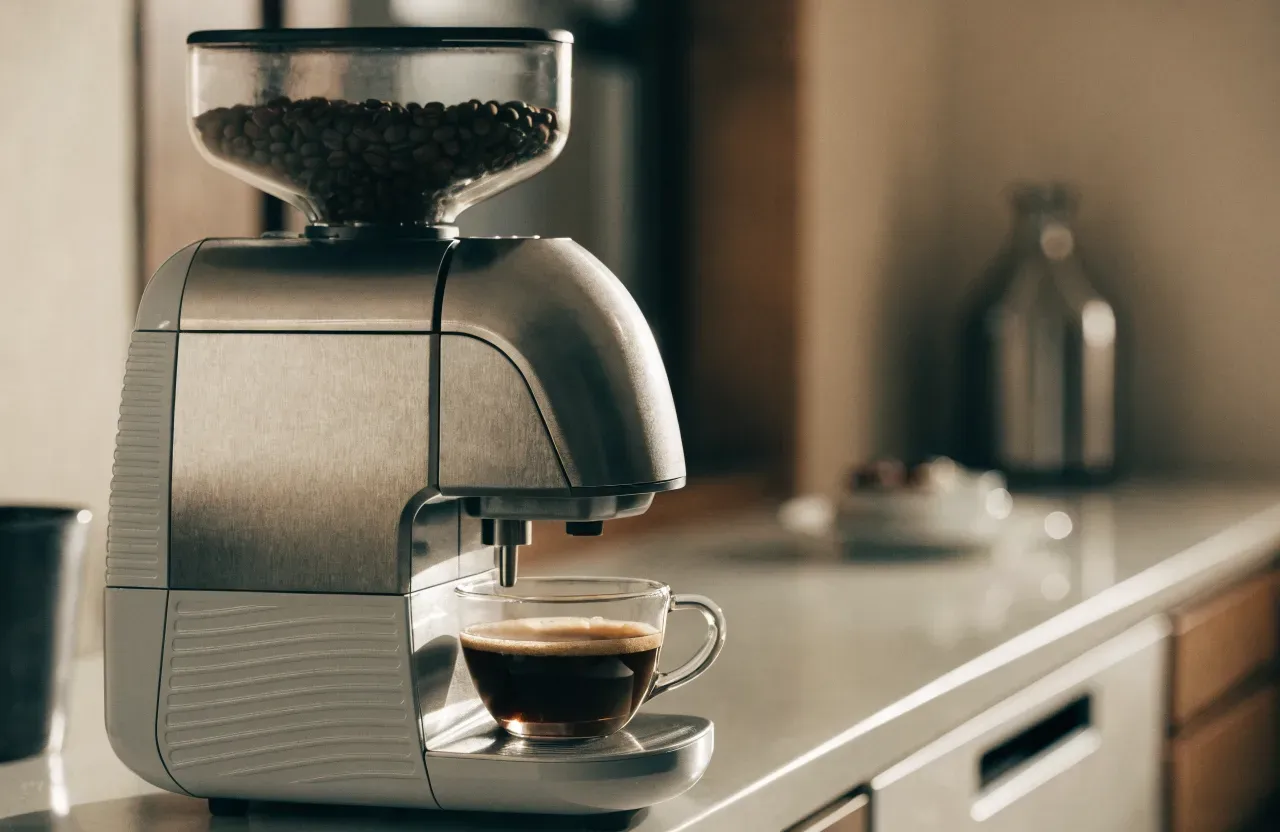
What the machine actually does for you
A bean to cup machine takes over the whole chain between a bag of whole beans and a finished drink. Press a button and it grinds a dose, drops the grounds into a small brew chamber, compresses them with a fixed mechanical tamp, pushes hot water through at roughly nine bar, ejects the used puck into an internal bin and rinses the group. On any model with a milk carafe or an automatic wand, it also steams and pours the milk, then flushes the milk line.
That is five or six separate skills folded into one press. Each of them is a place where a person can go wrong, and the machine does not go wrong in the same way twice. The dose is the dose. The tamp pressure is the tamp pressure. That consistency is genuinely the product here, and it is worth saying clearly rather than treating it as a consolation prize.
What the machine cannot do is taste the result. It has no idea whether the shot ran sour, and it will reproduce a mediocre extraction with perfect reliability until somebody changes the grind setting. It is a machine that removes variance, not one that finds the right answer.
What you give up
The trade is control, and it is specific rather than vague. On a manual setup you can change grind, dose, tamp, pressure, temperature and time independently. On a bean to cup machine you typically get a grind dial with ten or so steps, a strength setting that mostly changes the dose, a volume setting, and a temperature choice with three positions. Dose range is usually capped somewhere around 11-12 g, because the brew unit is a small fixed chamber. That ceiling is why the espresso tends to read as lighter in body than an 18 g basket from a manual machine.
The grinder is the other honest limit. A built-in grinder is engineered to fit inside a machine that also has to house a boiler, a pump and a brew unit, and it is priced as one component of the whole. A dedicated grinder at the same money as the entire appliance is a different class of thing. If you have read our piece on why grind size matters more than almost anything else, this is the compromise that piece is warning about.
There is also no diagnosis. When a shot tastes wrong on a manual machine you can watch it run, see it channel and respond. Here the extraction happens inside a sealed unit, so a sour shot gives you one lever, the grind dial, and no evidence about why.
Cleaning is the part nobody mentions in the shop
Every advantage above comes back as maintenance. The brew unit needs rinsing regularly and, on removable-unit machines, a proper wash under the tap every week. Machines with a sealed unit instead want cleaning tablets on a cycle they will remind you about. The grounds bin fills faster than you expect, roughly every eight to ten drinks, and it needs emptying before it is full or it jams the ejector.
Milk is the serious one. A milk circuit is warm plastic tubing full of protein, and it must be flushed after every milk session and stripped down weekly. This is not fussiness. A neglected milk line is the most common cause of a bean to cup machine that “started tasting off”, and no amount of good coffee fixes it.
Set against that, the daily cleaning burden is lower than a manual setup with a separate grinder, where you are wiping a portafilter, knocking a puck, purging a steam wand and brushing a grinder chute. The bean to cup machine moves the work from every drink to every week.
Who it genuinely suits
An office, first. Ten people with no shared technique will get better coffee from a button than from a machine that assumes a trained hand, and the consistency argument becomes overwhelming when the alternative is nine different opinions about tamping.
A household where somebody wants a drink and nobody wants a ritual, second. If the honest answer to “do you want to spend four minutes on this” is no, then a manual machine will quietly become an expensive kettle.
A household with mixed preferences, third. Long black for one person, cappuccino for another, hot milk for a child, all from the same box without retraining anyone.
Who it does not suit: anyone who wants to chase a specific cup. If you enjoy adjusting things, the lack of feedback will frustrate you within a month, and a semi-automatic machine is the better buy at any budget.
Bean to cup against the alternatives
| Bean to cup | Manual machine plus grinder | Capsule | |
|---|---|---|---|
| Effort per drink | One button | Three to five minutes | One button |
| Control | Grind, strength, volume | Everything | None |
| Ceiling on quality | Good, rarely excellent | Very high with practice | Fixed by the capsule |
| Cleaning | Weekly, and milk lines daily | Daily, but quick | Almost none |
| Cost per cup | Beans only | Beans only | Highest |
| Best for | Offices, mixed households | People who enjoy the process | Low volume, low effort |
The line that matters is the last one. These are not three points on a quality scale. They are three different answers to the question of how much of your morning the coffee is allowed to have. If the capsule column is what you are weighing instead, our piece on what capsule machines gain and give up covers that side properly.
Frequently asked
- Is a bean to cup machine real espresso?
- It is brewed at espresso pressure from freshly ground coffee, so yes in the sense that matters. The brew unit uses a small, fixed puck and a light automated tamp, so the result tends to be lighter in body than a well dialled shot from a manual machine. Most people notice the difference only when the two are side by side.
- How often do I really have to clean one?
- The machine will ask for a rinse most days, a brew unit clean weekly, a milk circuit clean after every milk session, and descaling on a schedule it sets itself. Skipping the milk clean is the single most common way these machines start making coffee that tastes stale.
- Can I use oily dark roast beans in one?
- You can, but the hopper and the grinder chute are the part that suffers. Very oily beans clog the chute and gum the burrs, which shows up as inconsistent dosing rather than as an obvious fault. A medium roast keeps the machine happier.
Related reading
A commercial machine at home
Power, plumbing, drainage and heat: what a bar machine actually demands of a kitchen, and when the answer is to buy a smaller machine instead.
Lever machines: spring against direct
A spring lever pulls a curve the machine decides. A direct lever pulls the curve your arm decides. That single difference sorts every lever machine sold.
Single boiler, heat exchanger or dual boiler
The three ways a machine makes brew water and steam at once, what each one costs you in waiting, and which one suits how you actually drink.