Capsule machines
Capsule machines: what you gain and what you give up
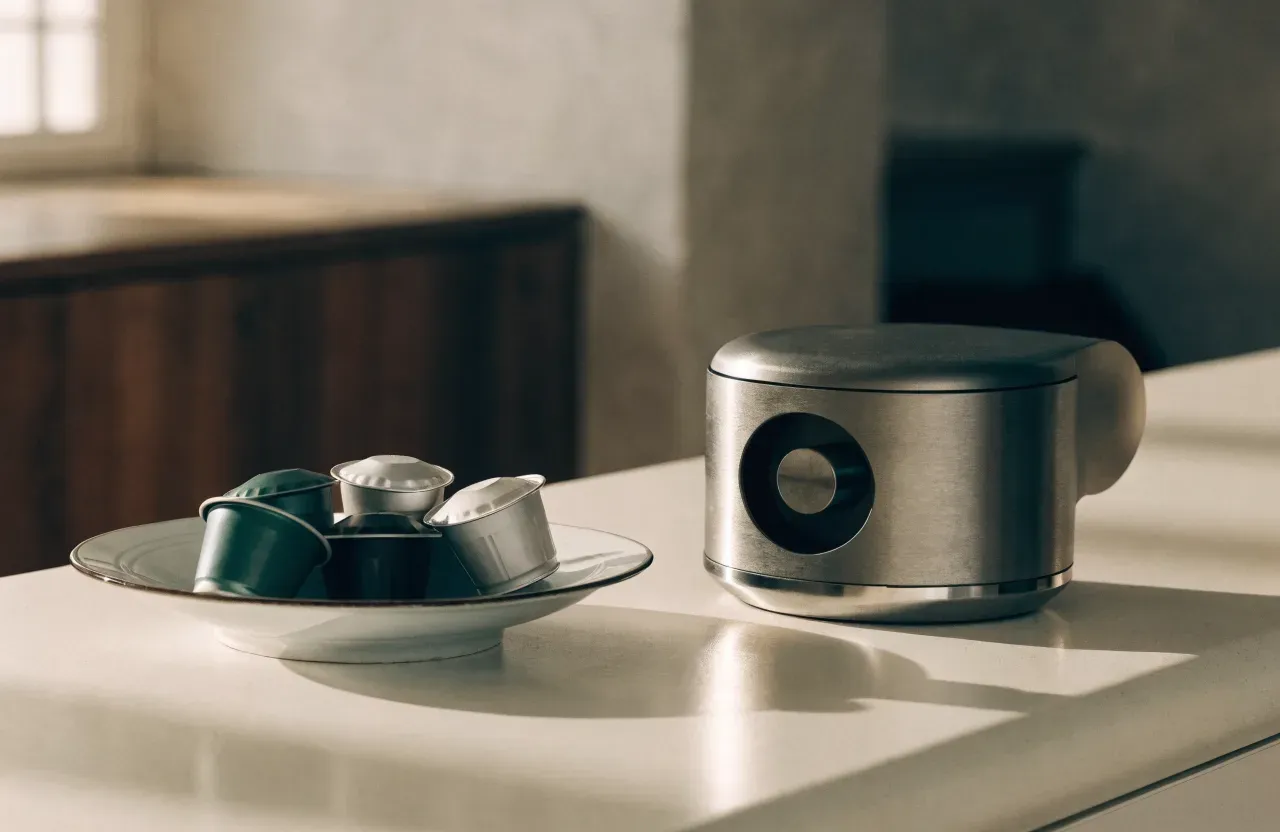
What you actually gain
The honest pitch for a capsule machine is that every decision has already been made by somebody who knew what they were doing. The coffee was ground to a grind size matched to that exact capsule, dosed to the tenth of a gram, tamped or packed to a fixed density, and sealed. Your machine adds hot water at pressure and a timer. There is nothing left for you to get wrong.
That matters more than enthusiasts usually admit. The most common bad coffee in the world is not a mediocre capsule. It is a manual machine owned by somebody who never got past the first month, pulling gushers from stale supermarket beans through a grinder that cannot hold a setting. A capsule machine has a floor, and the floor is well above that.
The second gain is time and mess. Thirty seconds, one moving part, no puck to knock out, no grinder to brush, no scale, no purge. The third is footprint: the machines are small, they heat in under half a minute, and they do not want a dedicated corner of the worktop.
What is happening inside the capsule
This is where the marketing and the physics part company. In a traditional espresso, the coffee bed itself provides the resistance. Around 18 g of finely ground coffee, evenly tamped, is what the pump has to push against, and the crema is an emulsion of coffee oils and dissolved carbon dioxide forced through that bed.
A capsule holds far less coffee, usually around 5-7 g for an espresso-style capsule, and it is not tamped into a puck you could ever build resistance against. So the resistance is engineered into the container instead. Depending on the system, hot water enters through pierced holes and leaves through a foil plate that tears into a pattern of very fine jets, or through a pressurised valve that only opens above a set pressure. Either way the pressure drop happens at the exit rather than through the coffee.
The practical consequence is the foam. What sits on top of a capsule shot looks like crema and behaves like froth. It is largely air whipped into the liquid as it sprays through those jets, so it is paler, larger-bubbled and gone within a minute or two, where a real crema from a well extracted shot is denser and persists. It is not a fake in any sinister sense. It is simply a different mechanism producing a similar-looking result.
This is also why capsule coffee is hard to push around. There is no grind to change, so the usual fix for a shot that tastes sour is unavailable to you. The variables you have are water volume, water hardness and which capsule you buy.
The four costs
Cost per cup. This is the big one and it does not go away. A capsule typically holds around 5-7 g of coffee and is priced per unit. The same coffee bought as whole beans works out at a small fraction of that per drink. Over two drinks a day the difference across a year is comfortably more than the price of a decent grinder, which is exactly the calculation worth doing before buying.
Choice. A closed system limits you to what its owner sells, plus whatever compatible capsules exist for it and are any good. You will not find the small roaster whose Kenyan you liked last month, and you will not find last week’s roast date at all.
Freshness you can verify. The seal is real and it does slow staling, which is a genuine engineering advantage over an open bag. But most systems print a best-before date rather than a roast date, so you know when the manufacturer stops standing behind it and not when the coffee was made. For a category whose entire argument is consistency, that gap is odd.
Waste. Every drink produces a piece of packaging that has to be collected, opened, emptied of wet grounds and processed. Some schemes do this well. Many places have no scheme at all, in which case the capsule is landfill with about 6 g of compost inside it.
So who should buy one
| Capsule machine | Bean to cup | Manual plus grinder | |
|---|---|---|---|
| Skill needed | None | Almost none | Real, and takes weeks |
| Cost per cup | Highest | Low | Low |
| Coffee choice | One ecosystem | Any beans | Any beans |
| Waste per drink | One capsule | Grounds only | Grounds only |
| Time per drink | Under a minute | About a minute | Three to five minutes |
| Quality ceiling | Fixed at purchase | Good | High |
Buy one if you drink one or two coffees a day, you have no interest in the process, and you would rather spend nothing on learning it. That is a large and entirely reasonable group of people, and a capsule machine serves them better than a neglected manual machine ever will.
Do not buy one if you drink four a day, because the arithmetic turns against you quickly, or if the idea of adjusting something appeals to you at all. In that case start with a bean to cup machine if you want the button, or read our comparison of pods against capsules if you want a sealed system that is at least an open standard.
Frequently asked
- Is capsule coffee really espresso?
- Not in the traditional sense. Traditional espresso builds resistance from the ground coffee itself, tamped into a puck. A capsule builds most of its resistance from an engineered exit, usually a plate pierced into fine jets or a pressurised valve. The drink is brewed under pressure and has a foam on top, but that foam is aerated rather than emulsified, and it collapses much faster.
- How old is the coffee inside a capsule?
- Often much older than the printed date suggests, and there is no way to check. The seal genuinely does slow staling, which is the honest case for capsules. What it cannot do is tell you the roast date, because most systems print a best-before date measured in months or years rather than a roasted-on date.
- Are aluminium capsules better than plastic for recycling?
- Aluminium is more valuable to recycle and is accepted in more schemes, but only when the used grounds are separated out, which usually means a dedicated collection bag rather than your kerbside bin. Plastic and mixed-material capsules are harder to process. Either way the real variable is whether they are collected at all where you live.
Related reading
A commercial machine at home
Power, plumbing, drainage and heat: what a bar machine actually demands of a kitchen, and when the answer is to buy a smaller machine instead.
Lever machines: spring against direct
A spring lever pulls a curve the machine decides. A direct lever pulls the curve your arm decides. That single difference sorts every lever machine sold.
Single boiler, heat exchanger or dual boiler
The three ways a machine makes brew water and steam at once, what each one costs you in waiting, and which one suits how you actually drink.