Pod machines
Pods or capsules: the difference nobody explains
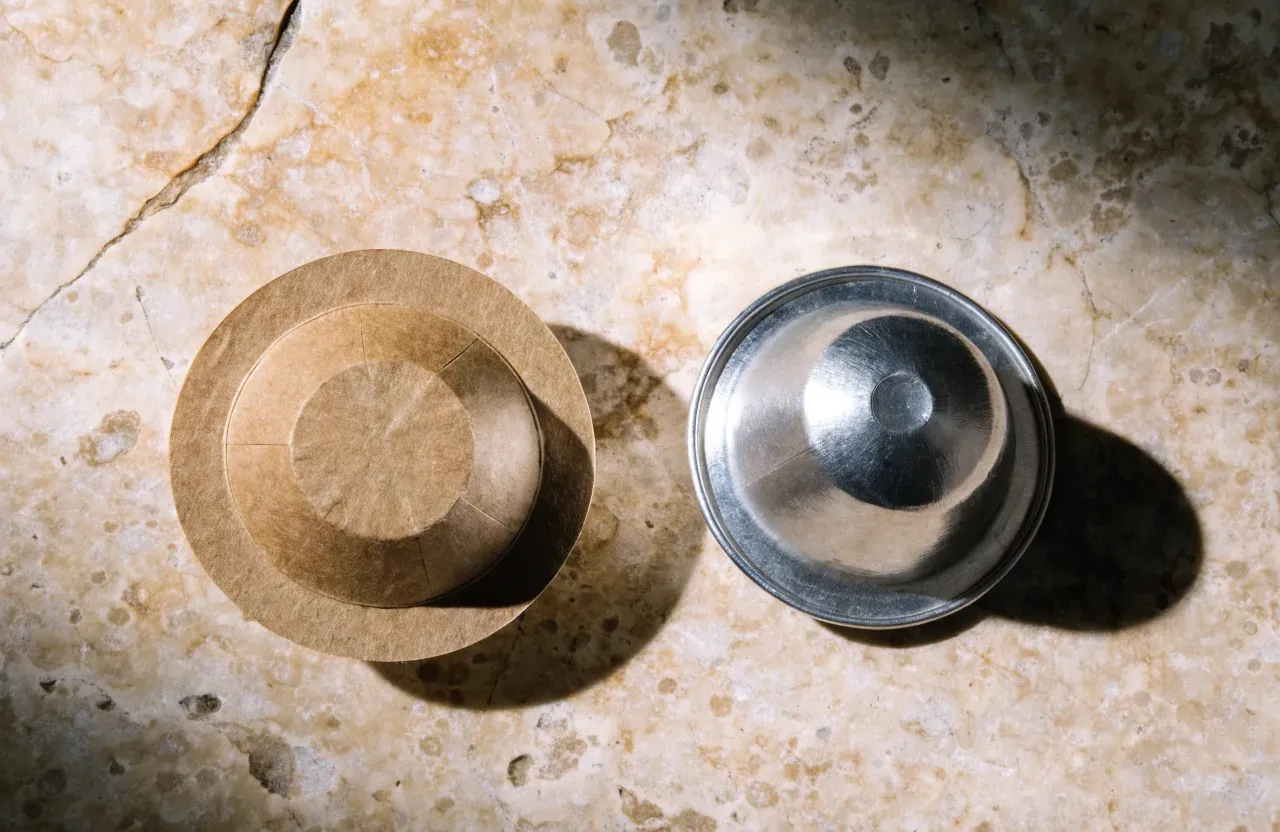
The difference is the standard, not the shape
People use pod and capsule interchangeably, and shops encourage it, but they describe two genuinely different products.
An ESE pod, short for Easy Serving Espresso, is about 7 g of ground coffee tamped between two discs of filter paper, sealed at the edge into a flat pouch 44 mm across. ESE is a published specification. Anyone can make pods to it, anyone can make a machine that takes them, and a pod bought from one company works in another company’s machine. It is closer to a teabag than to a cartridge.
A capsule is a rigid sealed container, usually aluminium or a multi-layer plastic, holding roughly 5-7 g of coffee under an inert gas. Its dimensions, its piercing pattern and its internal exit geometry are the property of whoever designed the system, and they are designed so that only capsules made for that system fit that machine. Some patents have expired, which is why compatible capsules exist for the older formats, but the relationship is still one manufacturer defining the standard.
That distinction drives everything below. It is not about paper versus metal. It is about an open format versus a closed one.
What each one does to the coffee
Inside the pod, the coffee is genuinely tamped into a puck, and water passes through it much as it does through the basket of a manual machine. The bed is thin and the dose is small, so the body is lighter than a proper double, but the extraction mechanism is the ordinary one: resistance comes from the coffee. That is why a pod shot from a good machine can taste recognisably like espresso, with a crema that behaves like crema rather than like froth.
A capsule works differently. The coffee is not tamped against anything you could brew through in the normal way, so the resistance is built into the container’s exit, usually a foil that tears into fine jets or a valve that opens at a set pressure. The foam on top is largely aerated by that spray. We cover the mechanics of this properly in what capsule machines gain and give up, but the short version is that a capsule is pressure-brewed coffee designed to resemble espresso, while a pod is a very small espresso.
The trade runs the other way on freshness. Paper breathes. An ESE pod is protected only by its individual overwrap, and once a box has been open a while the difference shows as a flat, papery cup. A capsule’s seal is the best preservation in domestic coffee, full stop.
Price, choice and what happens to the packet
| ESE pod | Capsule | |
|---|---|---|
| Standard | Open, published, 44 mm | Closed, owned by the system |
| Material | Filter paper, plus a foil overwrap | Aluminium or multi-layer plastic |
| Dose | About 7 g, tamped into a puck | About 5-7 g, not tamped |
| How pressure builds | Through the coffee bed | At an engineered exit |
| Who can make them | Any roaster | The system owner and licensees |
| Fits a normal machine | Yes, with a 44 mm pod basket | No |
| Shelf life once boxed | Months, and it shows | Long, gas-flushed |
| Cost per cup | Lower, and competitive | Highest in domestic coffee |
| Disposal | Composts whole, minus the wrapper | Needs a collection scheme |
The competition line is the one that ends up mattering most. Because anyone can make an ESE pod, small roasters do, and they sell them at prices set by a market rather than by the owner of a razor-and-blades system. You can buy a single origin in pod form from a roaster you like. You cannot generally do that in a closed capsule format.
Disposal is nearly as decisive. A used pod goes in a food waste bin or a compost heap as it is, coffee and paper together, with only the foil overwrap to separate. A used capsule has to reach a scheme that will cut it open, empty the wet grounds and recover the metal or plastic. Where such a scheme exists and is used, aluminium recycles genuinely well. Where it does not, the capsule is landfill.
Which to choose
Choose pods if you already own or want a portafilter machine. This is the real argument for them: a pod basket turns an ordinary machine into a pod machine on the mornings you cannot be bothered, and back into a proper machine at the weekend. Nothing in the capsule world offers that. Buy in small quantities, because freshness is the format’s weakness.
Choose capsules if the drink has to be identical every time, you drink one or two a day, and you want no equipment beyond one small box. Accept that you are buying into one company’s catalogue, and check whether capsule collection actually exists where you live before it becomes an ongoing regret.
Choose neither if you are drinking three or more a day. At that volume the arithmetic moves decisively towards a bean to cup machine for the button, or a grinder and a machine for the cup. Our first coffee setup guide walks through that threshold with actual numbers.
Frequently asked
- Can I use ESE pods in a normal espresso machine?
- Usually yes. A pod is 44 mm across and most 58 mm portafilters take a dedicated pod basket that holds one, and many machines ship with one in the box. It is worth checking your basket size before buying a box, because a pod sitting loose in a standard double basket will channel badly.
- Which is fresher, a pod or a capsule?
- A capsule, and not by a small margin. Paper is porous, so an ESE pod relies on its outer wrapper for protection and starts staling once that is opened. A sealed capsule is flushed with inert gas and holds for months. Pods answer this by being cheaper and more readily bought fresh, not by matching the seal.
- Are ESE pods actually compostable?
- The pod itself is coffee wrapped in filter paper, so it composts in a home heap or a food waste bin without being taken apart. The individual foil overwrap does not, and that is the part people forget. It is still much less waste per drink than a capsule.
Related reading
A commercial machine at home
Power, plumbing, drainage and heat: what a bar machine actually demands of a kitchen, and when the answer is to buy a smaller machine instead.
Lever machines: spring against direct
A spring lever pulls a curve the machine decides. A direct lever pulls the curve your arm decides. That single difference sorts every lever machine sold.
Single boiler, heat exchanger or dual boiler
The three ways a machine makes brew water and steam at once, what each one costs you in waiting, and which one suits how you actually drink.