The roasting process
What happens inside the roaster
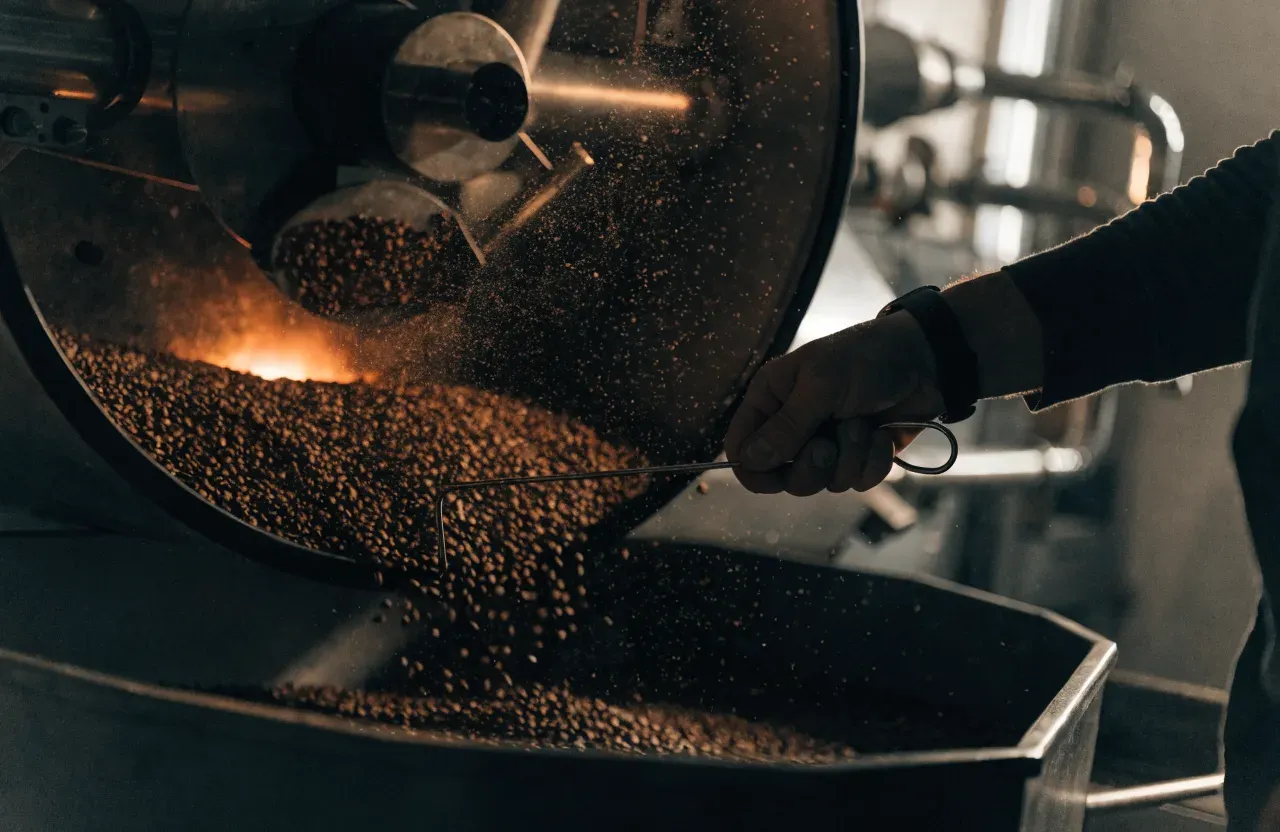
The roast is four phases, not a temperature
Put green coffee into a hot drum and nothing you would recognise as coffee happens for several minutes. What follows is a sequence, and each part of it deposits something different in the cup. Naming them is the whole trick, because once you can picture where a roast is, you can hear and smell where it is going.
The bean arrives at around ten to twelve per cent moisture, grassy and dense, with almost no aroma. It leaves as a brittle, hollow, fragrant thing that has lost most of that water and around fifteen per cent of its weight. Between those two states are drying, Maillard, first crack and development, with second crack waiting past the point most specialty roasters choose to stop.
Drying, and why nothing seems to happen
For the first three to five minutes the bean is mostly boiling off water. Heat going into it is spent on evaporation rather than on raising its temperature, so the bean climbs slowly and the smell in the room is hay and raw grain. This is the phase people rush, and rushing it is expensive: water carries heat from the outside of the bean towards the centre, and a bean scorched on the surface while still wet inside will taste both roasty and underdeveloped at once.
Drying ends somewhere around 150 °C of bean temperature, when the surface turns from pale green to a wheat yellow and the aroma shifts towards bread and toast. Nothing in the cup comes directly from this phase. Everything in the cup depends on it having gone evenly.
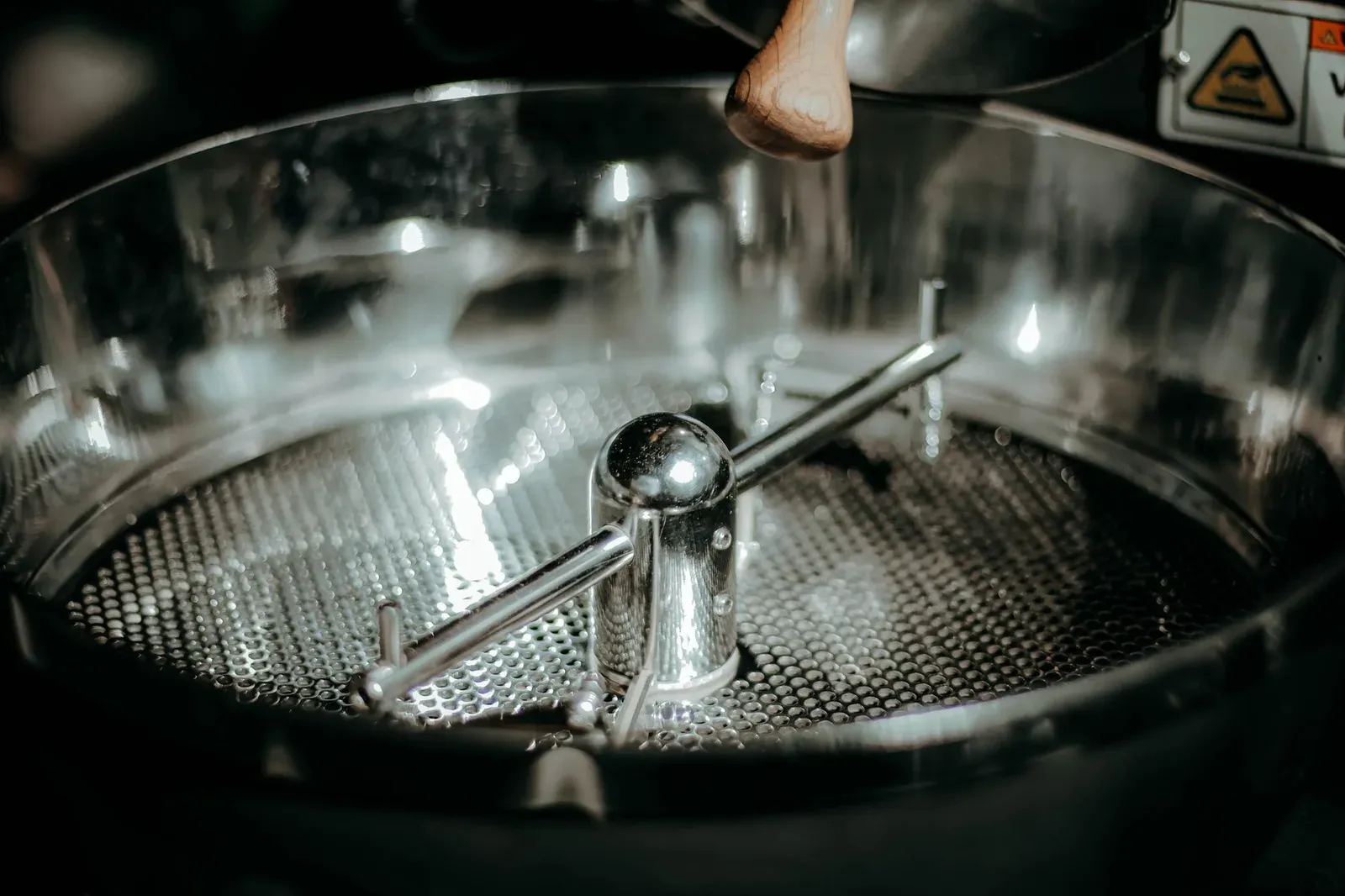
Maillard is where the flavour is built
Once the free water is gone, the bean heats much faster, and the amino acids and sugars inside it start reacting with each other. This is the Maillard reaction, the same chemistry that browns bread crust and seared meat, and it is the single largest source of what you will eventually taste. Caramelisation runs alongside it as the sugars themselves break down.
Concretely, this phase builds the sweetness, the body and the great majority of the aromatic compounds: chocolate, nut, caramel, dried fruit. The bean turns tan, then brown, then a deeper brown, and the smell moves from bread to biscuit. It is also the phase where a roaster has the most influence. Stretch the Maillard window and you generally get more sweetness and more body at the cost of some clarity and floral aroma. Compress it and you keep the delicate top notes but can end up with a thin, sharp cup.
First crack, development, and knowing when to stop
Around 196 to 205 °C, steam and carbon dioxide trapped inside the bean reach a pressure the cell structure cannot hold, and the bean fractures audibly. First crack sounds like popcorn starting, it is impossible to miss, and it marks the moment the coffee becomes drinkable rather than green and vegetal. The bean expands, the silverskin flakes off as chaff, and the surface goes from matte to slightly open.
Everything after first crack is development. Stop the instant the cracking begins and you get an aggressively acidic, thin cup with a papery finish, the kind of flavour people mistake for a brewing fault. That is worth knowing, because a lightly roasted coffee that will not extract properly is a common cause of a sour shot, and no amount of grinding finer fixes it. Our piece on why your espresso tastes sour covers what to change first when the coffee itself is not the problem.
Let development run another minute or two and the acidity resolves into something sweeter and rounder, the body fills in, and the roast flavours start to appear. Push further and you reach second crack, at roughly 224 to 230 °C, a quieter and sharper sound as the bean’s structure gives way again and oils migrate to the surface. Past that point, origin character is largely gone and what you taste is the roast: dark chocolate, then smoke, then ash. That is a legitimate choice for a traditional espresso blend and a poor one for a distinctive single origin, which is the argument running underneath what specialty coffee actually means.
Charge temperature and airflow are the two real controls
A roaster has fewer levers than people imagine. Charge temperature is the drum temperature at the moment the green coffee goes in, and it sets how much energy is available at the start. Charge hot and the drying phase is short and the bean gains momentum early, which suits a dense high-grown coffee that resists heat. Charge cool and the whole curve stretches, which suits a softer or a decaffeinated bean that scorches easily.
Airflow does two jobs. It carries heat by convection, which is gentler and more even than the drum’s conductive heat, and it pulls the chaff and the smoke out of the drum. Too little airflow and the bean roasts in its own smoke, which tastes exactly as it sounds. Too much and you strip heat out of the system and stall the roast, a flat spot in the curve that costs sweetness and is difficult to recover from.
This is why a profile is a curve rather than a setting. Two batches dropped at the same final temperature can taste nothing alike if one climbed steadily and the other stalled at first crack and was rescued with a burst of gas. What roasters watch is the rate of rise, the speed at which bean temperature is climbing, and the convention is to keep it falling smoothly rather than letting it flatten or jump. The number on the dial tells you where the roast ended. The shape of the line tells you what it will taste like.
Frequently asked
- How long does a roast actually take?
- On a drum roaster, most specialty profiles land somewhere between nine and fourteen minutes from charge to drop. Faster roasts tend to leave the centre of the bean underdeveloped, and much slower ones flatten the acidity and dull the aroma. The range matters less than the shape of the curve inside it.
- Is a dark roast stronger than a light one?
- No. Dark roasting drives off aromatic compounds and breaks down some of the caffeine, so a dark roast is usually less acidic and more bitter rather than stronger. What people call strength is mostly extraction and ratio, which happen in the brewer, not in the roaster.
- What is development time, and does the percentage matter?
- Development is the stretch between first crack and the drop. Roasters often quote it as a share of total roast time, commonly between fifteen and twenty-five per cent. It is a useful shorthand for comparing your own roasts, but it is contested as a target in its own right: the same percentage on two different machines with two different curves does not produce the same cup.
Related reading
Resting coffee: why a fresh roast is not ready yet
Roasted coffee is full of carbon dioxide for days. How long to rest beans for filter and for espresso, and what a bag that is too fresh does to the cup.
How to read a bag of coffee
Roast date, process, altitude, varietal and the tasting notes: what each line on a bag is actually claiming, and which ones are worth paying for.
Dark roast without the burn
A developed dark roast is sweet, heavy and smooth. A scorched one is ashy and thin.