First look
Lelit Mara X V2: first look
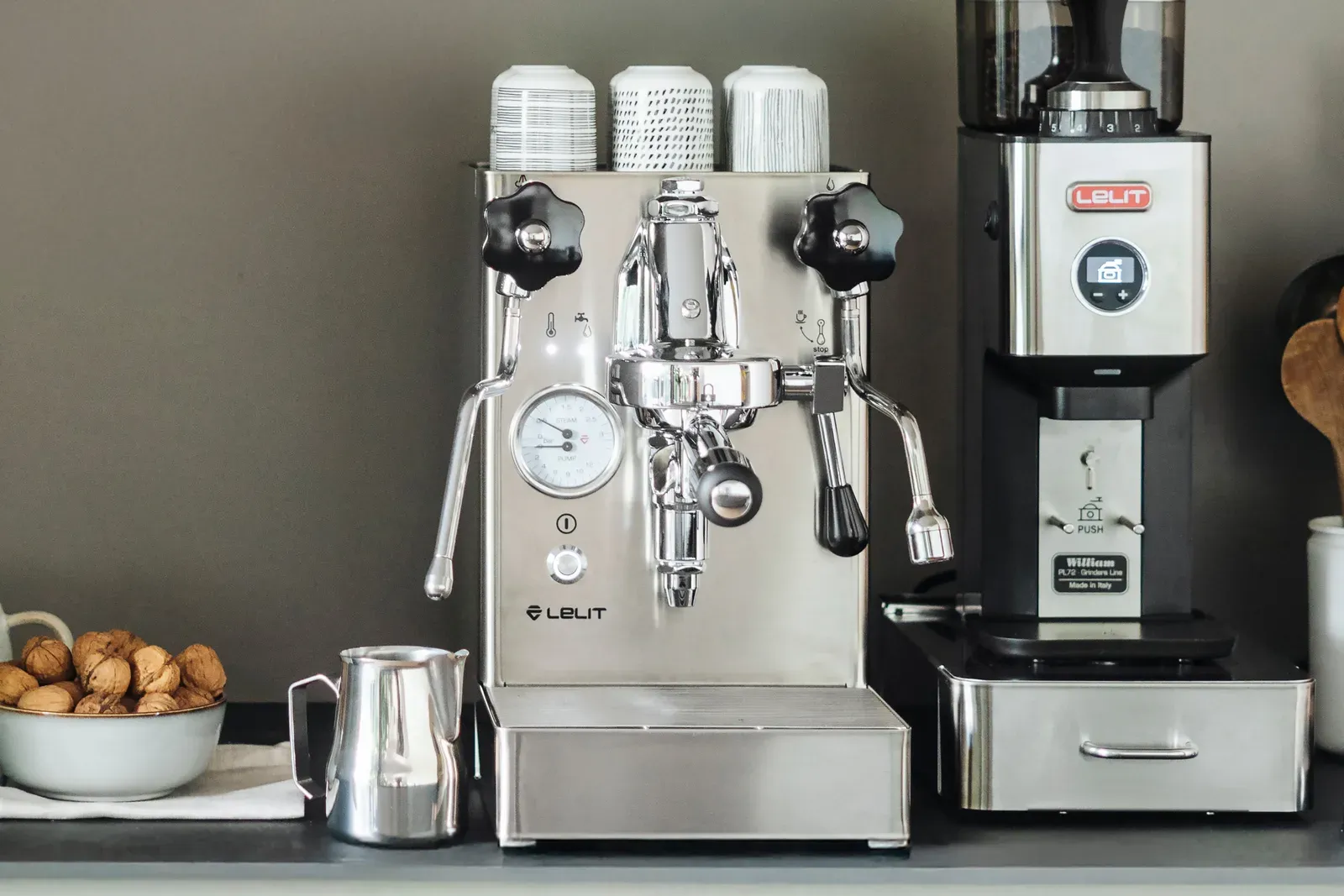
Not tested yet This is a presentation built from the manufacturer’s specification and how the product is meant to be used. We have not had it on the bench, so there is no score.
For someone making several milk drinks a day who wants an HX machine that does not need a cooling flush routine, not for anyone who wants to set brew temperature to the degree or profile flow out of the box.
What it promises
- Steam on tap from a 1.8 L boiler, with a second probe aimed at the classic HX overheating
- Commercial-size 58 mm group with mechanical pre-infusion and three IMS baskets in the box
- Pump and steam gauges on the front, a quiet pump and room for a mug under the spouts
- Lelit sells a flow paddle and group gauge as kits, so the machine can grow
What to weigh first
- Lelit allows up to 24 minutes to warm up, so a timer plug is part of the setup
- Brew temperature is three steps (Warm, Hot, Extra Hot), with no readout in degrees
- The MaraX3 now sits beside it with electronic flow control, and Lelit's dual boiler Elizabeth costs slightly less in France
What it is
A heat exchanger espresso machine with a 1.8 L steam boiler, an AISI 316L stainless steel heat exchanger, Lelit’s 58 mm L58E group with mechanical pre-infusion, a 2.5 L tank and a dual gauge for pump and steam pressure. Lelit lists it at $1,699.95 in the United States, €1,399 in France and £1,299.95 in the United Kingdom.
Lelit’s own pages now call it simply MaraX. The model code on its technical sheet, PL62X-2G, is the second generation, which is what retailers and owners call the Mara X V2. It is 35.5 cm tall and weighs 18.4 kg, which is the size and weight of a serious single-group machine rather than an appliance.
The heat exchanger, and the problem it is solving
If the three boiler types are new to you, start there. The short version: a heat exchanger keeps one boiler at steam temperature and runs the brew water through a tube inside it, so steam is always ready and the water for the shot is heated on its way through.
The classic weakness is that the brew temperature is a by-product. The boiler is regulated for steam, the water sitting in the exchanger overheats while the machine idles, and every owner learns a cooling flush before the shot. Get the flush wrong and the shot is pulled hotter than intended.
The Mara X is Lelit’s answer to that. It uses two temperature probes and a thermosiphon circuit, and Lelit says the system keeps brew temperature constant, cuts the wait between shots and avoids the overheating typical of classic HX machines. That is a claim about the design, and it is the right problem to be solving. It is also the whole reason to choose this machine over a conventional HX at the same money, so it is the part a full test would have to check first.
Coffee mode and steam mode
A mode button picks one of two settings. Lelit pitches Xmode Steam for everyday milk and coffee drinks and Xmode Coffee for people who mostly drink espresso. The trade is the one every HX makes: the boiler cannot be ideal for milk and for the shot at the same moment, and the modes let you say which one you care about more.
On top of that sits a three-step temperature button: Warm, Hot and Extra Hot. Lelit does not publish the degrees behind those steps, and the machine has no display, only LEDs and the gauge. If you know what a PID actually changes and want to set 93 °C rather than “Hot”, this is the limit you will notice.
The group, the baskets, the gauges
The L58E group takes Lelit’s LELIT58 portafilters and tools, and the box includes a two-spout portafilter and IMS baskets for 9–11 g, 14–18 g and 18–21 g, plus a blind basket for backflushing. Good baskets from the start mean one less thing to buy.
The pre-infusion is mechanical, built into the group rather than programmed. The pre-infusion piece covers why a gentle start helps an even extraction.
Lelit describes the pump as silent, the drip tray leaves room for a mug, and the tank opens fully at the top and counts fillings to remind you when to change the softener filter. A flow-control kit, a paddle with a gauge on the group, is sold separately for owners who want to change the flow during the shot.
The trade-offs worth weighing
Warm-up is slow. Lelit gives up to 24 minutes, and an energy-saving mode drops steam pressure after a period of inactivity. A heavy boiler takes time to heat evenly, so this is honest rather than poor, but it means a timer plug or a habit of switching on before the shower.
The range has moved around it. The MaraX3 now offers Lelit’s electronic flow control, Pagaia, on the same heat exchanger idea. And in France, Lelit’s own Elizabeth dual boiler is listed at €1,349, just below the Mara X, though with much smaller boilers (0.3 L and 0.6 L). If you steam milk for one or two drinks at a time, that comparison is worth making before you buy.
Who should buy it, and who should not
Buy it if milk drinks are most of what you make, if you make several in a row, and if you want the steam of a big boiler without learning a flush. It is also a good fit if you want a 58 mm group with a well-supported accessory range and the option of a flow kit later.
Do not buy it if you drink mostly straight espresso and want to set the temperature to the degree, if you need a machine ready in a few minutes, or if flow profiling is the reason you are upgrading. A dual boiler or the MaraX3 answers those better. The choosing an espresso machine guide sets out the questions, and the espresso machines hub lists the alternatives.