Machine care
Machine care: the jobs you only do once a year
Scale is the one that ends machines
Everything in the weekly routine is about flavour. The yearly jobs are about whether the machine is still working in five years, and the first of them is scale.
Heating hard water precipitates calcium and magnesium carbonates out of it, and they deposit on the hottest surfaces: the element, the boiler walls, the pipework, and eventually the narrow passages of the group. The first symptom is not a leak. It is that the machine takes longer to warm up and no longer holds its temperature through a shot, because the element is insulated from the water it is meant to be heating. Shots go inconsistent, then reliably sour, and the usual response is to blame the grind. If you have already worked through the sour espresso checklist and nothing helps, temperature stability is the next suspect.
Left long enough, scale blocks a solenoid, cracks an element, or seizes a valve, and at that point a household machine is often not worth repairing.
The interval comes from your water, not the calendar
There is no universal schedule, and manufacturers quote one only because they cannot ask you where you live. Hardness decides it, and hardness varies enormously between towns and sometimes between streets. A test strip costs a few pence, and your water company publishes figures by postcode. Either gives you a number in German degrees (°dH) or parts per million of calcium carbonate, and from there the interval follows.
| Water | Roughly | Descale every |
|---|---|---|
| Very soft | Under 4 °dH, under 70 ppm | 18–24 months, if at all |
| Soft to moderate | 4–8 °dH, 70–140 ppm | 9–12 months |
| Moderately hard | 8–15 °dH, 140–270 ppm | 4–6 months |
| Hard | 15–22 °dH, 270–390 ppm | 2–3 months, or treat the water |
| Very hard | Over 22 °dH, over 390 ppm | Treat the water, do not just descale |
The descale itself is machine specific, so follow the manual for the order of operations. The shape is the same on most machines: make up the solution in the tank at the stated concentration, run part of it through the group and part through the hot water tap or steam wand so that every path sees it, leave it to stand for the time on the packet, then flush at least two full tanks of clean water through every one of those paths. Poor rinsing is the common mistake, and the next few drinks taste sharply acidic.
Two cautions. A brass boiler and an aluminium thermoblock do not want the same chemistry, so buy the descaler your manufacturer names. And on a machine neglected for years, one descale can dislodge a sheet of scale that then blocks something downstream, which is how a well-intentioned descale becomes a service visit.
Treat the water instead, where you can
Descaling removes scale. Softening stops it forming, which is the better answer in a hard water area.
An in-tank cartridge, the kind sold for jug filters or as a machine-specific insert, uses ion exchange to swap the hardness minerals out. It works, it needs replacing on a schedule, and its capacity drops fast in very hard water. A plumbed machine can take an inline filter head sized to the water, which is what cafes use.
What you are aiming for is not the softest water available. Coffee needs minerals to extract, and water stripped bare tastes hollow, which is the argument in water is the ingredient nobody tests. The target is moderate total hardness with the carbonate hardness, the part that forms scale, kept low. That gives you good extraction and a boiler that stays clean.
Gaskets, screens and a pressure check
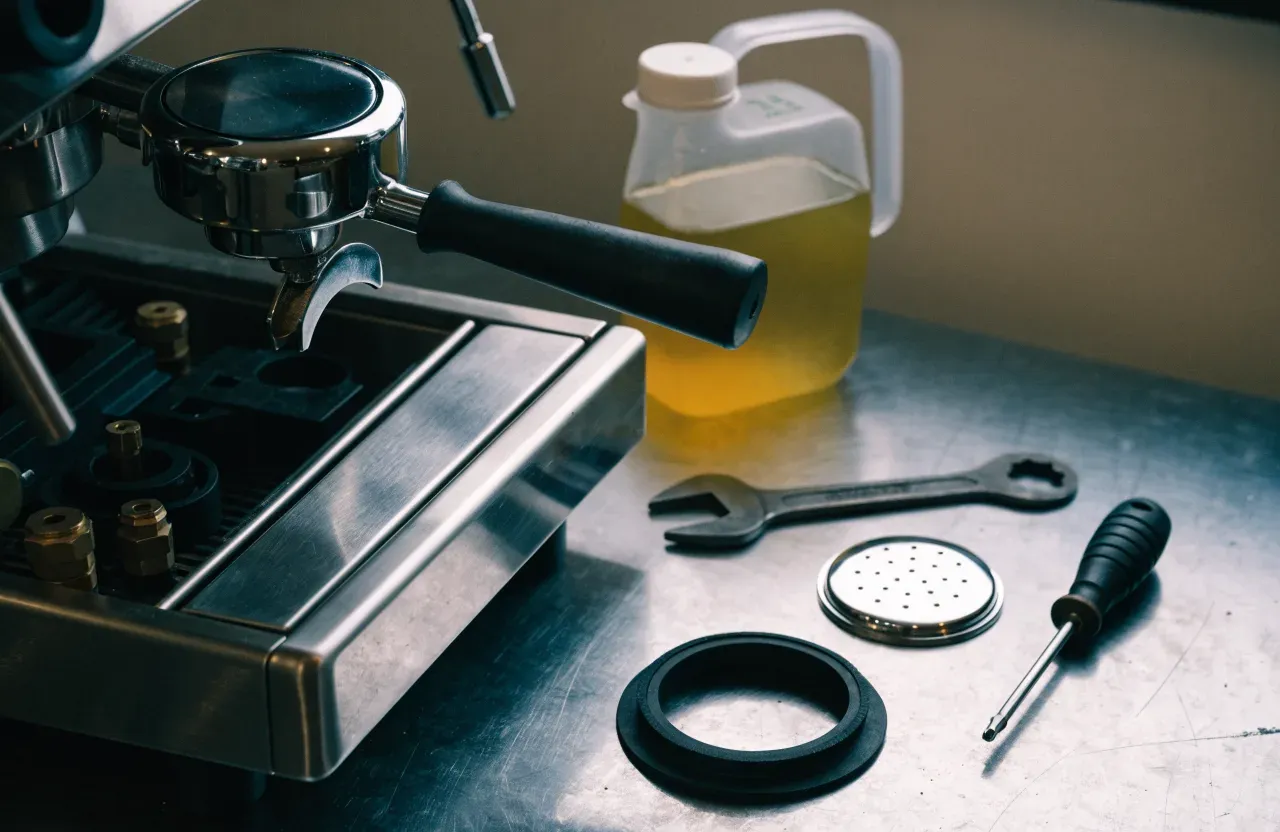
The group gasket is a consumable. It is compressed every time you lock in the portafilter and cooked at brew temperature all day, so within a year it hardens, shrinks and stops sealing. The symptoms are a portafilter that has to be forced further round each month, water weeping from the rim during a shot, and a hiss where there should be silence. Replacing it costs a few pounds and takes fifteen minutes with a flathead screwdriver, and doing it before it fails is far easier than after, when the old one has welded itself into the groove.
Replace the shower screen at the same time. It is cheap, and a screen whose holes have partially closed distributes water unevenly no matter how well you clean it in the weekly routine.
Once a year, check the pump pressure. Lock in the blind basket and run the pump: the needle should settle around nine bar, or wherever the machine is specified. A screw-in gauge for a bottomless portafilter costs less than a bag of good coffee if the machine has none of its own. Pumps drift as they wear, and an over-pressured machine compacts the puck and channels while an under-pressured one runs fast and thin. Most vibration pumps have an adjustable overpressure valve, though the access varies enormously by model.
When to stop and pay someone
There is a line, and it is worth naming.
Cleaning, descaling, gaskets, screens, baskets and the steam wand tip are all owner jobs on any machine. Beyond that, anything involving the boiler, the solenoid, the electrical side, a seized fitting or a pressure adjustment you cannot reach without removing the boiler is where a service makes sense.
The economics are simple. A service on a household machine typically costs less than an hour of a plumber’s time, and includes a descale, new seals throughout, a pressure calibration and a check of the safety devices. A single stripped thread in a brass boiler can cost more than that to put right and can take the machine out of use for weeks waiting on a part. If a job needs a torque you are guessing at, or a part you cannot buy twice, that is the signal. Book the service when you are already due a descale and a gasket, and you pay for one visit rather than a repair.
Frequently asked
- Can I use vinegar to descale?
- You can, and people have for decades, but it is a poor choice on a modern machine. Vinegar is aggressive towards aluminium and some seals, it needs a great deal of rinsing, and the smell lingers in the boiler. A proprietary citric or lactic acid descaler is formulated for the metals involved and costs very little.
- Do I still need to descale if I use filtered water?
- Usually less often, and sometimes hardly at all, but it depends on the filter. A carbon jug filter improves taste and removes chlorine while leaving most of the hardness behind. Only an ion exchange or reverse osmosis system meaningfully reduces the minerals that form scale, so check what your filter actually does before extending the interval.
- Is completely soft water better for the machine?
- Better for the boiler, worse for the coffee and potentially bad for the machine in another way. Water stripped of all minerals extracts poorly and tastes hollow, and it can be corrosive to some metals. The aim is moderate hardness with the temporary hardness reduced, not zero, which is why the recommended ranges sit in the middle rather than at the bottom.
Related reading
Bringing a 1970s lever back to life
A fifty-year-old lever machine is mostly brass, a spring and four seals. Here is the order to work in, and the two faults that mean walk away.
Buying a used espresso machine
Second hand is the cheapest route to a serious machine, and the fastest route to a boiler you cannot replace. What to check, what to walk away from.
Baskets, gaskets and screens: the parts that change the shot
A few pounds of replaceable parts sit between your grinder and your cup.