Medium roast
Medium roast, and why it is the safe default
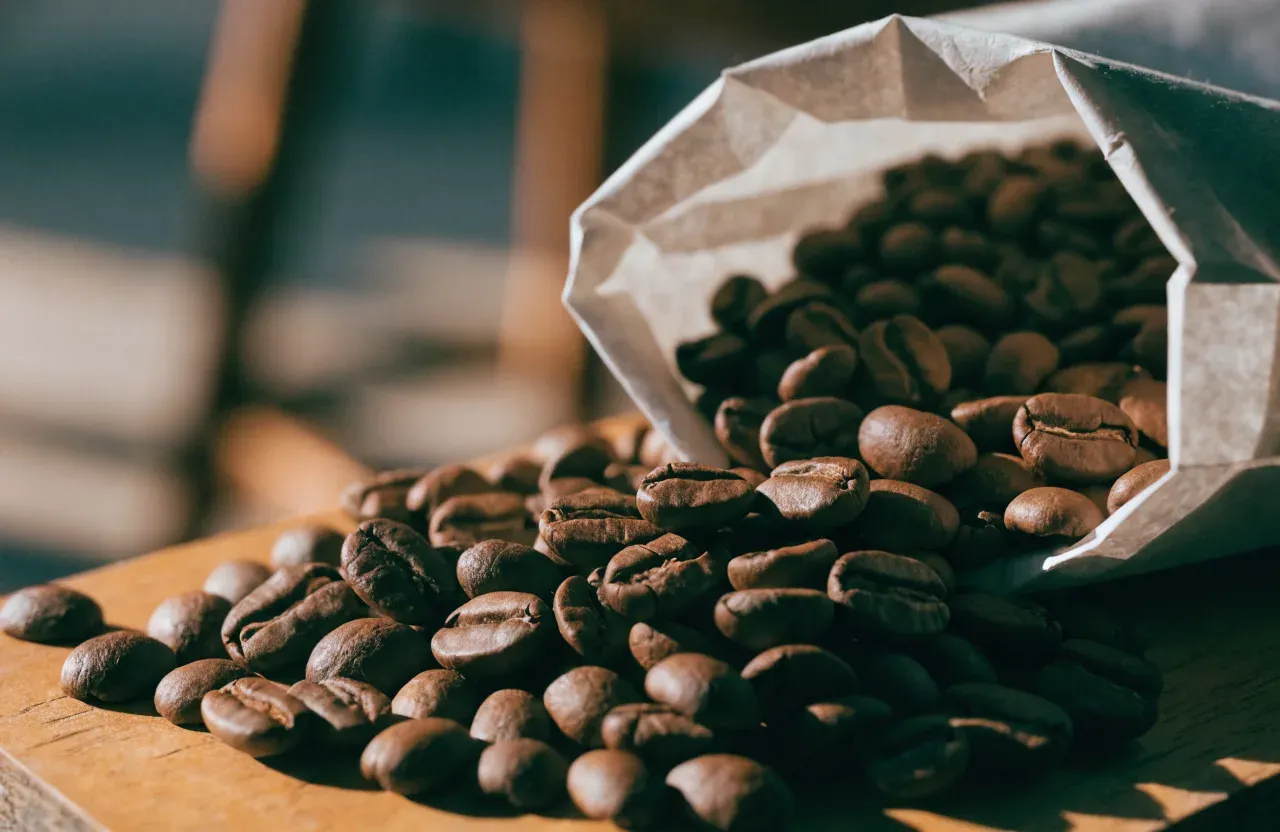
Where first crack sits, and what happens after it
Every roast style is defined by its relationship to one event. Somewhere around 196 °C of bean temperature, steam and carbon dioxide trapped inside the bean overcome the cell walls and the structure gives way all at once. That is first crack. It is audible across a room, it sounds like the beginning of popcorn, and after it the bean has roughly doubled in volume and lost most of its remaining water.
A light roast is dropped shortly after that noise stops. A medium roast is dropped one to three minutes later, in the stretch roasters call development, and everything that separates the two happens in those minutes.
What happens is chemistry with a deadline. Maillard reactions between amino acids and reducing sugars continue, producing the melanoidins that give coffee its body and much of its brown colour. Caramelisation of the remaining sugars runs alongside them, building the toffee, nut and chocolate notes that people recognise as “coffee flavour” without being able to name. At the same time the chlorogenic acids that carry a lot of the sharpness are steadily breaking down, so perceived acidity falls.
The window where sweetness and acidity overlap
The result is an overlap rather than a compromise. For a window of a couple of minutes the sweetness has arrived and the acidity has not yet left, and the cup carries both. Push past it and you trade the last of the origin character for more roast character, which is the territory of a dark roast.
| Roast stage | Roughly when | What the cup gains | What it loses |
|---|---|---|---|
| Just after first crack | 0–1 min development | Maximum origin character, high acidity | Body, sweetness, forgiveness |
| Medium | 1–3 min development | Caramel sweetness, body, balance | Some florals and the sharpest acids |
| Approaching second crack | 3–5 min development | Deep bittersweet roast flavour | Most origin character |
Why the window is so forgiving
The practical argument for a medium roast is not really about flavour. It is about how wide the range of settings is that produces something drinkable.
Solubility is the reason. Roasting makes the bean porous, and porosity governs how readily water pulls compounds out of it. A light roast is dense and gives up its flavour reluctantly, so a grind a step too coarse leaves you sour. A dark roast is brittle and gives everything up at once, so a grind a step too fine leaves you bitter and ashy. A medium roast sits between the two, which means the curve of extraction against grind setting is shallower and the acceptable band is wider.
The same is true of temperature. A light roast needs water at 94 to 96 °C to extract properly, and a dark roast tastes harsh anywhere near that. A medium roast is comfortable across 90 to 95 °C, so a kettle without temperature control, or a machine whose thermal stability is approximate, does not cost you the cup. It is also less sensitive to water hardness and to a few days either side of the ideal rest, which is why it travels well from a roastery to a kitchen that has not been calibrated for it.
None of this makes it better coffee. It makes it robust coffee, and for anyone whose grinder is a step-collar model rather than a stepless one, robustness is worth more than a theoretical ceiling. If your brews are inconsistent and you are trying to work out why, switching to a medium roast while you sort out the grind removes one variable from the problem.
Why espresso blends live here
Open almost any bag sold as an espresso blend and the roast will be described as medium or medium-dark. There are four reasons, and they are all practical.
Espresso has about thirty seconds to do its work under pressure, so the coffee has to be soluble enough to give up a full extraction in that time. A medium roast is. It also has to produce crema, which comes from carbon dioxide dissolved in the shot under pressure, and a roast this side of second crack has plenty of it without the beans having gone oily.
Then there is milk. A flat white or a cappuccino asks the coffee to remain recognisable through 150 ml of steamed dairy, and the caramelised sugars of a medium roast are exactly what survives that. A lighter roast is swallowed by the milk; the roast notes here sit against it instead.
Finally there is the machine and the person operating it. Espresso magnifies every error, and a roast with a wide extraction window absorbs some of them. A shot pulled slightly coarse on a medium roast tastes a little soft. The same error on a light roast tastes actively sour, which is the most common complaint in home espresso and is worked through in why your espresso tastes sour.
The honest summary is that a medium roast is the default because it fails gracefully. If you are buying coffee for other people, for a machine you do not control, or for a week where you cannot be bothered to dial anything in, it is the right answer, and it stays the right answer until you specifically want what a lighter or darker roast offers instead.
Frequently asked
- What actually is first crack?
- Steam and carbon dioxide build up inside the bean until the cell structure fails, which happens audibly and all at once. It sounds like popcorn starting, it marks the point where the bean has roughly doubled in volume, and every roast style is defined by how long after it the coffee is dropped.
- Is medium roast the same as a medium grind?
- No, and the two are unrelated. Roast describes how far the bean was cooked; grind describes how finely you break it up afterwards. A medium roast is ground fine for espresso and coarse for a french press, exactly like any other roast.
- Why do so many espresso blends say medium?
- Because espresso is unforgiving and a medium roast is not. The style has enough solubility to extract in thirty seconds, enough sweetness to survive milk, and a wide enough window that a small grind error does not ruin the shot.
Related reading
How to read a bag of coffee
Roast date, process, altitude, varietal and the tasting notes: what each line on a bag is actually claiming, and which ones are worth paying for.
Dark roast without the burn
A developed dark roast is sweet, heavy and smooth. A scorched one is ashy and thin.
What happens inside the roaster
Drying, Maillard, first crack, development, second crack. What each phase puts into the cup, and why a roast profile is a curve rather than a setting.