Equipment
The barista kit worth buying, and the kit that is not

Buy scales first, and it is not close
Everything else on this page is a refinement. Scales are the thing that turns espresso from a series of hopeful attempts into a process you can actually steer. Dose in, yield out: those two numbers define the brew ratio, and the ratio is the frame that every other variable is judged inside. Without them you cannot tell whether this morning’s shot ran fast because you changed the grind or because the basket happened to take 17.2 grams instead of 18.
What to look for is unglamorous. Resolution to 0.1 grams, a footprint small enough to sit under the cup on the drip tray, and a fast start-up, because a set of scales that takes six seconds to wake up and zero will be abandoned inside a month. Auto-off should be at least three minutes or disableable. A built-in timer is pleasant and not essential; your phone has one.
Everything after this is ordered by how much it changes the cup, and the drop between the first item and the last is steep.
The tamper, and why the number on the box matters
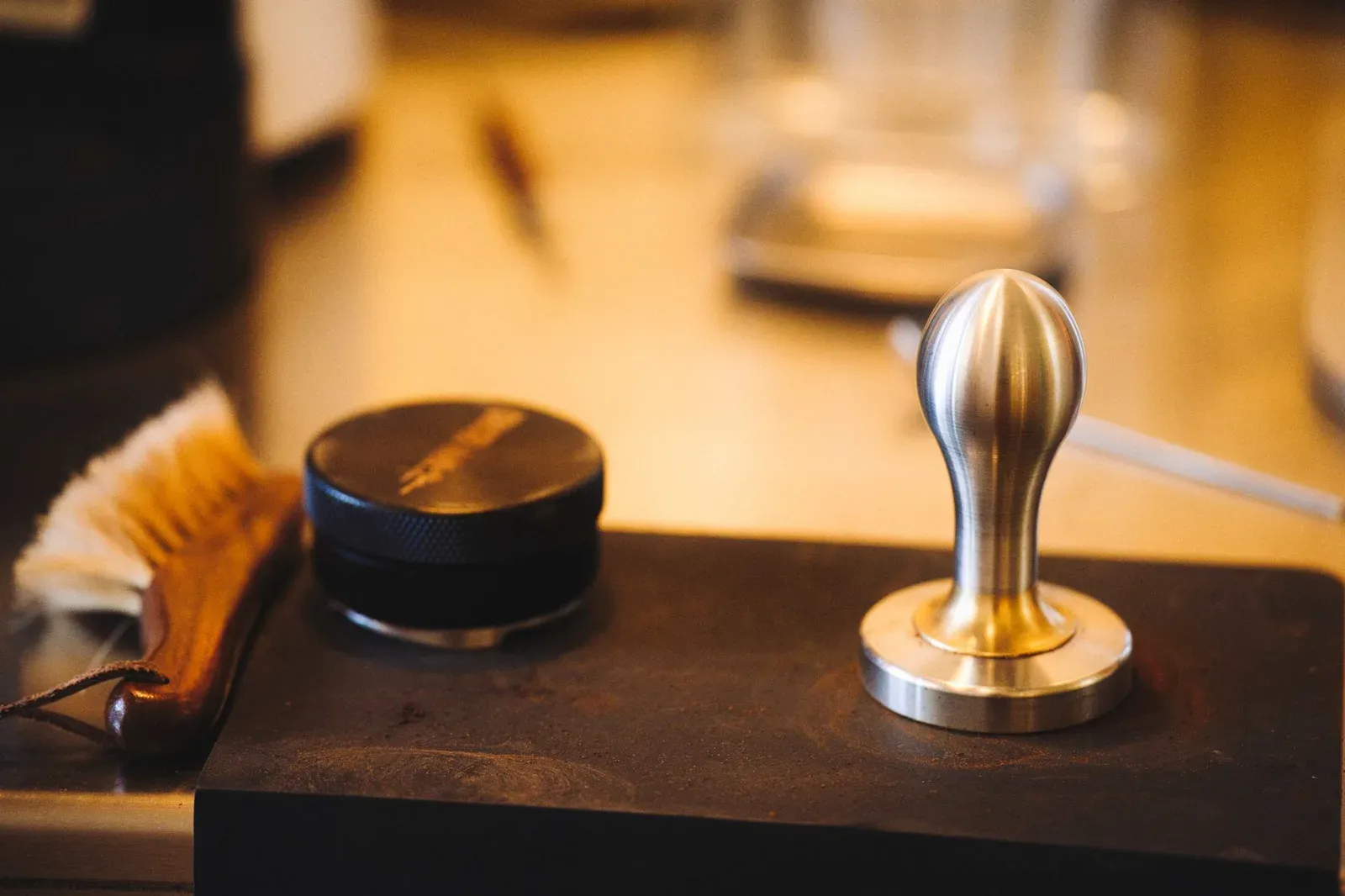
A tamper’s job is to leave a flat, evenly compressed bed with no gap at the edge. The only specification that reliably does that is diameter. Baskets called 58 mm are usually 58.3 to 58.6 mm across at the top of the puck, and a 58.0 mm tamper leaves a ring of loose grounds all the way round. Water takes that ring, because water takes the easiest path available, and you get a sour, fast shot with a hole in it. Measure your basket or find its real figure, then buy to it.
Pressure is the part that gets discussed and matters least. Past roughly 15 kg the puck is as compressed as it is going to get, and consistency between shots counts for far more than the exact force. If your wrist is not consistent, a calibrated or self-levelling tamper buys that consistency cheaply. If it is, they buy you nothing. Tamping explained goes through the mechanics in more detail.
A WDT tool belongs next to it. Grinders throw clumps, and a clump is a dense spot the water flows around rather than through. Stirring the dry grounds with fine needles before tamping breaks them up and evens the bed out. This is one of the few accessories where a cheap version and an expensive version do the same job: what matters is that the needles are around 0.3 to 0.4 mm and that there are enough of them.
Milk, waste and heat
A jug with a defined spout is the cheapest meaningful upgrade to a milk drink. A rounded, generic pouring lip spreads the stream, and a spread stream drops foam onto the surface in a blob instead of cutting into the crema. A sharp spout gives you a narrow, controllable stream at low flow, which is the whole basis of pouring anything recognisable. Size to your drink: 350 ml for one cappuccino, 600 ml if you make two at a time. A jug that is too large will not build a whirlpool with a small volume of milk in it.
A knock box is about the sink, not the coffee. Wet pucks block drains and they sit badly in a bin. Any box with a padded bar works. This is a purchase you make once and never think about again.
A thermometer earns its place only if your machine has no temperature gauge. Milk has a narrow useful window, and beyond about 65 °C the proteins that hold the foam start to give up and the flavour turns cooked.
What the table says to buy
| Item | What it changes | Worth buying twice? |
|---|---|---|
| Scales, 0.1 g | Makes dose and yield repeatable, so every other change is measurable | No. A good set lasts years |
| Tamper matched to the basket | Removes the loose edge ring that channels | No, if you buy the right diameter first |
| WDT tool | Breaks grinder clumps, evens the bed | No. A cheap one does the same job |
| Milk jug with a sharp spout | Controls the stream, which is most of latte art | Maybe, for a second size |
| Knock box | Keeps pucks out of the sink | No |
| Thermometer | Stops overheated milk on a machine with no gauge | No, and you may stop using it |
The kit sold as essential that is not
A bottomless portafilter is a diagnostic instrument. Watching the underside of the puck tells you instantly whether you are channelling, which is genuinely useful while you are learning, and it makes no difference at all to a shot that was already even. Buy it to see a problem, not to fix one.
Distribution discs, the spinning levellers that sit on top of the grounds, mostly compact a bed that a WDT tool has already sorted out. Used instead of stirring they compress clumps rather than removing them. Puck screens are similar: they keep the group head cleaner and they may slightly reduce the mess, but claims about the shot itself are contested and no consistent effect has been shown outside anecdote.
Then there is the category that needs no argument. Pressurised baskets exist to make stale, wrongly ground coffee produce something that looks like crema, so they actively hide the feedback you are trying to read. Precision shot glasses, branded tamping mats and stands, weighted portafilter handles and colour-coded dosing cups are all fine to own and change nothing. If you have money left after the six items above, it belongs in the grinder, every time. The grinder sets what is possible; the accessories only stop you wasting it.
Frequently asked
- What should I buy first if I can only buy one thing?
- Scales that read to 0.1 g and switch on fast. Dose and yield are the two numbers every espresso adjustment is made against, and if you are not measuring them you cannot tell whether a change helped or whether the last dose simply happened to be a gram heavier.
- Does a more expensive tamper make better coffee?
- Only up to the point where it fits. A tamper matched to your basket within a few tenths of a millimetre leaves no unpressed ring for water to escape down, and that is the entire mechanism. Beyond fit you are buying a handle that feels nice, a calibrated spring that enforces a pressure which matters less than most people think, and a self-levelling base that is genuinely useful if your wrist is inconsistent.
- Is a milk thermometer still worth buying?
- If your machine has no gauge and you are still learning, yes. Milk has a narrow window, roughly 60–65 °C, and overshooting it is the most common fault in a home flat white. Most people can retire the thermometer after a few weeks, because the jug becomes too hot to hold at about the right moment and the hand learns it.
Related reading
Dialling in a new bag
A repeatable routine for the first four shots from a new coffee: what to fix, what to change, and how to know when you are done.
Pre-infusion and the bloom
Wetting the coffee before you brew it properly is the same idea on an espresso machine and on a pour over. What it fixes, and how long it should last.
Puck prep: WDT and distribution
What happens between the grinder and the group head decides the shot. Clumps, distribution tools, the WDT needle, and which steps are worth the time.