First look
Baratza Virtuoso+: first look
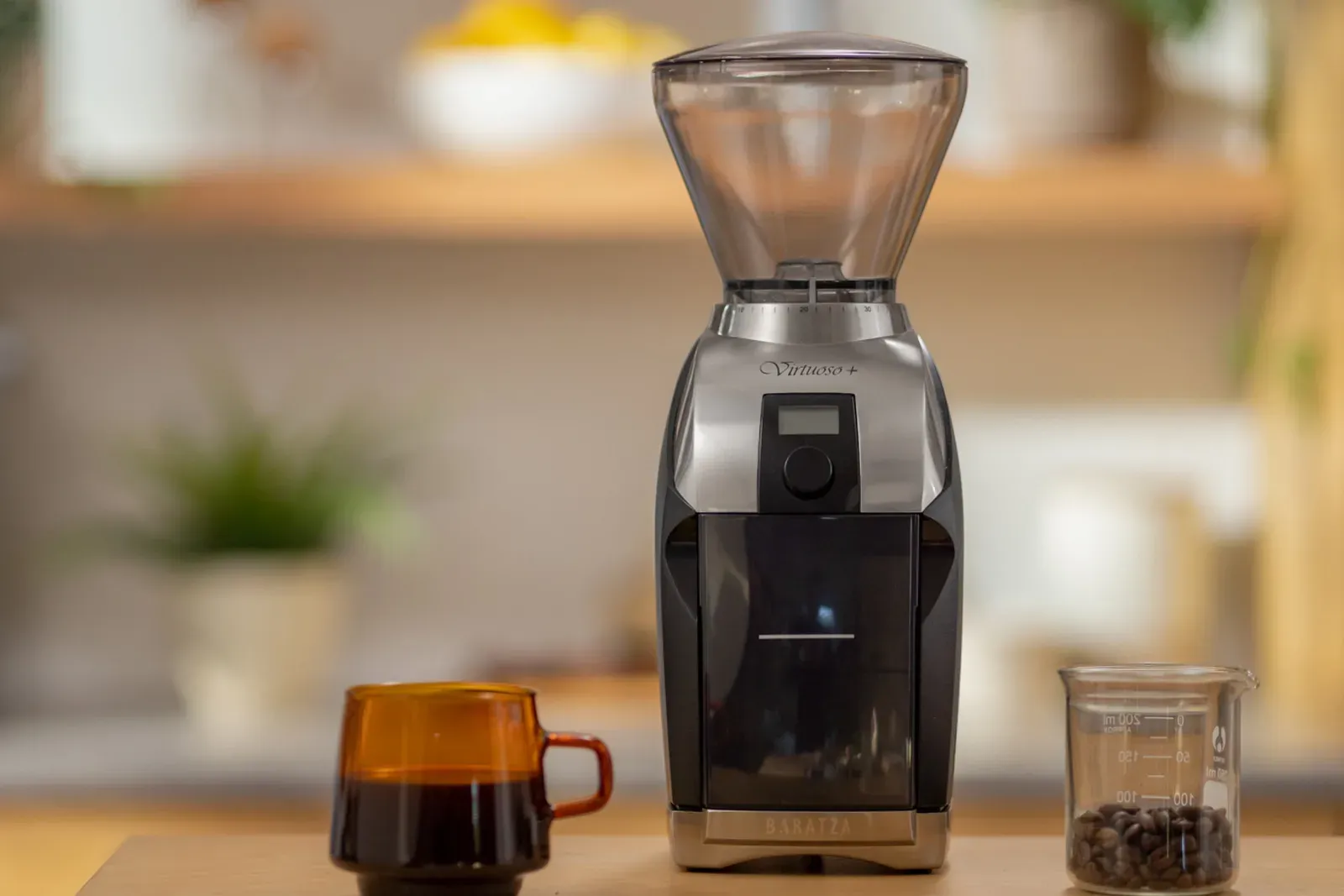
Not tested yet This is a presentation built from the manufacturer’s specification and how the product is meant to be used. We have not had it on the bench, so there is no score.
For a filter drinker who wants more than the Encore's burr and a repeatable timed dose from a hopper; anyone planning espresso should look at the Encore ESP or the Opus 2 instead.
What it promises
- The M2 conical burr, where the standard Encore uses the M3
- A digital timer in tenths of a second, so a hopper dose repeats without a scale under the spout
- Forty settings spread over the whole range, with Baratza's own starting point for each brewer
- Every internal part sold separately, as on every Baratza
What to weigh first
- $100 more than the Encore in the US for a burr and a timer in the same body
- Espresso starts at setting 8 of 40, which leaves only a handful of positions at the fine end
- A hopper grinder: beans left on top go stale, and a timed dose drifts when the setting or the coffee changes
What it is
The Virtuoso+ is a 40 mm conical burr grinder with forty settings, a 300 g bean hopper, a 120 g grounds bin and a digital timer on the front. It lists at $249.95 in the US, where it was out of stock on Baratza’s own store as we wrote this, and it carries a one-year warranty there.
Put its specification next to the Encore’s and most lines are identical: the same 13 × 15 × 34 cm footprint, the same hopper and bin, the same 70 W motor turning the burr at 550 rpm without load. Two lines differ, and they are the whole case for the dearer grinder. The burr is Baratza’s M2, where the Encore has the M3. And the Encore’s on/off switch is replaced by a timer that runs from 0.1 to 40 seconds in tenths.
The burr is the reason
Baratza describes the M2 as precision-milled in Europe and says it reduces fines. Its own speed figures hint at the difference: 1.3 g per second at setting 10 for both grinders, and 2.4 g per second at setting 30 for the Virtuoso+ against 2.2 g for the Encore. At the coarse end, the M2 moves coffee through faster.
What matters for filter is the spread of particle sizes, not the speed. Fewer fines mean a faster drawdown on a V60 and less of the bitter, muddy edge, and fines are exactly what keeps the Encore at the floor rather than the top of the filter grinder guide. Baratza’s claim points the right way. How large the gain is in the cup is what a proper test would have to settle, and this page is not one.
It is worth knowing that the Encore ESP uses the M2 too, according to Baratza’s own specification, and costs $199.95. That grinder spends its adjustment on espresso, forty steps there and twenty for filter. For a filter drinker, then, the Virtuoso+’s case against its own cheaper sibling rests on the timer and on settings spread evenly across the range rather than bunched at the fine end.
The timer, and what it does not do
A timer turns a hopper grinder into something that doses. Fill the hopper, find the time that gives your 20 g, and the next morning’s dose is a press of the dial. Hold the dial for three seconds and it switches to pulse mode, which grinds for as long as you press.
The catch is in Baratza’s own numbers. Grind speed nearly doubles between setting 10 and setting 30, so a timer value only holds for one setting. Change the grind and the dose changes with it. A denser or a lighter coffee does the same. The time is a shortcut you recalibrate with a scale each time the coffee or the setting moves, not a replacement for the scale.
And a hopper is a convenience, not storage. Beans sitting on the grinder see air and light all day, which is why storing coffee at home argues for leaving them in their valve bag. Baratza sells a single-dose hopper for this grinder if you want that workflow, though the timer then matters less.
Espresso is not its job
Baratza’s suggested starting points put espresso at 8, AeroPress at 12, a V60 at 15, an automatic brewer at 18, a Chemex at 20 and a French press at 28. That is a filter grinder’s scale. Below setting 8 there are only seven positions left, and espresso needs its finest adjustment exactly there. The Encore ESP review shows how even forty espresso steps can leave a shot between two clicks, and a scale laid out for filter will do it more often.
Baratza offers a dosing cup that fits a 54 mm portafilter, with a 58 mm adapter, so the Virtuoso+ can feed a machine. For a pressurised basket on an entry-level machine that may be enough. For anything more, buy for espresso from the start.
Against the Opus 2
The obvious rival is Fellow’s Opus 2, which costs $199.95. On paper it has the larger burr (48 mm against 40 mm), stepless adjustment that reaches espresso properly, and single-dose loading. The Virtuoso+ answers with a hopper and timer for people who do not want to weigh every morning, and with Baratza’s record: every internal part is sold separately and repair guides are public, and a ten-year-old Baratza is still a working grinder. The Opus 2 is too new to have that record either way.
Who it is for, and who it is not
Look at it if you brew filter, mostly with one coffee at a time, want a better burr than the Encore’s and like the idea of a dose at the press of a button. In France the gap to the Encore is 80 € rather than 100 dollars, which makes the step up easier to justify.
Look elsewhere if espresso is part of the plan, where the Encore ESP or the Opus 2 are the better starting points, or if you already weigh every dose and would never use the timer, in which case the Encore ESP puts the same burr on the counter for $50 less, with twenty filter steps rather than an even forty. Grind settings by method is the place to start once it is on the counter.