First look
Fellow Opus 2: first look
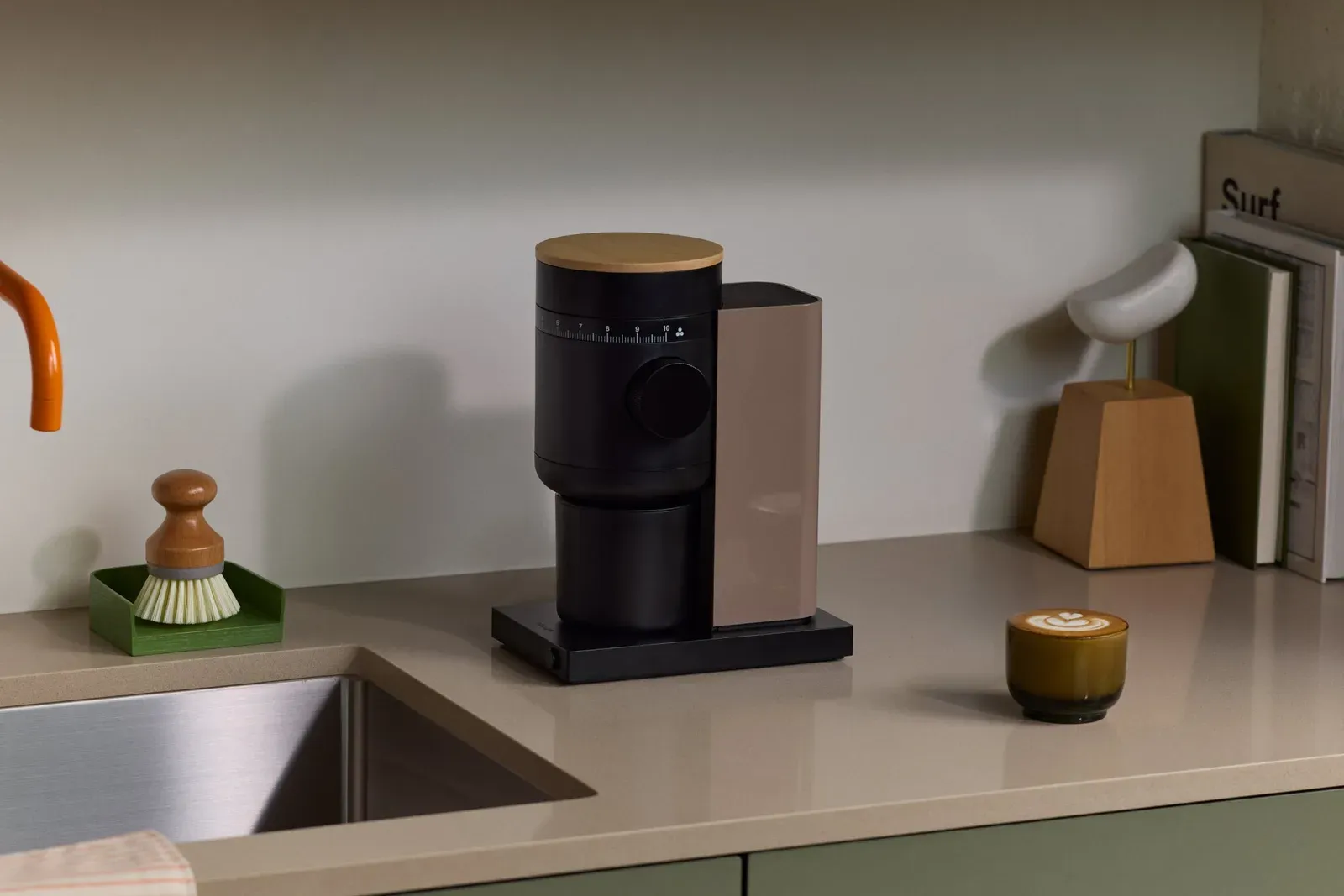
Not tested yet This is a presentation built from the manufacturer’s specification and how the product is meant to be used. We have not had it on the bench, so there is no score.
The grinder to look at first for a home that pulls espresso and brews filter on the same counter and wants one machine for under $200; a filter-only drinker is still better served by the Ode.
What it promises
- 48 mm conical burrs at $199.95, larger than the 40 mm sets in the Encore ESP and the first Opus
- A stepless dial from espresso to cold brew, so a shot is never stuck between two clicks
- Single-dose loading and an espresso catch cup that fits 54 and 58 mm portafilters
- A built-in ionizer aimed at the static that throws light roasts onto the counter
What to weigh first
- One dial for every method means a long turn, and a reset by eye, each time you switch between espresso and filter
- Conical burrs give a rounder, less separated filter cup than the 64 mm flats in Fellow's own Ode Gen 2
- A new design from 2026, with no long-term record yet on parts and repairs
What it is
The Opus 2 is Fellow’s all-purpose electric grinder: 48 mm stainless steel conical burrs, a stepless adjustment dial on the side, a 100 g single-dose bin on top and two magnetic catch cups underneath, one for brewed coffee and one for espresso. It lists at $199.95 in black or white, and at $249.95 in the colourways with a wooden lid and a metal dial. Fellow gives both the same burrs and the same stepless adjustment, so the extra fifty dollars is finish.
It replaces the original Opus, and the change that matters is the burr: 40 mm on the first Opus, 48 mm here. More diameter on a conical set means more cutting edge per turn, so the same dose comes through faster, with less heat and, all else equal, fewer fines. Fellow quotes about nine seconds for an espresso dose. The stepped adjustment of the first model is gone as well, replaced by a dial with printed marks and no detents.
One dial from espresso to cold brew
This is the decision the rest of the grinder follows from. Espresso needs fine resolution at the fine end, and a stepless dial gives it: you can stop anywhere. The problem worked through in the Encore ESP review, a bag whose right setting sits between two clicks, does not exist here. Fellow’s own starting point is that most espresso lands around 0–2 on the dial, and that a 58 mm basket usually wants finer than a 54 mm one.
The cost is on the other side of the dial. A range that runs from espresso to cold brew without steps has a lot of travel and no click to come back to. Pull a shot in the morning, brew a V60 in the afternoon, and you turn it a long way twice a day and find your espresso setting again by reading the marks. It is the routine the filter grinder guide warns about, because readjusting one grinder twice a day gets old quickly. If both methods happen every single day, two grinders are still the cleaner answer.
Opus 2 or Ode Gen 2
Fellow answers this one itself, and the answer is straight: the Ode Gen 2 is built for filter and does not grind for espresso, while the Opus 2 covers everything at a lower price. Fellow currently lists the Ode Gen 2 at $399.95, twice the Opus.
What the Opus gives up is the burr. The Ode’s 64 mm flat set is built for the coarse end, and flat burrs tend to produce one narrow peak of particle sizes, which tastes like clarity in a light washed coffee. Conical burrs tend to put more fines beside the main size, which tastes like body. Conical or flat burrs explains why.
If espresso is in the house, or likely within a year, the Ode is the wrong grinder at any price, and the Opus 2 is the one in this family to look at. If you only brew filter, mostly light roasts, the Ode’s burrs are the reason to spend the difference.
Against the Encore ESP
At this price the comparison that matters most is the Baratza Encore ESP, which also costs $199.95 and does the same two jobs. On paper the Opus 2 has the larger burr, 48 mm against 40 mm, and stepless adjustment against forty espresso steps and twenty filter steps. For espresso that is a real difference, because step size is exactly where the Encore ESP runs out.
The Encore ESP has the one thing the Opus 2 cannot show yet, which is a record. Baratza sells every internal part and publishes its repair guides. Fellow says the Opus 2 has tool-free burr access and internals designed for long-term care, and backs it with a two-year warranty. Whether its parts will still be easy to buy in a decade is not something a specification can answer, and on that point the Baratza is the safer purchase. Baratza’s own Virtuoso+ adds a timer to the same 40 mm M2 burr, but it is a filter grinder first.
Details worth knowing
The bin takes 100 g, but this is a single-dose grinder rather than a hopper grinder: weigh the dose, pour it in, and it stops by itself once the chamber is empty. The beans stay in their bag, which is where they keep best. Fellow claims near-zero retention, thanks to an internal impeller that pushes the grounds out. That is the manufacturer’s figure, not one we can vouch for. The same goes for the ionizer, which is aimed at the static that throws light-roast grounds onto the counter.
The body is plastic (ABS, polycarbonate, nylon and POM, Fellow says) around stainless burrs, 2.3 kg in all and 267 mm tall, with a 300 W motor.
Who it is for, and who it is not
Look at it if you want one electric grinder for espresso and filter for around $200, with espresso from an entry-level or mid-range machine, or if you change coffees often and want single-dose loading at this price.
Look elsewhere if you only brew filter, where the Ode’s flat burrs are the better tool, or if you pull very light roasts on a machine that holds its temperature to the degree, where a larger flat burr earns its price (choosing an espresso grinder covers that step up). And if fifteen years of repairs is what you are really buying, Baratza has the longer answer.
Once it is on the counter, grind settings by method gives starting points for each brewer, and dialling in a new bag is how you get from there to a good shot.