First look
Timemore Sculptor 064S: first look
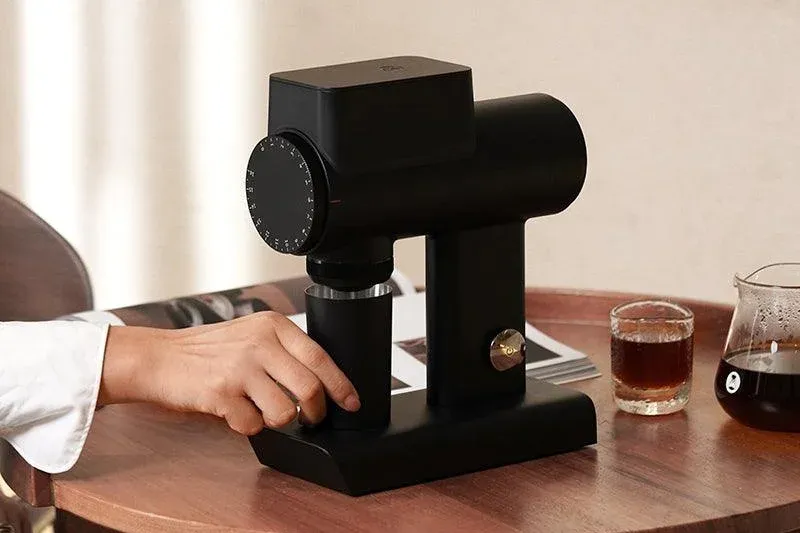
Not tested yet This is a presentation built from the manufacturer’s specification and how the product is meant to be used. We have not had it on the bench, so there is no score.
For someone who wants one flat-burr grinder for espresso and filter, weighs out every dose anyway, and does not want to pay for 78 mm burrs.
What it promises
- 64 mm flat burrs rated by the maker for both espresso and pour-over
- Stepless dial, so an espresso setting never falls between two clicks
- Brushless motor with speed control, rare at this price
- Vertical feed and a rotary knocker to clear the chute without a bellows
What to weigh first
- 150 W is well under the 400 W of the larger 078 models
- About 30 g of hopper, so it is a single-dose grinder whether you like it or not
- US units run on 100–120 V only; Europe needs the EU-plug version
What it is
The Sculptor is Timemore’s electric grinder line, and it is a long way from the hand grinders the brand is known for. The 064S is the smaller of the two bodies: 64 mm flat burrs, a stepless adjustment dial, a 150 W brushless motor with variable speed, and a single-dose layout with a hopper of about 30 g. It lists at $599 on Timemore’s US store and €699 on its European one.
The “S” matters. The Sculptor range is sold with different burrs, and the 064S set, co-developed with the burr specialist Grindinglabs, is the one Timemore rates for both pour-over and espresso. The plain 064 uses a two-layer turbo burr meant for pour-over. If you want a single grinder for both methods, the 064S is the configuration to buy.
Flat burrs at 64 mm
Sixty-four millimetres is the size that made flat burrs a home-grinder proposition, and it is the size Fellow chose for the Ode as well. Timemore sells its own 64 mm SSP set as an upgrade for this body, so the grinder can change character later without being replaced.
Flat burrs are associated with a more even particle size, which in the cup reads as clarity on filter and a cleaner, lighter-bodied shot on espresso. The burr shapes piece explains why that holds for good flat sets and not for every one. What the spec promises is a different kind of coffee from a conical, not simply a better one.
Stepless, and why it matters for espresso
Timemore uses a stepped dial with 36 settings on its pour-over-only models and a stepless one on the S versions. That is the right call. On filter, steps are convenient because you can return to a setting by number. On espresso, the usable band is narrow, and a stepped grinder sometimes leaves the right setting between two clicks, which is the limit described in our Baratza Encore ESP review. A stepless dial removes it. The cost is that switching between espresso and filter means turning a long way and finding your marks again, so note them.
Motor, speed and the single-dose workflow
The motor is brushless, with PID control and Hall sensors, and a separate knob sets its speed. Timemore’s case for brushless is stability and a longer life, and speed control adds a second dial for shaping the grind beyond its size. Timemore’s own guidance on how speed changes the result is written for the 78 mm models, so treat it as a starting point here rather than a rule.
At 150 W, the 064S has well under half the power of the 078 series. Timemore says the motor holds its set speed even on dense beans at fine settings; the spec gives you no reason to doubt it, but it is the number to watch if you grind very light roasts for espresso.
Beans go in from the top and a vertical auger feeds them down into the burrs. Timemore’s argument is that gravity keeps the feed steady and leaves little coffee behind, so there is no bellows. A rotary knocker on the chute shakes out what does stay. Timemore advises closing the magnetic lid while grinding to stop beans jumping, sells a hopper extension, and the motor stops on its own after sixty seconds.
The catch cup is held by magnets and measures about 57 mm across, which Timemore says fits a 58 mm portafilter. Weigh, grind, tip: the grinder care guide explains why single dosing is worth that small ritual.
Where it sits
Below it, the Fellow Ode Gen 2 also has 64 mm flat burrs, but it is a filter grinder and does not claim espresso. Beside it, the Eureka Mignon Specialità is a stepless espresso grinder with a hopper and smaller 55 mm burrs. Above it, Timemore’s own 078S has 78 mm burrs and a 400 W motor for a good deal more money. The 064S is the one that tries to do both methods with large flat burrs at a mid price.
Who it suits, and who it does not
It suits someone who brews espresso and pour-over, weighs every dose already, and wants flat burrs without paying for 78 mm ones. It is also a sensible next step after a hand grinder, since the workflow is the same and only the cranking goes.
It does not suit anyone who wants to fill a hopper on Sunday and grind all week, or a beginner who has not yet decided espresso is staying. For that, choosing an espresso grinder starts lower, and dialling in a new bag is the skill any of these needs.