Manual grinders
Anatomy of a hand grinder
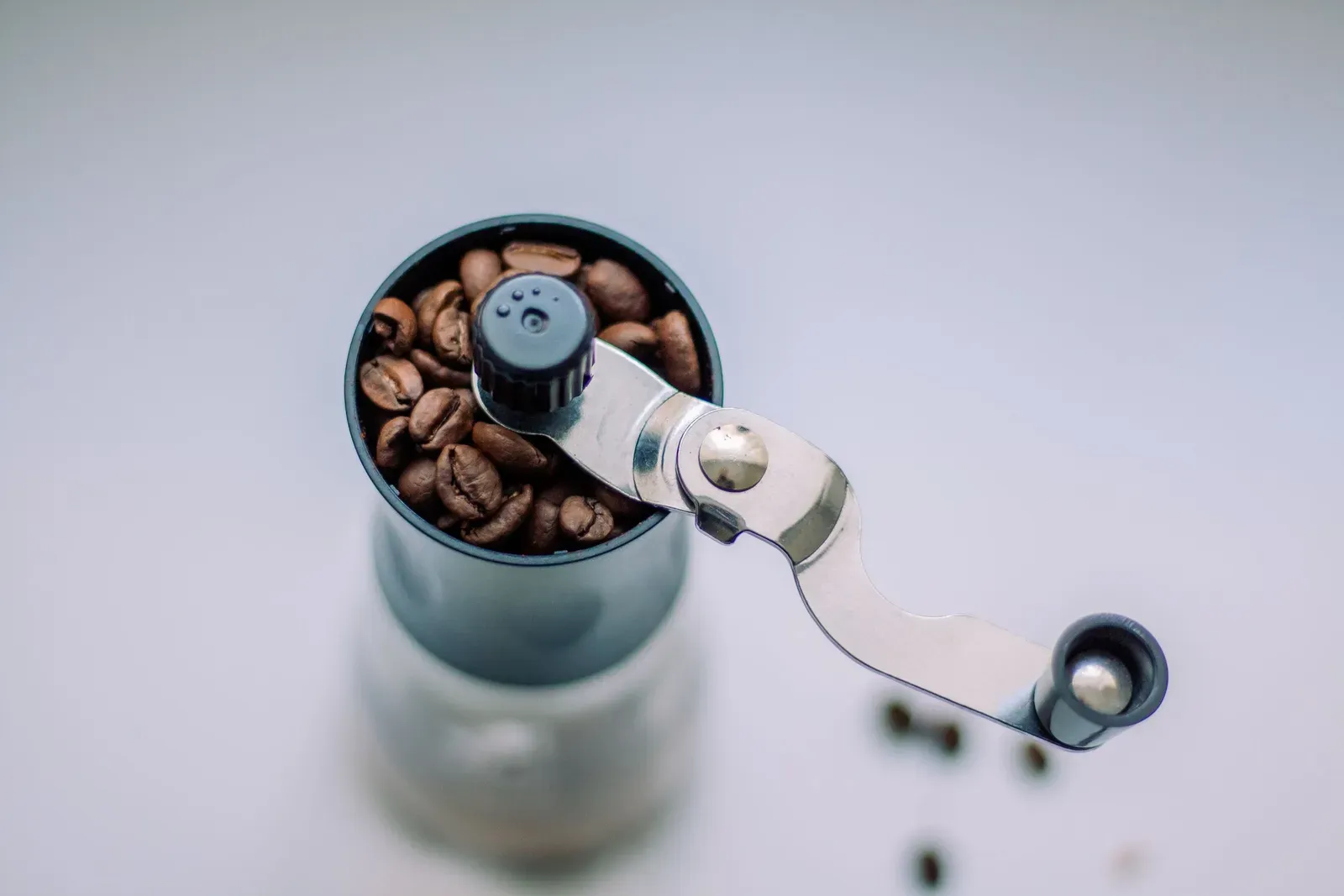
Take a hand grinder apart and there are fewer than fifteen pieces on the table. That is the whole appeal: a small number of parts, and almost nothing to fail. It is also why the differences between a 30 euro grinder and a 250 euro one are easy to name once you know where to look.
The burrs
Everything starts here. A hand grinder uses a conical burr set: a cone shaped inner burr that turns with the handle, inside a fixed outer ring. Beans fall into the gap between them, get cracked by the coarse teeth near the top, and are ground down to size by the finer teeth at the bottom. Our piece on conical or flat burrs covers the geometry in detail.
Two things separate burr sets. The first is material: hardened steel, machined to shape, against ceramic, which is usually cast. Steel burrs can be cut with sharper, more precise teeth, and that precision is what keeps the spread of particle sizes narrow. The second is size. Bigger burrs, around 47 to 48 mm in the better grinders against 38 mm in budget ones, grind faster per turn and spread the work across more cutting edge.
If you remember one thing about grind size, make it this: the average particle matters less than how many particles are far from it. The burrs decide that spread before anything else is involved.
The shaft and the bearings
The inner burr sits on a steel shaft that runs up through the body to the handle. The question is how firmly that shaft is held.
Entry level grinders support it with a single bushing near the top. Turn the handle with any sideways pressure and the bottom of the shaft, where the burr is, moves. The gap between the burrs changes through the rotation, so the grinder produces boulders on one side and dust on the other. You cannot set your way out of that.
Better grinders hold the shaft with two bearings, one above and one below the burrs or two stacked close together on a thick shaft. The inner burr then turns on a fixed axis. This is the single largest step in grind quality between a cheap hand grinder and a good one, more than burr material, and it is the first specification worth checking.
The adjustment
How you change the grind matters more than people expect. There are two common systems.
Under the burrs. A nut or dial below the inner burr pushes it up or down. It is simple and cheap, but you often have to turn the grinder over to reach it, and many have no reference marks.
External ring. A numbered ring on the body, usually between the handle and the catch cup, adjusts the burr without disassembly. The best ones click in steps of around 12 to 25 microns, small enough to dial in an espresso and marked so you can go from filter to espresso and back without guessing.
For filter brewing, a coarse adjustment is tolerable. For espresso, where one step can move a shot by several seconds, it is the difference between usable and frustrating. Our honest take on hand grinding for espresso goes further.
The body, the handle and the catch cup
The body is usually aluminium, sometimes stainless steel or wood. It needs to be stiff, so the bearings stay aligned, and comfortable to grip, because you will hold it for thirty to sixty seconds every morning.
The handle length sets the leverage. A longer crank turns more easily but is awkward to store. Some grinders use a folding or detachable handle, which is worth having if the grinder travels.
The catch cup screws or slides on underneath. Look for a magnetic or threaded fit that does not drop off, and a size that holds the dose you actually brew. A 20 gram cup is fine for one cup of V60, tight for a Chemex for two.
Where the money goes
Put a 40 euro grinder next to a 200 euro one and the price difference is spent in a predictable order: two bearings instead of a bushing, machined steel burrs instead of cast ceramic, a precise external adjustment instead of a nut, and a body built tight enough to keep all three aligned. Finish and branding come last.
That order is also a buying guide. A grinder that has the first two and a basic adjustment will make better coffee than one with a beautiful body and a single bushing. Our hand grinder buying guide uses exactly that order to rank them, and hand grinders, when they win explains when one is a better buy than an electric.
Keeping it working
A hand grinder needs very little. Brush the burrs every week or two, keep it dry, and never wash the burrs and bearings in water. Our page on grinder care covers the rest, including how to tell when burrs are worn.
Frequently asked
- Are ceramic burrs worse than steel?
- For most uses, yes. Ceramic burrs stay sharp for a long time but are usually cast rather than machined, so their geometry is less precise and they produce more fines at a given setting. Every grinder at the top of the hand grinder market uses steel.
- What is a dual bearing grinder?
- One where the shaft is held by a bearing above the burrs and another below, or by two bearings close together on a long shaft. Either way, the inner burr cannot swing as you turn the handle, which is the single biggest step up from entry level grinders.
Related reading
A grinder for filter only
If you never make espresso, a grinder built only for filter is cheaper, faster and often better in the cup. What to look for, and what you can ignore.
Hand grinding for espresso, honestly
A good hand grinder can match an electric costing three times as much in the cup. What it costs you instead is time, effort and patience at 7am.
Conical or flat burrs
The burr shape argument, with the marketing removed: what each geometry does to the grind distribution, and when it matters in the cup.