Pour over
Pouring: spiral, centre or pulses
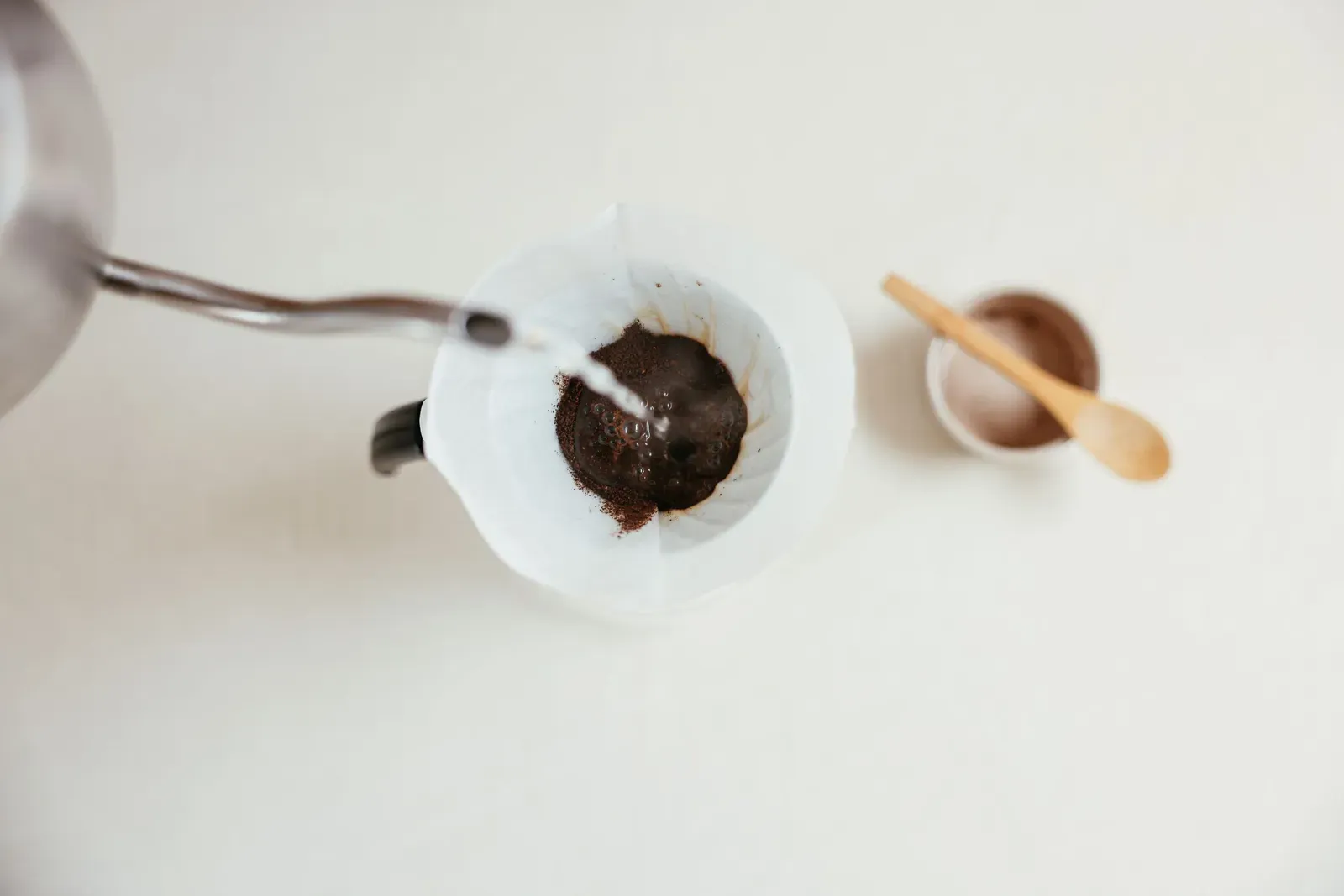
Two people can use the same coffee, grinder, dripper and recipe and get different cups. The difference is often the pour. It sounds like a detail, but in a pour over the water is also the spoon: every time it hits the bed, it stirs.
What pouring controls
- Agitation. A strong, high stream churns the grounds and extracts faster. A low, gentle stream disturbs them less.
- Bed height and water level. A high water level pushes harder on the bed and speeds up flow through the paper.
- Evenness. Water poured always in the same spot leaves dry pockets elsewhere, which under extract.
The goal is an evenly wet bed, a steady water level and a flat bed at the end. Before any of that comes the bloom; our piece on pre-infusion and the bloom explains why the first 30 to 45 seconds matter.
The spiral
Pour in slow circles from the centre outward, stopping about a centimetre from the paper, then back toward the centre.
What it does: wets the whole bed evenly and adds moderate agitation. Good for: cone brewers like the V60, and the bloom on any brewer. Watch out for: pouring onto the paper. Water that runs down the filter wall bypasses the coffee entirely and dilutes the cup.
The centre pour
Keep the stream low and in the middle, moving in very small circles, if at all.
What it does: gentle agitation; the water spreads outward through the bed on its own. Keeps the bed flat and reduces fines moving to the bottom. Good for: flat bottom brewers, and grinders that produce a lot of fines, where extra agitation would slow the drawdown. Watch out for: a crater in the middle if the stream is too strong or too high.
Pulses
Instead of one continuous pour, split the water into stages: for example, bloom with 40 g, then four pours of 60 g, each started when the level has dropped a little.
What it does: each pour adds a burst of agitation and keeps the water level in a known range. It makes the recipe easy to repeat and to write down. Good for: learning, dialling in, competition style recipes, and larger brews like a Chemex. Watch out for: letting the bed run dry between pulses, which can lead to channelling.
A simple routine to start
For 15 g of coffee and 250 g of water in a V60:
- Bloom with 40 g, a gentle spiral to wet everything. Swirl the dripper. Wait 40 seconds.
- Pour to 150 g in a slow spiral, staying off the paper.
- At about 1:30, pour to 250 g, centre pour, low and gentle.
- Give the dripper one light swirl to flatten the bed.
- Aim to finish the drawdown between 2:45 and 3:30.
Our V60 single cup recipe has the full version.
Adjusting
If it runs fast and tastes sour: pour higher or add a pulse. If it runs slow and tastes bitter: pour lower and gentler, or grind coarser. Change only one thing at a time. A scale with a timer, covered in our kettles and scales guide, makes the comparison honest, and a grinder built for filter makes every pour easier to control.
Frequently asked
- Do I need a gooseneck kettle?
- For pour over, it makes a real difference. A gooseneck gives a thin, controllable stream that you can place exactly. A normal kettle pours too much, too fast, and churns the bed. Our kettles and scales guide compares them.
- How many pulses should I use?
- Two to five is typical for a single cup. More pulses add agitation and usually lengthen the brew; fewer give a gentler, faster brew. Start with three after the bloom and adjust.
Related reading
A grinder for filter only
If you never make espresso, a grinder built only for filter is cheaper, faster and often better in the cup. What to look for, and what you can ignore.
Cold drip is not cold brew
Both use cold water and both take hours, but one drips and one soaks. How cold drip and cold brew differ in method, taste and effort, and which to make at home.
Fixing a moka pot: bitter, sputtering, leaking or weak
Most moka pot problems come from heat, grind, a tired gasket or a packed basket. Symptom by symptom, what is going wrong and how to fix it.