First look
Sage Barista Express Impress: first look
Not tested yet This is a presentation built from the manufacturer’s specification and how the product is meant to be used. We have not had it on the bench, so there is no score.
For someone who wants real espresso from whole beans without learning to dose and tamp first, and who drinks medium roasts with milk.
What it promises
- Assisted tamp at a fixed 22 lb with a twist finish, so the puck is level every time
- The dose indicator reads the last tamp and corrects the next grind
- Grinder, PID and pre-infusion in one body for less than most pairs cost
- 2 L tank and a 250 g hopper sized for a household, not a single cup
What to weigh first
- 25 grind steps cover the whole range, which is coarse for light roasts
- One Thermocoil does brew and steam, so milk drinks happen in sequence
- 54 mm basket means a smaller pool of baskets and tampers than 58 mm
What it is
The Barista Express Impress is the Barista Express with the two hardest steps of espresso taken off your hands. It is sold as Sage in the UK and most of Europe and as Breville in the United States; the model is the same, and so are the parts. The list price is $799.95 in the US and €829.90 in France, and at the time of writing both official stores sell it for about 650.
The machine around the new part is familiar. A Thermocoil heater with PID temperature control brings water to 93 °C, a 15 bar pump runs a low-pressure pre-infusion before the 9 bar extraction, and a 54 mm portafilter takes an 18 g dose. The tank holds 2 litres and the hopper 250 g of beans. The steam wand is manual.
The lever is the whole point
Grind into the portafilter on a standard Barista Express and you then do two things by feel: judge whether the basket holds the right amount, and tamp it flat with consistent force. Both are where beginners lose shots, and both are covered at length in tamping explained.
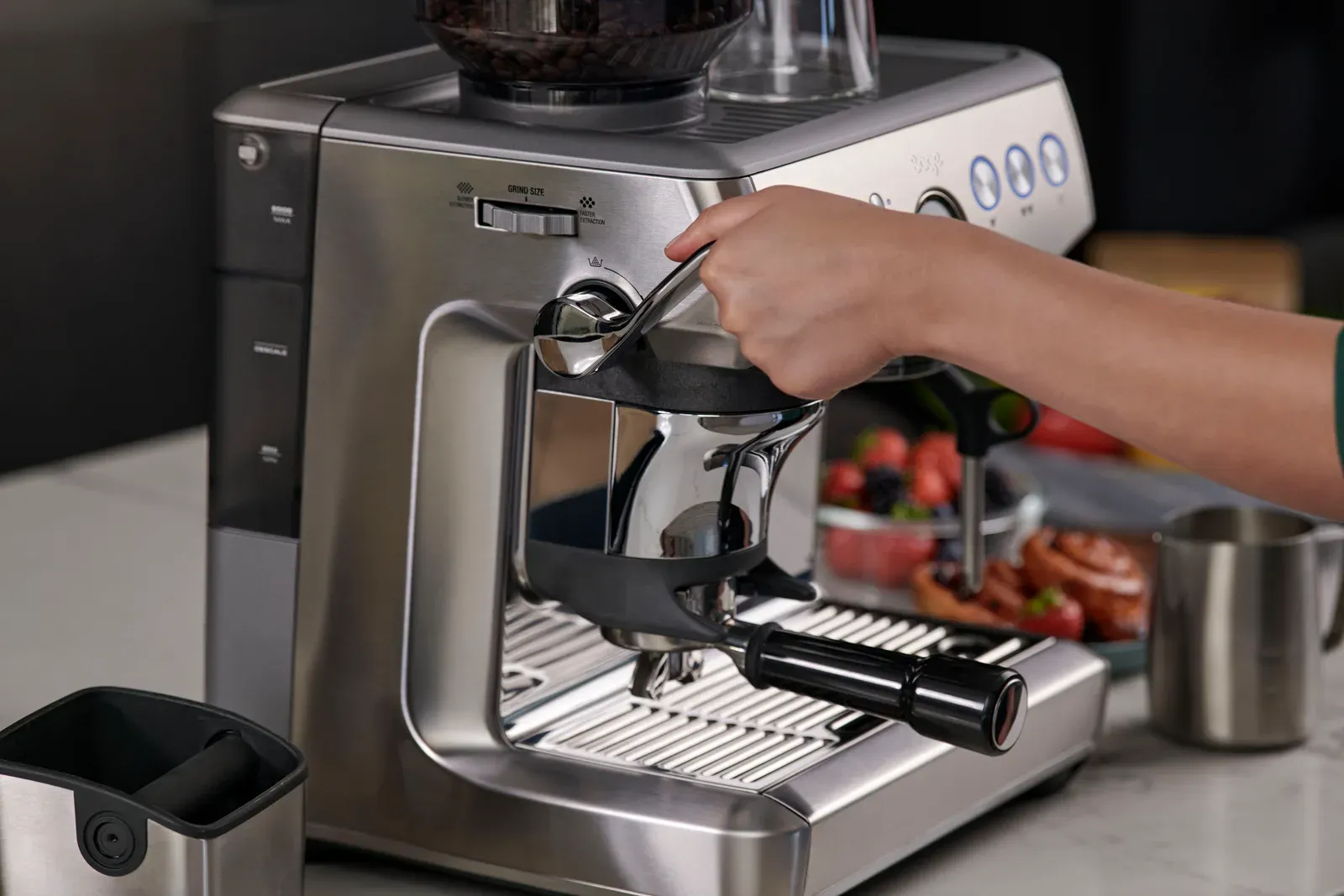
The Impress moves both into the machine. You grind into the portafilter, then pull down a lever above the grinder cradle. It presses the coffee at a constant 22 lb, finishes with a 7° twist, and the dose indicator on the front panel tells you whether the basket was under, over or right. The next grind is adjusted from that reading. Sage calls this the Impress Puck System; what it amounts to is a fixed-force tamp with a feedback loop on dose.
The consequence is easy to predict. The variables a new owner struggles with most become constants, which leaves grind size as the one real decision. That is the right variable to leave in your hands, because it is the one that changes from bag to bag. The trade-off is covered in automatic dosing against doing it yourself: a fixed tamp and a self-correcting dose remove mistakes, and they also remove some freedom an experienced hand would use.
The grinder decides the ceiling
The built-in grinder uses steel conical burrs with 25 settings across its whole range. That is enough for medium and darker roasts in the 54 mm basket, which is the coffee this machine is aimed at. It is coarse for light roasts, where the right setting can fall between two steps and the only workaround is changing dose or ratio. For comparison, the Baratza Encore ESP puts forty steps in the espresso region alone.
The other limit is time. A grinder inside the machine is the first component a keen owner outgrows, and you cannot replace it without replacing everything else. Choosing an espresso grinder explains why that matters more than it seems on day one.
Heat, steam and the 54 mm basket
The PID is the part that keeps shots repeatable, for reasons set out in what a PID actually changes. The Thermocoil design is fast to heat, but one heater serves both the shot and the wand, so a latte is a shot, then a pause, then steam. For one or two milk drinks in a morning that is fine. For a queue of cappuccinos it is the machine’s bottleneck.
The 54 mm portafilter is Sage’s own size. Baskets, tampers and distribution tools exist for it, but from fewer makers than the 58 mm commercial standard.
Against the Bambino Plus
This is the comparison most buyers will actually make. The Bambino Plus costs about $499, heats in seconds and has an automatic milk wand that stops at the right temperature, but it has no grinder. Add a capable entry grinder and you spend about $700, a little under the Impress list price, with better milk automation and a grinder you can keep when you change machines.
The Impress wins on the shot side: the dose and the tamp are handled, and the whole thing is one appliance on the counter. The Bambino pairing wins on milk and on the path forward.
Who it suits, and who it does not
It suits someone starting from whole beans who wants the machine to catch the beginner’s mistakes, who drinks medium roasts, and who would rather have one appliance than two. The lever is the reason to choose it over the plain Barista Express.
It does not suit a light-roast drinker, anyone who already owns a good grinder, or someone who knows they will want to upgrade parts one at a time. If that is you, choosing an espresso machine lays out the alternatives, and the espresso method covers what any of them needs from you.